Connie Converse was a folk-music genius. Then she vanished

 The Musick Group/ Heroic Cities LLC
The US female singer-songwriter made stunning, forward-thinking songs in the 1950s, but was barely known – and aged 50, she disappeared. Now, with a new re-release of her music, she's recognised as a trailblazer.
Centring on an edgy, city-dwelling female protagonist unapologetically owning her sexuality, the brilliant song Roving Woman sounds like the work of a millennial musician. Evoking the smoky, airborne notes of a late-night Brooklyn bar, it contains lilting guitar harmonies that float in and out of focus like cascading cigarette smoke, while its melancholy vocal is reminiscent of popular contemporary folk musicians like Weyes Blood, Jessica Pratt and Angel Olsen. "Someone always takes me home!" the lead singer swoons.
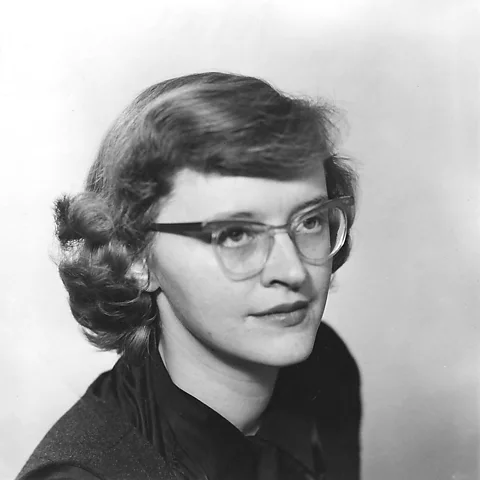
Yet the truly remarkable thing about this track is it was actually recorded more than 70 years ago. Roving Woman isn't the work of some lo-fi singer-songwriter in their early 20s, but is in fact the forward-thinking creation of Connie Converse. She was a bedroom musician who wrote the bulk of her songs in early 1950s New York, years before Bob Dylan came on the scene and sparked a new singer-songwriter movement.
 The Musick Group/ Heroic Cities LLC
But she pulled back from her musical dreams at the turn of the 1960s and then, in 1974, aged 50, disappeared completely – never to be heard from again. It was only this century that this mysterious artist's work was rediscovered and has found a devoted audience, stunned by just how pioneering she was. And now a new vinyl re-release of the 2009 cult compilation How Sad, How Lovely, should only make her more popular.
Among her fans are many high-profile musicians, including Greta Kline, the indie-rock star who goes by the stage name Frankie Cosmos. "I'm inspired by her to tell a full story or present a deep feeling with only a few words," she tells the BBC. "I think she has threads of so many genres present in her songwriting. There's touches of math rock and metal in there. I'm still surprised by how many people don't know about her."
Her mysterious story
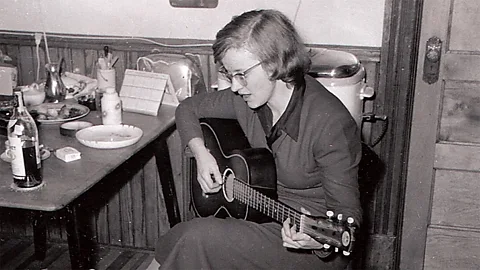
Connie Converse (real name Elizabeth) was born way back in 1924. Armed with just a Crestwood 404 reel-to-reel tape recorder and lowly Regal acoustic guitar that she somehow made sound as expansive as an orchestra, Converse innovated from a place of relative obscurity within various tiny New York City-based apartments across the early 1950s. She even attempted creating an ambitious folk opera that contained the eerily prophetic lyrics: "Never had a husband, never had a son / Dead at the age of 51."
She was a completely self-funded, "DIY" musician long before such internet-era terminology ever existed. Although her friends and family knew the working-class Converse as a genius, the world was slow to wake up. Having seen her music repeatedly rejected by record-label bosses for being too complex, the artist ended up in a blue funk.
The closest she got to the mainstream was a TV performance on 1954's The Morning Show, hosted by Walter Cronkite; no footage still exists, it didn't spark any real breakthrough. This left the artist with little exposure beyond the songs she sent to family or performed occasionally at dinner parties.
She continued to work on music throughout the 1960s, but at a slower pace, while taking various jobs including a stint as the editor of the influential Journal for Conflict Resolution in Michigan. In letters to loved ones, written just before she vanished, she said she had struggled in life "to find a place to plug in".
What happened to her when she went missing remains unknown – in 2023's To Anyone Who Ever Asks: The Life, Music and Mystery of Connie Converse, the definitive biography about her, the author Howard Fishman writes how some believed she drove her car off a cliff in Canada, while others had claimed she started a new life in Brazil.
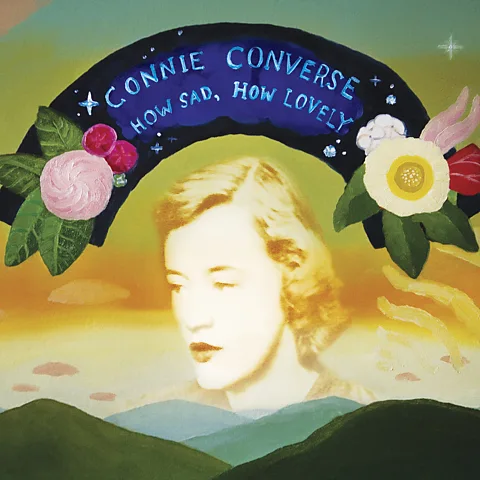
Whatever the reality, Converse's never-solved disappearance certainly provided her music with an extra point of intrigue when, decades later, it came to public attention. In 2004, the late producer Gene Deitch debuted on WYNC radio some of her songs that he had recorded at private dinner parties in 1954 and 55, creating a surge of interest in this musical enigma, and resulting in the 2009 release of How Sad, How Lovely. The album also featured bedroom recordings Connie made, which are punctuated by endearing nervous coughs. Now its vinyl re-release comes at a time when Connie's stock is particularly high, especially after a recent glowing Pitchfork review and her songs being covered by everyone from Karen-O to Bill Callahan over recent years.
"I first thought this Connie Converse character had to be a hoax or a gimmick," laughs author Fishman, who is also a band leader. "These songs were too fresh, too modern, too anachronistic to have been recorded in the 1950s."
Why her music was ahead of its time
Converse was raised in Concord, New Hampshire in a right-wing Christian household, in which alcohol and the discussion of sex were outlawed [her dad was proudly part of the pro-Prohibition Anti-Saloon League of New Hampshire]. Her music provided a raw autobiography of her time escaping this strict upbringing and living freely in New York City. She was also bravely attempting to make female promiscuity and sexual empowerment less taboo.
 The Musick Group/ Heroic Cities LLC
"Connie was quite ahead of her time in terms of gender roles, because she did not subscribe to the gender roles of her day in any way," Fishman says. This is also reflected throughout the songs, in which men are sometimes killed by a resilient woman, such as on Playboy of the Western World or The Clover Saloon.
Gender aside, the reason her songs remain quite so astonishing is because they were created at a time in US music history when introspection and existentialism didn't really exist yet in folk music, with even the use of the first-person "I" considered a songwriting faux pas.
Consider the fact that the biggest US song in 1952, when Roving Woman was recorded, was Kay Starr's Wheel of Fortune, which is full of saccharine lyrics about "yearning for love's precious flame" and wondering whether the wheel's arrow will "point my way". Then compare this to the intricate, three-dimensional conversational style Converse displays, where every action is meticulously considered – the level of sophistication is worlds apart.
Another song, Trouble, has Converse approaching a weeping willow tree to "teach her how to cry" – eight full years before Johnny Cash would do the same thing on Big River.
Meanwhile, the stumbling-around-the-abyss atmosphere of One By One (and its tales of walking alone at night) reflected the seasonal depression Converse dealt with. "She put all of this pain into the music," Fishman says, adding that another thing unique to Converse was "her amazing way of taking childhood ditties; using a naïve form to disguise a more complicated, winking foray into adult themes." Her use of sophisticated alliteration and loose, shoegazey lyrics were also 30 years before the Cocteau Twins. "He was elegant past all dreaming" she sings on another song.
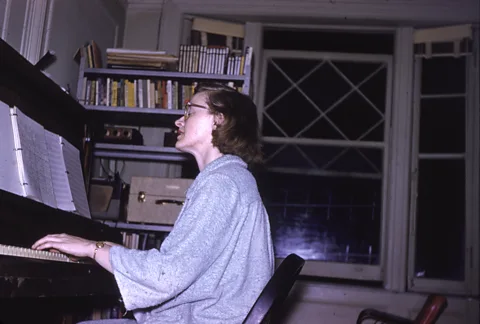
All this innovation is at the heart of what Converse described as her "guitar songs" period from 1950-1955; in later years, she wrote theatrically to piano. Among the tracks on How Sad, How Lovely is the enchanting Talkin' Like You (Two Tall Mountains), which compares men to pigs, correlates "a sort of a squirrel thing" in a tree to the sound of "us when we are quarrelling", and features striking guitar notes that are both galloping and morose. The song's message seems to be about re-connecting with nature and going on a long walk to forget about bad men, and it resonates at a time where many are looking to detox from the digital world.
Similar themes can be found in my personal favourite Connie Converse song, We Lived Alone. Here her winsome vocals effortlessly shift between the perspective of a single woman and her countryside house; both giddy to have finally found one another. The music fully embraces the idea of unplugging from the city, suggesting that simply holding "a lamp against the dark" in isolation can make one as "happy as a lark". "Connie so obviously understands human beings are a part of this natural world – not superior or separate from it," explains the Grammy-winning US soprano Julia Bullock referring to We Lived Alone, one of her all-time favourite songs and one that she's covered on stage.
 Third Man Records
"The music references nature's intrinsically effervescent life cycle," Bullock continues. "There are only a few songwriters in the world who have that kind of linguistic sophistication, without being pretentious."
A further reason Connie Converse is so special is in how her music taps into musical history, Bullock believes: "I've asked friends to arrange her works with Schubert, the 19th-Century German composer, in mind. It all lands, it all works. And that’s because of Connie's interest in the lineage and legacy of song repertoire – honouring composers of past centuries alongside her contemporaries."
Her many talents
Another one of Converse's fans is Martin Carr, the English folk musician and lead singer of the band The Boo Radleys, who has written several songs paying tribute to her. "Connie had a dramatist's eye – the ability to conjure a fully inhabited world from a single detail," he explains. "The fact that she named a song after a J M Synge play, or was capable of lyrics such as 'Spring seemed to linger in a little bunch of flowers he pressed into my hand', tells you she was reaching well beyond the American folk tradition."
Carr is also particularly impressed by Converse's guitar playing and believes it's extraordinary no matter what generation you come from. "Her guitar playing is phenomenal. I can't play her songs, they're too hard for me!" Carr enthuses. "Her playing reminds me of the way Paul Simon plays; orchestral arrangements for six strings. She was a true individual, an artist of no time."
More like this:
• How the Eagles' Greatest Hits broke the charts
The ability of her songs to sound like they were produced today is a big reason why the re-release of How Sad, How Lovely is sure to keep the mythology around Connie Converse alive. Fishman says he's been approached to adapt his biography into other narrative forms. He welcomes my suggestion that Elisabeth Moss would be the perfect actor to play Connie Converse in a Hollywood biopic. "That's her doppelganger!" he laughs. "There's musicians out there who don't even realise they're inspired by her. Look, Connie Converse was a genius, and I know it's only a matter of time before she is understood as a significant figure of the 20th Century."
One that certainly does understand is Julia Steiner, the lead vocalist of the Chicago indie band Ratboys, who says the group's song A Vision was inspired by Connie's way of "finding mythic meaning in the everyday" and conjuring up seasonality with her lyrics. The most inspiring aspect of the Connie Converse story, Steiner says, is that it proves more of the best music could similarly be sitting undiscovered on a tape right now, waiting in dusty patience for the right era into which to be reborn.
"Listening to Connie's music makes me wonder how much other perfect art has been lost in obscurity, perhaps simply because our culture didn't yet possess a framework through which to understand or enjoy it."
Connie Converse's How Sad, How Lovely is out now on Third Man Records.
--
If you liked this story, sign up for The Essential List newsletter – a handpicked selection of features, videos and can't-miss news, delivered to your inbox twice a week.
For more Culture stories from the BBC, follow us on Facebook and Instagram.