How paddleboarding is reviving a dying language

 Ren O'Flaherty
The millennia-old language of Gumbaynggirr was critically endangered. Now, a series of tourism initiatives are helping to bring it back from the brink of disappearance.
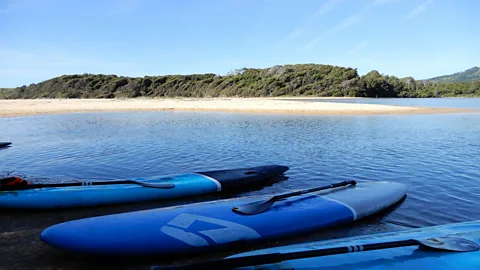
I stepped into the cool salt water, wading through the shallows of Moonee Creek on Australia's eastern coast. Overhead, rainbow lorikeets chattered in the eucalyptus trees while red dragonflies buzzed past. I was in the heart of Gumbaynggirr Country, an Aboriginal nation spanning roughly 6,000 sq km between the Clarence and Nambucca rivers in New South Wales (NSW).
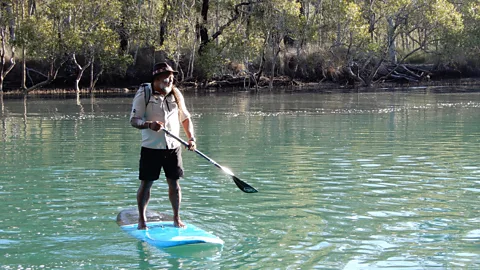
"We're the first paddleboarders in the world," said our Gumbaynggirr cultural guide, Troy Robinson. "We're only doing what our old ancestors have done since time immemorial." As the tour's three other participants and I struggled to steady ourselves on our foam boards, Robinson glided along the mangroves lining the banks of his ancestral land, dreadlocks spilling from beneath his Akubra hat.
I followed his lead, making long strokes with my paddle as schools of small, almost translucent mullet darted beneath my board and aquatic insects flitted across the creek's surface. Robinson, who had smeared white ochre across his cheeks and forearms, explained that his people have traditionally used the paste as a natural sunscreen. I told him I was imagining his ancestors paddling alongside us, curious about the blue foam SUPs and plastic paddles. "They would've carved their vessels out of the trees though," he said, laughing.
 Ren O'Flaherty
After an 8.5-hour overnight train from Sydney to Coffs Harbour, I'd sought out Wajaana Yaam Adventure Tours to paddle with purpose. The Gumbaynggirr-owned outfitter not only offers travellers the chance to experience a sliver of Australia through the eyes of its original residents, it also directs a portion of its proceeds towards revitalising their community's endangered millennia-old language.
The return of a lost language
Before Britain began colonising Australian in 1788, the continent was home to more than 250 Aboriginal and Torres Strait Islander nations, with more than 800 dialects between them. Gumbaynggirr, whose origins are believed to stretch back thousands of years, is one of them.
In 1909, the NSW state government forcefully relocated many Aboriginal people from their traditional lands onto reserves and missions, where they were forbidden from practising their culture or speaking their language. As a result, by 2019, just 120 Aboriginal languages remained across the nation, and 90% of those were threatened with extinction.
"We don't truly know ourselves if we don't know our language and we don't speak our language," said Clark Webb, a Gumbaynggirr cultural leader and Wajaana Yaam's founder. "For a time, our language was… officially listed as critically endangered."
 Getty Images
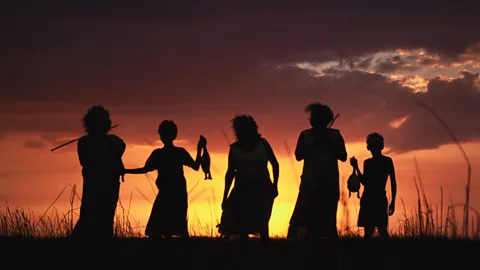
According to the National Indigenous Languages Survey, by the early 2000s, only 30-50 Gumbaynggirr speakers remained – none of whom were children. In response, Webb developed three local tourism experiences under the Bularri Muurlay Nyanggan Aboriginal Corporation (BMNAC), whose profits were to be reinvested into Gumbaynggirr language revitalisation programmes – including NSW's first Indigenous bilingual school, which opened in 2022. "We're still endangered, but I feel like we've lifted out of the critically endangered scenario," he said.
Now with more than 100 students enrolled between the ages of five and 15, the school has become an important part of that revival. "We have 20 students who we consider highly proficient," Webb told me. "They can tell six cultural stories completely in Gumbaynggirr," each of which is more than five minutes long, he noted. "We've got another 30 [students] who we consider as proficient."
More like this:
• The stunning Canadian island you can see but not touch
• The hike making Australia a better place
• Japan's forgotten Indigenous people
Alongside Wajaana Yaam's paddleboarding excursions, BMNAC also offers monthly cultural immersion experiences at Niigi Niigi (Sealy Point) Lookout, where travellers can learn about Gumbaynggirr ceremony, song and dance. Nearby, the Nyanggan Gapi cafe serves baked goods flavoured with wattleseed and lemon myrtle, native ingredients long used in Aboriginal bush tucker (meals prepared using native animals and plants).
"That's where tourism fits in," Webb said. "It's about educating people from all walks of life about why language and culture is so important to our communities. Our best tour guides are the people who know the language and know the culture because they can give a deeper analysis and interpretation of our stories and plants."
 Ren O'Flaherty
A paddle with purpose
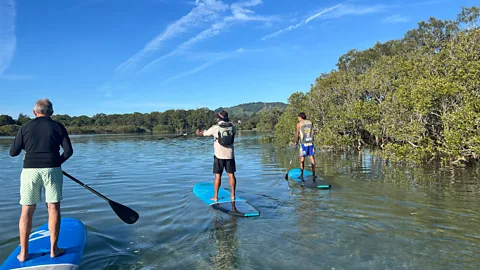
During our 2.5-hour, 3km (1.8 mile) paddle to and from the Moonee Creek river mouth, Robinson offered us a crash course in the Gumbaynggirr language, stories and traditional bush foods.
As I paddled past mangroves, she-oaks and paperbark tea trees lining the banks, pairs of large yellow-tailed black cockatoos screeched into view. Robinson explained that these birds are called gawiyarr in Gumbaynggirr and that their presence symbolises impending rain. He also shared knowledge passed down from his ancestors about how subtle changes in nature indicate when certain foods are ready to gather.
How to experience Gumbaynggirr culture:
• Paddle with Wajaana Yaam Adventure Tours: hear guides tell stories about their land, culture and language.
• Join a Giingan Gumbaynggirr Cultural Experience: watch dancers perform, experience a cultural ceremony and hear Gumbaynggirr creation stories.
• Eat at Nyanggan Gapi Café at the Niigi Niigi (Sealy Point) Lookout: taste native wattleseed and lemon myrtle in their baked treats.
Pointing to a she-oak on the riverbank with spindly green needles drooping from its spiky fruits, he explained: "When it blossoms a nice olive tip… that tells us when all the shellfish are full." He then gestured to a she-oak's bough that had warped into sharp bends. "We make boomerangs out of them too. There's no other branch that'll make that bend, it makes it really tough."
Andrea Pappas, a fellow paddler from Brisbane, said the tour helped her see the creek from a different perspective. "Listening to [Robinson] talk about the creek and the Indigenous history… was wonderful," she said. "Indigenous people always looked after the nature."
Mid-way through our journey, we stopped for a hard-earned break. Robinson took a few steps back from the shore and dove in, sending schools of mullet scattering. We soon joined him, floating with the tide and peering through goggles at curious fish below. Back on our boards, Robinson pointed out small holes in the creek bed where ngalan (stingrays) searched for crustaceans, and ngaduun (hermit crabs) left trails as they roamed across the sandy floor. Every few minutes Robinson shouted in excitement as he spotted yet another stingray or flathead fish. As the creatures raced away, we followed their ripples in search of them.
Ren O'Flaherty"[Wajaana Yaam have] such amazing operators who offer an insight not only into Aboriginal culture, but land preservation and the historical process and learnings from cultural groups," Susan Colby, Coffs Council's destination marketing team leader told me. "That's really important, and a lot of the community benefit from that."
In fact, Colby said that she's so fond of Wajaana Yaam's three paddle tours that she has become something of a regular guest. "I've done all of them!" she exclaimed. "It's just so lovely being out there and hearing the stories and the food sources and just paddling around in the peace and nature."
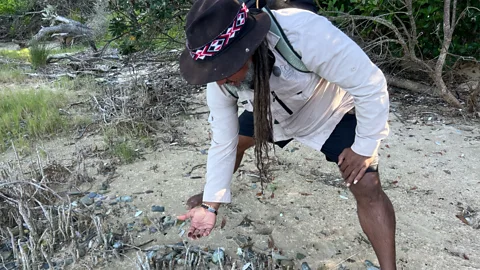
As we neared the creek's mouth, Robinson called us ashore and gestured to the dunes behind him. This, he explained, is an ancient Gumbaynggirr archaeological site filled with shells, animal bones and discarded tools made of rock. "[We] call this one Munim Munim (lots of rocks)," he said, explaining how the Gumbaynggirr origin gave the creek its name.
Crouching down to show us shells and rock chippings scattered across the sand, he clarified that while many people would call this a "midden" in English, the Gumbaynggirr word is "mirlarl" (sacred site). Then, turning some shells over in his hands, he spoke in Gumbaynggirr to Country: the living earth, waterways and skies that make up Aboriginal ancestral lands.
 Ren O'Flaherty
I began to yearn for a similar connection to the traditional languages of my own family. Although they grew up on opposite sides of the globe, my grandfathers – one Irish, the other Wonnarua (an Aboriginal nation 400km (250 miles) south-east of Coffs Harbour) – came from cultures whose languages were restricted and suppressed. Webb's comment about not truly knowing oneself if you don't know or speak your language cut through me.
Back at the boat ramp, after we had packed our boards away, Robinson invited us down to the creek for one final swim. I took a deep breath, then dove under the water. Floating in the turquoise water, needles of the she-oak filtering out the late-March sun, I smiled knowing this paddle adventure would have a wider impact for the community's younger generation.
I asked Robinson if there was a Gumbaynggirr term describing what happens when they pass their language down to their children. "Gumbaynggirr daari," he said. "It means being strong when you're singing, when you're dancing, when you're on Country."
--
If you liked this story, sign up for The Essential List newsletter – a handpicked selection of features, videos and can't-miss news, delivered to your inbox twice a week.
For more Travel stories from the BBC, follow us on Facebook and Instagram.