'A kind of dream world appeared': The 'bizarre' story of the world's first LSD trip

 Getty Images
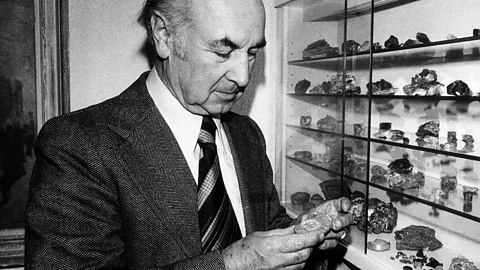
Dr Albert Hoffman accidentally discovered the hallucinatory effects of LSD in April 1943. In 1986, he told the BBC about a "terrifying" bicycle ride home from the laboratory – and about how his "problem child" drug changed the world.
"At the end of the synthesis, I got in a very strange psychic situation. A kind of dream world appeared, a feeling of oneness with the world." Dr Albert Hofmann, a Swiss chemist, was working on a routine experiment at a pharmaceutical firm in the town of Basel when he made a world-changing chance discovery. His first experience with what would become known as LSD was gentle and intriguing. His decision to take the psychedelic drug three days later resulted in terrifying visions and one of the most unusual bicycle trips ever.
Warning: This article contains graphic descriptions of drug use
The story began on Friday 16 April 1943 when Hofmann was preparing a fresh batch of lysergic acid diethylamide, a compound he had first synthesised five years earlier. The 37-year-old was studying medicinal plants by experimenting with ergot, a fungus that grows on corn, to see if a drug derived from it could help midwives prevent post-childbirth bleeding. Owing to its German name, Lysergsäurediethylamid, the compound is now better known as LSD.
Interviewed on the BBC in 1986, Hofmann said that his unexpected first experience with the drug reminded him of "mystical" childhood moments in woods and forests. The sensation of "seeing the true aspects of nature, the beauty" filled him with happiness. Hofmann wondered if this pleasant and dreamy state was in some way connected with the crystals of LSD that he had been purifying. While he hadn't eaten any of the compound deliberately, he may have got some of it on his fingers. This would imply that the substance was very potent. He decided to find out by experimenting on himself when he was back in work on Monday.
Cautious by nature, he began with what he thought was the smallest dose that could have any effect. "I started with 0.25 milligrams," he recalled, planning to increase the amount only if nothing happened. "But this very small dose, the first dose of my experiments I planned, was very, very strong," he said. After taking the drug, Hofmann began to feel unwell, and rode home unsteadily on his bicycle through the streets of Basel. As the journey progressed, things got weird. His vision distorted as if he was looking in a fairground mirror. By the time he made it home, his sense of reality had disintegrated.
When Hofmann stepped into his sitting room, he was startled by how completely it seemed to have changed. "The room itself and the objects in this room had quite a different form, different colour, different meaning," he told the BBC. Even an ordinary chair appeared to be a "living object", as though it were moving from within. "That was so unusual that I really got afraid that I had become insane," he said.
The bizarre hallucinations continued all evening. A kindly neighbour who brought him milk as an antidote appeared to have transformed into a witch. "At times, Hofmann felt as if he was dead, and had arrived in Hell," said the BBC's reporter. The chemist only felt himself returning to the normal world about six hours after he first took the drug.
Undeterred by this alarming experience, he would take LSD several more times over the next few decades to observe its effects. His ride home from the laboratory is commemorated on 19 April every year by people inspired by LSD, either scientifically or creatively. In 1985, Illinois professor Thomas B Roberts coined the name "Bicycle Day" for the anniversary.
Hofmann reported what he had discovered to his boss at the pharmaceutical firm, Sandoz. From the effect that LSD had on him, he calculated that one teaspoon would be enough to affect 50,000 people. He said that he and his colleagues "realised immediately that it was a very important agent which could be useful in psychiatry and in research". Sandoz began distributing LSD to psychiatric hospitals as an experimental drug called Delysid. Some psychiatrists used it with patients for its effects on the subconscious mind, allowing them to release suppressed memories and mental conflict.
LSD spreads around the world
The effects of this powerful new drug caught the attention of the US military, which began a top-secret research programme known by the code name MK-Ultra. One civilian who was exposed to LSD during this research was Ken Kesey, who would later write One Flew Over the Cuckoo's Nest. He told the BBC: "I decided that this was too important a business to leave in the hands of the government." Awed by the hallucinogenic power of the still-legal drug, Kesey began to distribute it to his friends, and, in 1964, he assembled some like-minded people dubbed the Merry Pranksters and set off across the US in a brightly painted bus. LSD was leaking out of laboratories across the country and fuelling the counterculture experience.
By now, it was well known that users risked experiencing so-called bad trips, terrifying spirals of panic and fear that can cause long-term psychological damage. Still, many people who took LSD were evangelical about its potential to change the world for the better.
One of its keenest promoters was former Harvard psychologist Timothy Leary, whose "turn on, tune in, drop out" catchphrase became a defining slogan of the psychedelic era. Leary had written to the Swiss pharmaceutical company in 1963 to place an order for 100g of LSD, enough doses for two million people. The letter was addressed to Hofmann. Already alarmed by non-medical abuse of his discovery, Hofmann advised Sandoz against supplying Leary. "I immediately realised that it would be dangerous because a substance which has such a deep effect must be used carefully," he told the BBC.
In History
In History is a series which uses the BBC's unique audio and video archive to explore historical events that still resonate today. Sign up to the accompanying weekly newsletter.
Hofmann noted how hallucinogens had been used for centuries by ancient cultures and Indigenous communities, but only in religious settings and always "in the hands of the shaman, not in the public". In modern society, he added, the closest equivalent to a shaman is a psychiatrist, and such drugs "should remain in the hands of the shaman". That was why he worried from the start that "bad things could happen" through unwise and uncontrolled use, a fear he felt was later vindicated.
More like this:
• How 'shocking' musical Hair escaped censorship
• The long, strange success of the Grateful Dead
• How Easy Rider revolutionised Hollywood
By 1969, more than one million Americans were estimated to have tried LSD without medical supervision. Many found the darker side of its mental effects overwhelming, but Hofmann said that he never felt guilty because "it is not LSD which is bad". Used in the proper way, he maintained, LSD was not a harmful substance. It became "very, very dangerous" only when taken incautiously and without respect for its "deep influence on society and even on consciousness".
But with so many people taking it incautiously amid a growing number of media stories about the drug's damaging effects, legal regulation soon became inevitable. LSD was placed under strict international control by the 1971 UN Convention on Psychotropic Substances and would be banned in many countries.
Today, LSD is illegal in almost every country in the world, and where its use is allowed in medical research, it remains tightly controlled. The drug's powerful effect on the mind and risk of long-term "flashbacks" has seen it classified alongside substances such as cocaine and heroin for a high potential of misuse.
Hofmann died in 2008 aged 102. He told BBC that the main insight he had gained from his LSD experience was that "reality is not something fixed but rather ambiguous". He said: "Before, I had always thought there is only one reality, a true reality, and then I realised there are other dimensions."
While the title of his autobiography, LSD: My Problem Child, reflected his ambivalent attitude to the drug, he retained his faith in its therapeutic potential. He wrote: "I believe if people would learn to use LSD's vision-inducing capability more wisely, under suitable conditions, in medical practice and in conjunction with meditation, then in the future this problem child could become a wonder child."
--
For more stories and never-before-published radio scripts to your inbox, sign up to the In History newsletter, while The Essential List delivers a handpicked selection of features and insights twice a week.