This metro stop is Ancient Rome's new attraction

 Alamy
AlamyConstruction on Rome's Metro C has uncovered spectacular Roman ruins, and its new "archaeo-stations" are giving visitors a whole new way to experience the city's ancient past.
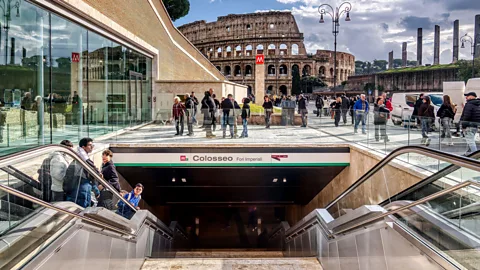
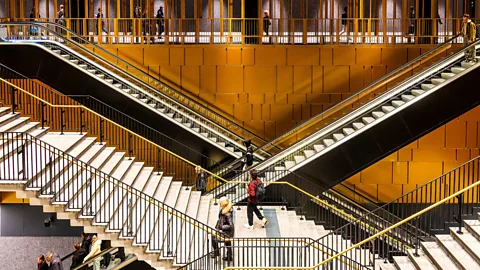
On a recent Friday afternoon, I made my way through the usual tourist queues swarming the Colosseum, and entered the recently inaugurated Colosseo-Fori Imperiali Metro C station. As I took the escalator underground, the crowds vanished. Metal gridwork and four cascades of criss-crossing escalators created an Escher-like atmosphere. Even so, I was still coming face to face with the city's storied past.
In one corner, a collection of ancient pottery first excavated a few metres away was displayed behind glass. Further ahead stood the crumbling remains of a Roman bath. But this wasn't a gallery or museum tour I'd had to book in advance; Rome's newest metro stop is also Ancient Rome's newest attraction, and my entry cost just €1.50 (£1.30; $1.75).
A unique problem
When most cities build metro systems, they simply blast through rock. But in Rome, a city famously built on the remains of its past, engineers must tunnel through nearly 3,000 years of history. Each time workers break ground, they risk encountering ancient ruins, requiring painstaking excavations. Civic progress is slow, often rerouted or indefinitely suspended.
This unique problem meant that until 2014, just two main metro lines (Metro A and Metro B) served a metropolis spanning 1285 sq km (496 sq miles). But construction on Metro C has been ongoing for nearly 20 years, and the closer it's inched from the suburb of Monte Compatri-Pantano to Rome's historical centre, the more of Ancient Rome it's unearthed.
During construction for its three newest stops, Ancient Roman drinking wells, a farm, military barracks, a 16-room home and more than half a million smaller artefacts like pottery, coins and jewellery have been discovered – mostly dating from the 7th Century BCE to the 5th Century CE. But delays, ballooning costs and countless traffic detours led to mocking witticisms around town: "Metro C isn't a subway; it's an archaeological dig with trains."
"There are always surprises in archaeology, so you must make adjustments," explained Simona Morretta, an archaeologist overseeing parts of the excavations.
 Alamy
AlamyTo showcase the discoveries from the excavated area, a total of seven "archaeo-stations" are planned – part transit hub, part self-guided museum exhibits.
The first archaeo-station, San Giovanni, opened in 2018. The second, Colosseo-Fori Imperiali, opened in December 2025. While it helps locals get around town, Metro C is also giving people a whole new way to experience Ancient Rome in the modern day.
The fragment tells a story
"A project like this could only happen in Rome," said historian Anthony Majanlahti. "Rome is a city built from the remains of its past. It's built on top of and made from its predecessor cities. Anything built in Rome has always had to take into consideration the city beneath it."
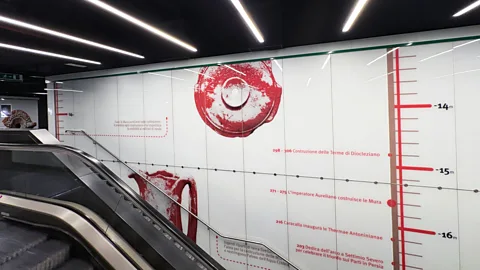
Unlike the artefacts it displays, Metro C's archaeo-stations are sleek and modern (the train itself is driverless). As you ride down the three cascades of escalators of San Giovanni station, illustrated timelines on the walls follow your descent to 27m (88.5ft) below ground level. Visitors pass markers indicating the geological depth from present day to the city's Medieval period, then markers showing the Imperial and Republican periods, all the way down to the Palaeolithic strata, highlighting important moments in Rome's architectural history along the way. You're free to hop off at any of the station's three floors to browse artefacts unearthed during the digs, each showcased on the level corresponding to the geological strata where it was found.
 Eva Sandoval
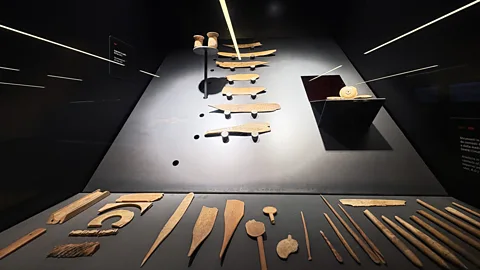
I stopped at the middle floor – surface level during Rome's Imperial period, now buried deep underground. Under what is now the residential San Giovanni neighbourhood, a series of clay and lead pipes are displayed, linked to the water basin and irrigation system that once occupied the site. I paused to examine a case of bronze coins from the 3rd Century CE, then perused a collection of Late Antique marble friezes. Multimedia exhibits are interspersed amid the artefacts; a looping video shows that here once stood a peach farm in the 1st Century CE, and in the station's lowest level – where the trains now run – traces of early human life were discovered. Clay gardening vases and farming tools line a display case. The case reads: Il frammento racconta ("the fragment tells a story").
It's a story some Romans are appreciating for the first time.
"Like any school kid, I studied Ancient Rome," said local shopkeeper Annalisa Molisano. "But it never came to life for me the way it did when I understood how it all fits together."
 Eva Sandoval
A window into history
It's just two stops from San Giovanni to the Colosseo-Fori Imperiali station.
Plan your trip:
Both Metro A and B lines intersect with Metro C: take Metro A to San Giovanni or Metro B to Colosseo-Fori Imperiali. Colosseo-Fori Imperiali and San Giovanni intersect. Porta Metronia is reachable only via Metro C.
The cost of a metro ticket is €1.50 (£1.30). Visitors may take in all three stations in one trip and stay as long as they like. The atrium of the Colosseo-Fori Imperiali station is free to visit and features multimedia exhibits about the history of the area. The station provides direct access to the Colosseum, Roman Forum and the Belvedere Cederna panoramic terrace.
After descending the escalators to the two middle floors, I come face to face with three ancient drinking wells, which have been reconstructed where they originally stood in the 6th to 3rd Centuries BCE. The objects found within – pottery, carved animal horns – are visible in a plexiglass-covered display that mimics the wells' shape. These reconstructed wells represent three of 28 found here to date; a source of drinking water before the construction of Rome's first aqueducts in 312 BCE.
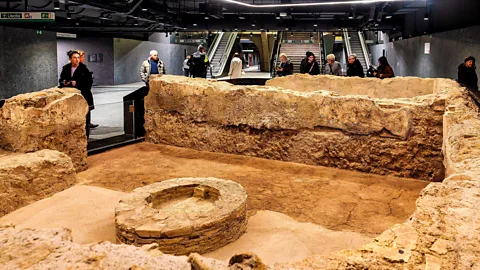
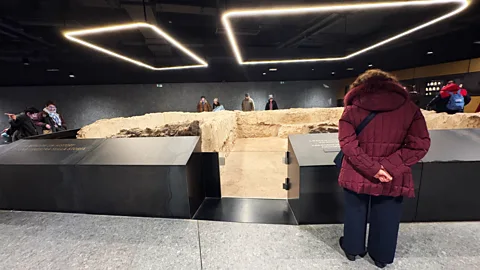
A handful of onlookers mill around the archaeo-station, where additional artefacts are displayed. There are household objects like knives and oil lamps; the remains of a mosaic floor and fragments of Roman statues, including the marble head of a Medusa found at the Temple of Venus and Rome. But the station's showpiece exhibit is the remains of a thermal bath, featuring a cold plunge pool and laconicum (sweat room). The bath is believed to have been part of a residential structure dating to the Imperial period, excavated in Colosseum Square and now displayed in situ within the archaeo-station, where visitors shuffle slowly around it as if awed by its power. The hydraulic structures are still clearly visible, and a video shows what the structure may have looked like thousands of years ago, before the residence was destroyed in Nero's fire of 64 CE.
 Eva Sandoval
I noticed a group of secondary school students on a field trip. Some giggled at the displays. Others posed for selfies around the bath.
"We talked about this metro stop for two classes before coming here," said their teacher, Annalisa Labriola. "It's one thing to see a photo on a screen or to be told that Rome is a city where history is stacked on top of history. But it's completely different to come here and see it. They've all used the metro, but their eyes lit up when we first arrived here."
Tourists, filtering down from the Colosseum, are impressed as well.
"We knew nothing about this when we planned our trip," said Annabeth Wilson, an office worker from New Jersey. "It's amazing. Our guide mentioned it. We came down here and thought we'd be here five or ten minutes. It's already been 45."
The reaction is exactly what the designers hoped for.
 Alamy
Alamy"It's almost like travelling back in time," said archaeologist Livia Galante when we strolled together through the stop. "A station like this is built to bring people here, not just to catch their train on the way to work, but to understand the history of the city by understanding the way it was built on top of itself."
Metro C wasn't built in a day
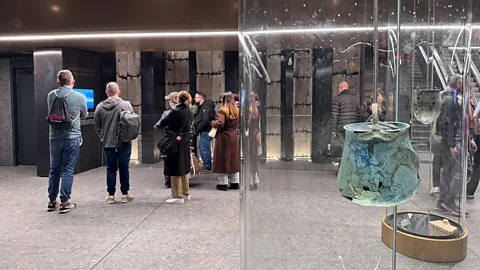
Located between Colosseo-Fori Imperiali and San Giovanni, Metro C's Porta Metronia station also opened in December 2025. But as with many digs in Rome, there was a twist. During the excavations, archaeologists uncovered the remains of a massive 2nd-Century CE Roman military barracks, including a multiple room residence decorated in frescoes and mosaics, thought to have belonged to the commander of the post. The discovery was so monumental that engineers redesigned the station to incorporate the ruins, which were removed and preserved as construction on the station continued.
"With Porta Metronia we entered a new phase," said Morretta. "Now we know that ancient structures can be carefully dismantled, preserved, then reinstalled inside the station once the work is completed."
 Eric J Lyman
Though the station currently displays several artefacts recovered onsite, a full archaeo-station is (hopefully) on track to open this June, where the barracks and residence will be visible to the public.
Preserving these treasures is one of Italy's fundamental challenges, as is the cost: Metro C is estimated to cost around €1 billion (£8.69m; $1.16bn) per kilometre through Rome's historical centre.
More like this:
• Italy's sunken city returning from the sea
• Sardinia's sacred Neolithic 'fairy houses'
• Italy's impressive subterranean civilisation
For years, locals complained about the expense, but now that the line conveniently reaches the Colosseum, those voices have mostly faded. And for supporters, the project is priceless.
"What I value about these stations is that it makes someone who'd normally be rushing through the city stop and realise they are physically immersed in history," said Galante. "It reminds people that Rome isn't just what you see on the surface. There's another Rome underneath."
Back at street level, the Colosseum dominates the landscape, as it has for two millennia. After years of construction scaffolding and traffic cones, the scene has returned to normal. Cars zoom past, tourists queue and locals now rush to catch their train.
Metro C will eventually reach north-western Rome, including the Vatican. It's never been clearer that the Rome visible above ground is only part of the story. The rest is below, still waiting to be uncovered one layer at a time.
--
If you liked this story, sign up for The Essential List newsletter – a handpicked selection of features, videos and can't-miss news, delivered to your inbox twice a week.
For more Travel stories from the BBC, follow us on Facebook and Instagram.