The blue light from your phone isn't ruining your sleep

 Hana Mendel
For a decade, we've been told our screens are wrecking our sleep. The real culprit is far bigger than the glow from your phone.
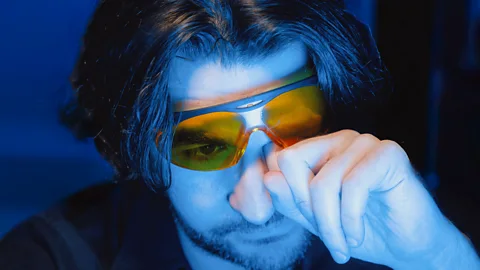
I have spent the last few weeks strapping on a pair of special orange safety goggles three hours before bed. They're made of thick, uncomfortable plastic that casts the world in a dull amber glow, making it hard to see anything blue. But I don't stop there. I cover the windows with blackout curtains and switch off all my lamps, one by one. In their place, I exclusively light my apartment with candles. My sleep routine is deranged, but it's for an experiment. I found out what happens when you banish blue light.
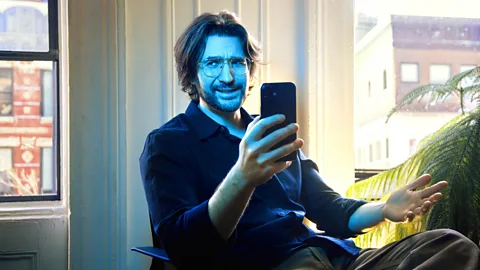
The world has grown increasingly panicked about this photochromatic fiend over the past 10 years. We're told that our phones, TVs, computers, tablets and LED light bulbs expose us to a perverse amount of blue light. Supposedly, this ruins our sleep by disrupting the natural rhythms of daylight that influence our internal body clock. There's science to back some of this up, but recent studies and analysis suggests that things are a lot more complicated. In fact, chances are good that you've fallen for some serious misconceptions on this subject. Experts tell me it's unlikely that light from your phone is ruining your sleep.
The research is mixed. Those features designed to dial down blue light on your phone at bedtime, for example, are probably doing very little to improve your sleep. But the lighting of modern life really can have a huge effect on your sleep. What would it take to make a change?
I wanted the truth. So, I called the experts and dove into the science.
And to see if I could spot the difference, I've plunged myself into the most extreme, blue-free evenings I could muster. I landed on practical advice that you can use – no dorky tinted goggles required. It could be the secret to a good night's sleep.
The blue screen of death?
The public freakout about blue light started with a study in 2014. Half of the 12 participants read on an iPad before bed. The rest read physical books. The iPad users took longer to fall asleep, felt groggier the next day and produced less melatonin. The researchers said the culprit was the glow emitted from the iPad's LED screen, which produces a disproportionate amount of light in the upper, bluer end of the spectrum. Under specific circumstances, blue-enriched light disrupts the daily circadian rhythm – our body's natural pacemaker – that uses daylight to help determine when we start to feel tired. Subsequent research seemed to support the findings. Sounds simple, right? It's not.
"This was an incredibly deceptive piece of work," says Jamie Zeitzer, a professor of psychiatry and behavioural sciences at Stanford University, who studies the effect of light on the circadian system. The science wasn't bad, he says, the problem is it brought people to bad conclusions.
It's true that our screens are bluer. Modern screens and lightbulbs use LEDs, which cannot produce pure white light. Instead, they use blue LEDs and cover some of them with a chemical called yellow phosphor. The blue and yellow mix together and trick your brain into seeing white, but extra blue always leaks out.
 Hana Mendel
And blue light really can influence your sleep. Zeitzer says that's mostly because you have a light-sensitive protein in your eyes called melanopsin which plays a key role in your sleep system. "And melanopsin is a blue sensitive protein, which basically means that it is most sensitive to blue light," he says. Melanopsin reacts to other colours of light too, the effect of blue is just a bit stronger.
"But the amount of light emitted from our screens is really inconsequential," says Zeitzer. Your life doesn't match the conditions of many blue light studies. "We bring someone into the laboratory, and they are exposed to very dim light all day long. And then they are given a bright light stimulus," he says. Under those circumstances, blue light makes people go haywire, but it doesn't reflect typical experience of human life.
After years warnings and millions of people flipping on the blue light filters built into their phones, the latest science suggests screens are not the main culprit here after all. For example, a recent review of 11 different studies and found that the light from screens only delayed sleep by about nine minutes, at worst. Not zero, but not life altering, either.
The amount of blue light emitted by the screens of phones, laptops and tablets has also been shown to be tiny compared to the blue light we receive from the Sun – 24 hours-worth of blue light from digital devices totted up to less than one minute spent outdoors, according to one study. Other studies have shown it's not enough to affect levels of the hormones that control our sleep.
So why am I so tired all the time? Zeitzer and others told me there are lots of other ways that light, blue and otherwise, could be ruining my bedtime. If I really wanted to tackle the blue monster, it was going to take a serious lifestyle change.
Kind of blue
I was out for dinner as the Sun went down on day one of my experiment. Around 20:30, I said I needed to head home. It was time to hide from the light. Based on the advice I was getting from sleep specialists, my extreme bedtime prepping started long before I get under the covers.
My routine starts with an absurd pair of glasses. If you wear normal glasses, you've probably been offered special clear coatings that promise to filter blue light. Studies suggest they don't do much. Real blue-blocking glasses aren't sexy. Frankly, they aren't a realistic solution for most people, either.
The good ones have deep orange, red or amber lenses that wrap all the way around your eyes so light can't get in from the sides. Serious manufacturers offer a spectrum report that shows how much blue light gets in. "You shouldn't be able to see much blue," says Håvard Kallestad, director of the sleep and chronobiology research group at the Norwegian University of Science and Technology.
The special blue-light googles I have were made for people who work with lasers that need eye protection. I put them on and looked out the window. There's a store with a blue neon sign down the street. With my glasses on, the light from the sign vanished. Bullseye.
Keeping Tabs
Thomas Germain is a senior technology journalist at the BBC. He writes the column Keeping Tabs and co-hosts the podcast The Interface. His work uncovers the hidden systems that run your digital life, and how you can live better inside them.
I sat down on the couch, thinking about the sacrifices I make for journalism. I scrolled through Instagram. It looked… orange. The whole point of what I'm doing is to see how light affects my sleep, so I didn't change anything about my phone, TV or computer habits. But the glasses are just the beginning.
"I think you need to turn your apartment into a cave," Kallestad says. "Just block light from entering and use candlelight." Modern LED lights produce a ton of blue light. Old school incandescent bulbs make much less, but candles are almost blue-free.
It's never really dark where I live in New York. So I covered my windows with blackout curtains, with only my phone and a couple of flickering candles standing between me and the inky darkness. I wasn't sleepy yet. It was going to be a long couple of weeks.
How to un-blue yourself
Experts agree that what really matters is the dose of light of light you're getting through the day. For optimal sleep, you want lots of light in the morning and much less at night. Blue light counts more, but it's your total exposure that makes the real difference.
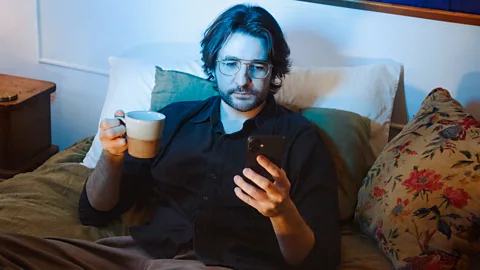
It turns out the solution starts the moment you wake up. Every morning during my test, I sat in front of a lamp that looks like a prop from a 1980s science fiction movie. It blasts bright light straight into my face while I drink my coffee. The lamp is small, so Kallestad says I need to sit as close to it as possible. It was not fun. The lamp is designed to treat seasonal depression, and the clinical temperature of the light is especially blue, which has been shown to increase alertness when you get it earlier in the day. But it's also priming my eyes to fend off the blue later that night.
 Hana Mendel
"The more light that you get during the daytime, the less impact the light in the evening has," Zeitzer says. The pre-pandemic world exposed people to a lot more light than they realised. There's the Sun during a commute, the piercing fluorescent bulbs of an office, a walk to lunch. Now, so many of us roll out of bed and sit under the same lighting conditions until we go to sleep. Our bodies can't tell the difference between day and night.
Leaving the house will fix that faster than any lamp. Even on a grey overcast day, Zeitzer says you're probably getting around 10,000 lux (the measure of light intensity). A bright sunny day can hit 100,000 lux. By comparison, your living room it's probably around 100 lux. (And your phone tops out around a measly 50-80 lux, Zeitzer says, and it's less when you have the brightness down.)
"Go outside if you can, use the lamp if you have to," says Kallestad. Even a 30-minute walk in the morning makes a real difference (just don't forget sunscreen). And if you can get outside again after 15:00, Zeitzer says that's also surprisingly useful. It further anchors your body clock and directly reduces how sensitive you are to light in the evening.
If you work from home, another tip you can try is a bit counter-intuitive. Turn your lights up bright during the day and start switching them off in the evening. "The real key with light exposure is contrast," Zeitzer says.
So, if being glued to your screens keeps you stuck inside all day, away from the sleep-promoting glare of natural sunlight, that's bad news. But the blue light coming from those screens contributes little to the wider issue of our lifestyles. The real problem, Zeitzer says, is what we spend our time doing on our phones and laptops before bed.
"It is much more the content, rather than the light, that is keeping people awake from these devices," Zeitzer says. It can also depend on how sensitive you are to light in the first place – I might be more or less sensitive than you.
My blue period
I use a sleep tracker to monitor my rest. It's not good enough for real science, but it's a rough indication. The quality of my sleep didn't seem to change much during my experiment. But I did notice some differences. Towards the end of the second week, I found myself a little more motivated to get into bed on time and it seemed easier to fall asleep. The amount of time I spent asleep didn't change in any meaningful way by the end of my experiment, but the time I feel asleep and got up in the morning was a little more consistent. Was this because I blocked blue light? Hard to say, but it felt like a big victory.
What I can tell you is I started to look forward to my candle evenings. It's possible this in itself could make a difference. When something "becomes part of the pre-bed process, it can act as a very strong psychological cue to help remind your body of what you're supposed to be doing next", Zeitzer says.
More like this:
• How microbes control your sleep
The same goes for the auto-dimming features that limit some blue light on your phone. "It doesn't really work that well, but the one thing that it can do is that when you have one of these filters, or if you wear blue blocking glasses in the evening, is that acts as kind of like a Pavlovian conditioning cue for some people. When the screen colour changes, or you put on your glasses, your brain starts to understand it is time to get ready for bed."
If you come by for a sleepover, you won't see me in the blue blocking glasses. It was a huge relief to give them up, but I might keep the candles.
--
For more technology news and insights, sign up to our Tech Decoded newsletter, while The Essential List delivers a handpicked selection of features and insights to your inbox twice a week.
For more science, technology, environment and health stories from the BBC, follow us on Facebook and Instagram.