Tax rebate not intended for millionaire pensioners, Findlay says

 PA
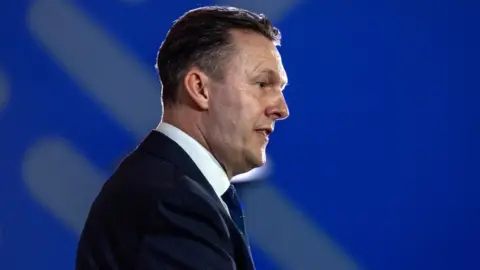
PAScottish Conservative leader Russell Findlay has defended his plan to give pensioners a £500 tax rebate while cutting spending on child and disability benefits.
The Tories have proposed tax breaks alongside welfare spending reductions in their Holyrood election manifesto, vowing to slash "huge amounts of government waste".
Speaking to BBC Radio Scotland Breakfast, Findlay insisted it was "entirely reasonable" to give pensioners on "modest incomes" the £500 boost.
However, he said he hoped millionaire pensioners would not apply for the payment.
The manifesto proposal would allow pensioners to claim back the first £500 they pay in tax on their pension income.
This £500 would be "triple locked", increasing in line with earnings, inflation or 2% – whichever figure was highest.
Asked if that was the correct use of public money as he attempted to cut waste, Findlay said the payment would not be available to "those at the upper level of earnings".
The Tory leader then qualified that, saying pensioners would have to apply for the payment.
"It'd be up to each pensioner to apply for this," he said. "So I would like to think that if you were a millionaire pensioner, of which there are very few, you would not be seeking to get your 50 quid."
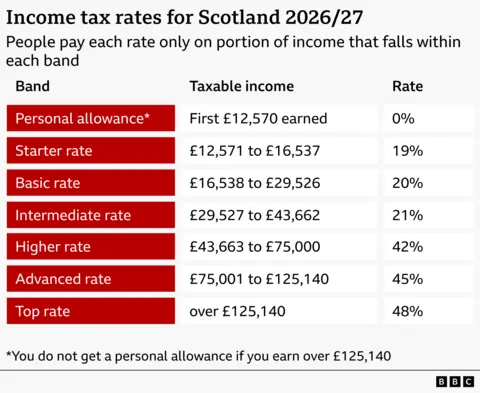
The Conservatives plan to cut income tax by raising the point at which Scots start paying the levy on their earnings.
Scotland's starter (19%), basic (20%) and intermediate (21%) bands would also be combined into one 19% bands.
And the level at which the higher rate (42%) kicks in would be raised to £50,270, matching the UK tax system.
Findlay said the current Scottish tax system was "completely unfair and unaffordable", telling the BBC radio programme that his party had tabled "costed and credible plans to bring that back down to a fair level".
He added: "Fundamentally, this is about ensuring that work pays."
According to costings published alongside the manifesto, the income tax cut would cost £370m in 2027-28, with the total forecast to rise to almost £2.8bn by 2031-32.
To fund this, the Tories propose several spending cuts. The manifesto document identifies £1.3bn worth of savings in 2027-28 through a range of measures.
These include introducing restrictions on adult mental health benefit claims (£592m), imposing a two-child cap for the Scottish Child Payment (£62m) and cutting the size of the civil service back to 2016 levels (£54m).
The party says that by 2031-32 cuts to adult mental health benefits could save almost £2bn, while civil service savings could total £1.5bn.

Findlay said that while Scots were "extremely fortunate" to live in a country that has a welfare safety net, he described social security spending was "out of control".
The gap between what the Scottish government spends on social security and what it receives from the Treasury via welfare spending south of the border is forecast to grow to £1.1bn in 2026-27, rising to £1.2bn in 2030-31.
This spending has to be funded by moving cash from other areas, increasing taxes and/or borrowing.
The Conservatives have vowed to end the Scottish government's "light touch" approach to benefits assessments.
Findlay claimed there were "huge and rapidly increasing numbers" of "wholly unnecessary" disability payments being made to people with mental health conditions, citing ADHD and autism.
As of October, about 200,000 people received Adult Disability Payment in Scotland due to due to "mental and behavioural disorders". Findlay told the BBC: "We believe most of those claimants wouldn't be applicable."
Findlay added that the Scottish Child Payment - which the government estimated kept 40,000 children out of relative poverty in 2025-26 - was "too generous".
Findlay said further savings could come from cutting "huge amounts of government waste".
He told the BBC his party wanted to slash the number of quangos - public bodies that operate at arms-length from government, of which there are about 130 in Scotland.
"Many of these aren't necessary," Findlay said, identifying ferry procurement body CMAL, the Scottish Land Commission and Community Justice Scotland as bodies he would scrap.
"When people are going to working hard to pay their taxes, they're doing so they want to see improved public services.
"They want to see the bins emptied. They want to see potholes filled. They want to see police officers on the streets.
"They don't want to pay for vast reams of a professional class that serve no purpose and add no value."
For a party with the word "conservative" in its name, the Tory proposals are really quite radical.
By 2031-32 they envisage spending an extra £6bn a year on tax cuts for people and businesses, extra school staff and NHS capacity.
That's to be paid for with £6bn worth of cuts from things like disability payments, the civil service and the cost of running government.
The Institute for Fiscal Studies has pointed out that meeting these savings targets will be challenging, and that while the plan may be costed on paper, "whether it would survive contact with reality is far from clear".
They said "giveaways on the scale proposed by the Scottish Conservatives cannot credibly be funded largely through back-office and administrative savings", saying there would likely also need to be "substantial cutbacks" to public services too.
There's also the point that the manifesto complains about a looming £5bn gap between spending and available funding by the end of next term, saying the nation's finances are not sustainable.
But almost every penny of savings the party proposes making is then committed to new spending, rather than filling this gap.
This is not austerity politics or small government by any means - it's a plan which would entail massive changes, which would be challenging to deliver.

Would you like to be in the audience for BBC Scotland's leaders debate?
The special episode of Debate Night, hosted by Stephen Jardine, will take place between 19:00 and 20:30 on Sunday 12 April in Paisley Town Hall.
The leaders of the Scottish Conservatives, Scottish Greens, Scottish Labour, Scottish Liberal Democrats, Scottish National Party, and Reform UK have been invited to take part.
You can apply to be part of the audience at bbc.co.uk/debatenight or by clicking this link.