Green candidate backs abolition of Scotland's prisons

 Facebook
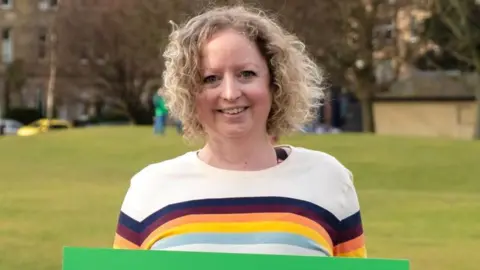
A Scottish Green election candidate is facing criticism after revealing she wants to abolish prisons.
Kate Nevens - who is standing on the Edinburgh and Lothians East regional list - says she is "keen to live in a Scotland" with no jails.
Political rivals have accused her of promoting "absolutely bonkers" and "monumentally stupid" views on justice reform.
A Green spokesperson said jails should be used as a last resort - but stopped short of calling for their abolition.
They added that the party wants to end "mass incarceration and punishment", instead focusing on crime prevention and supporting victims.
Prisons 'poor for wellbeing'
Nevens, a charity worker, is her party's second pick on the Edinburgh and Lothians East regional list.
As a result she has a good chance of being elected to Holyrood next month if the Greens perform well.
She is also a constituency candidate in Edinburgh North Eastern and Leith.
In a video posted on Instagram, she described herself as a prison "abolitionist" who wants "to see the complete abolition" of the prison system in Scotland.
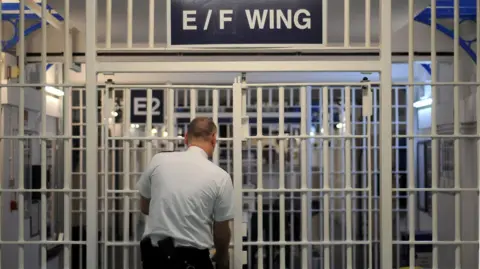
Nevens said: "Prisons are not safe, they're violent, they're poor for people's health and wellbeing, particularly if you're a woman. And they fail to support rehabilitation.
"So actually they do not make those of us who are not breaking the law safer either."
 PA Media
The candidate said the "ultimate goal" of the Greens was to "not have the prisons system as it is right now".
In the meantime, Nevens said the party wanted to "massively" reduce the number of people being sent to jail while focusing on "community justice", pointing to electronic tagging and un-paid or low-paid work as alternatives to custody.
She called for work to tackle the the "root causes" of crime - citing trauma and inequality.
Doubling down on her views in a later post, Nevens said she was "still keen to live in a Scotland with no prisons".
Scotland's prison population reached a record high last month despite the government introducing an early release programme.
Hundreds of inmates serving sentences of less than four years have been let out early since November in an attempt to reduce overcrowding.
The scheme does not apply to those convicted of domestic abuse or sexual offences.
A Green spokesperson said: "The evidence shows prison sentences result in high reoffending rates, which does little to keep the public safe in the long term.
"That's why our starting point is an assumption against custodial sentences for non-violent crimes.
"All forms of detention should be used as a last resort - mainly for violent crimes - and done to protect people and society where there is no alternative."

Scottish Labour's Pauline McNeill described the Green candidate's comments as ludicrous and reckless.
She said: "This would let murderers and rapists to walk our streets free of consequences for their heinous crimes.
"That is not progressive, it is monumentally stupid."
The SNP's Angus Robertson said the abolition call was "absolutely bonkers".
Scottish Conservative candidate Sue Webber said the justice proposal was "insane and irresponsible".
"It beggars belief that someone who fervently believes that murderers and rapists shouldn't be locked up is high up the Greens' Lothian list and likely to become an MSP."
Reform's Thomas Kerr said that "an end to prisons is not liberal or progressive but instead dangerous extremist ideology".
Scottish Liberal Democrat Liam McArthur said: "This is a dangerously naive view of the world.
"The first priority needs to be public safety and there are some people who are just too dangerous to be walking the streets."
He added that there must be a "credible alternative to imprisonment for low level offences", better education in prisons and action to reduce delays in the justice system.
There has been quite a political pile-on over the Green candidate who suggested getting rid of prisons, but existing policy is geared towards sending fewer and fewer people to jail.
There have long been efforts to cut Scotland's incarceration rate, which is among the highest in western Europe.
The government introduced a presumption against short sentences, urging judges not to hand out terms of under 12 months, in 2019.
But it hasn't worked - 73% of the sentences handed down in 2023-24 were for less than a year.
And an independent review set up by the government has suggested actually barring judges from handing out such short terms.
They also recommended having a presumption against sentences of under two years, as part of a "decarceration" programme which could "substantially reduce the prison population".
The idea would be to rebalance the judicial system from locking people up to dealing with more of them in the community, with prisons retained chiefly for serious offenders who pose a danger to the public.
In February the government said it would consider this report carefully - so significant changes to the prison system may actually come to pass.

Would you like to be in the audience for BBC Scotland's leaders debate?
The special episode of Debate Night, hosted by Stephen Jardine, will take place between 19:00 and 20:30 on Sunday 12 April in Paisley Town Hall.
The leaders of the Scottish Conservatives, Scottish Greens, Scottish Labour, Scottish Liberal Democrats, Scottish National Party, and Reform UK have been invited to take part.
You can apply to be part of the audience at bbc.co.uk/debatenight or by clicking this link.