Social Bite opens village for homeless people in Rutherglen

 Frame PR
A £3m village for homeless people has opened in South Lanarkshire.
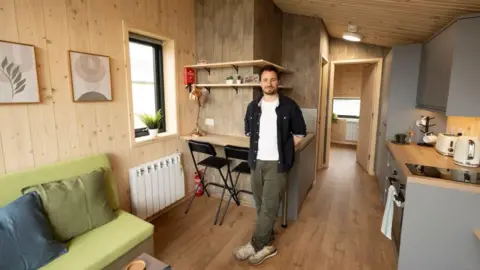
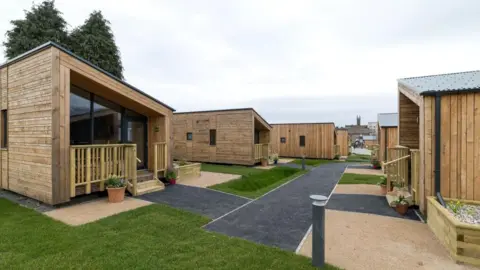
Harriet Gardens in Rutherglen will cater for 15 people at a time, with each person staying in a nest home - meaning a compact, modular building - and sharing a gym, community hub and cooking space with others in the village.
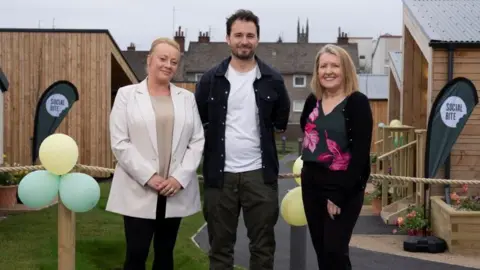
The new site, which was built on disused land that was formerly a saw mill, has been created by charity Social Bite and South Lanarkshire Council. It is the second built in Scotland, and the first established in the west.
Charity founder Josh Littlejohn told BBC Scotland News that more villages could help Scotland's homelessness crisis, letting people get used to owning their own property.
The village will be managed by charity partner the Salvation Army, who will provide round the clock support on site, with several people expected to begin moving in over the next two days.
Littlejohn said that a lot of homeless hostels in Scotland are no longer fit for purpose and lead to people being trapped "in a cycle of homelessness".
He added: "I'd love to work with local or national government, in Scotland and the UK, and have more of these built in places where people are trapped in these homeless BnBs in great numbers.
"Maybe these places aren't fit for purpose anymore, and they're expensive – Glasgow and Edinburgh councils are spending millions and millions on accommodation.
"If you create an environment where people grow in confidence, build relationships and then leave homelessness behind, then that is the first step in tackling homelessness as a problem.
"If people are homeless and living in a chaotic environment, then when they get their own tenancy they aren't sure how to handle and can end up losing the tenancy. I think models like this have a much bigger role to play in tackling the problem."
 Frame PR
In recent years several Scottish councils have declared a housing emergency, including both Glasgow and Edinburgh.
Jacqueline Fernie, a homelessness and housing manager for South Lanarkshire Council, said the problem had soared in the region since the Covid pandemic.
She estimated that the average number had gone from about 1000 people being considered homeless several years ago to around 1,500, due to a number of factors.
She said: "Traditionally, the highest number of homeless people are ones who have been asked to leave the family home.
"Now we also have the private rental sector shrinking, so more people lose private sector accommodation and at the same time there is now no room for people to start moving into that sector.
"Affordability is now a bigger problem than it has ever been before."
She first visited the Edinburgh homeless village about four years ago, and was keen to bring a similar project to South Lanarkshire.
Fernie told BBC Scotland News the idea could make a difference by giving people staying there independence and responsibility, both over their own homes and the wider village site.
She added: "Normally the payoff for staying in good quality supported accommodation is that you will be living in a small room and sharing facilities, so you are not actually managing a house.
"This for me is the best of both worlds. You've got your own home to manage but you have support on site with you. I think this can make a real difference for people who are caught in a cycle of repeat homelessness."
 Frame PR
Not everyone has agreed with this assessment.
The announcement of the plans prompted complaints from locals in 2024, but Littlejohn - who's next task is bringing Hollywood A-lister George Clooney back to Scotland for Social Bite events later this month - believes the village can dispel stereotypes about homelessness.
He said: "There is always a natural concern from people living here locally, because there is an idea they will have in their heads of a stereotypical homeless hostel.
"But the reaction from a lot of local people has been positive – they're actually proud, because they see the impact somewhere like this can have."
A community connections group has already been established to help create links between the new village and the surrounding Rutherglen area, with the town's main street not far away.
Other community groups - such as local gardening group Grow 73 - have already expressed interest at getting involved.
Karen Good, of the Salvation Army, is optimistic the new site can benefit both those living there and others in the wider area.
She said: "We want to involve the community that is around us, we don't want barriers there. That has probably been felt before.
"You're trying to break the stigma attached with homelessness and that's for people going through homelessness, but also for the wider community.
"This is giving a person an individual place they can call their home."