Israel's perpetual war with Iran may be hard to win with military might alone

 Getty
GettyOn the highway from Tel Aviv to Jerusalem, American flags now hang alongside Israeli ones – a public sign of appreciation for US involvement in fighting Iran.
"We used to beg American administrations only to recognise a Credible Military Threat [from Iran]," said Israel's former National Security Advisor, Tzachi Hangebi, who left office four months before this war began.
"The fact that both Israel and the US are working day in, day out to diminish the capabilities of Iran, that's beyond my most utopian fantasies."
America's decision to jointly wage war on Iran opened-up possibilities for Israel to attack its old enemy in new ways – officials here talk of dividing up targets with their US counterparts according to their respective capabilities.
But this war has so far not resolved any of Israel's regional conflicts in the way its prime minister suggested it would.
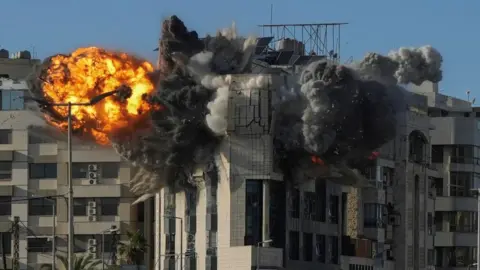
As US president Donald Trump talks of winding up the joint offensive in Iran, Israeli forces are still holding territory in Gaza and Syria, with new instructions from their defence minister to take a large swathe of southern Lebanon as a "buffer zone" against Iran's ally Hezbollah.
Some 600,000 people living inside this new 'security zone' have been told they will not be allowed back to their homes until Israel deems its northern communities safe from Hezbollah attacks. Mr Katz has ordered the destruction of all houses in Lebanese villages near the border, in the same way his forces razed communities in Gaza.
Tzachi Hanegbi says Israel will continue its direct confrontation with regional enemies like Hezbollah, even if Washington forces an end to military action in Iran.
"Donald Trump might make a decision that there are no more [Iranian] targets relevant to the nuclear capabilities, and that he would like some kind of ceasefire, and whatever he will do, we will accept," Hangebi told me.
"[But] we'll go forward in Lebanon. We'll keep on doing it, and I'm sure America won't tell us, 'No'."
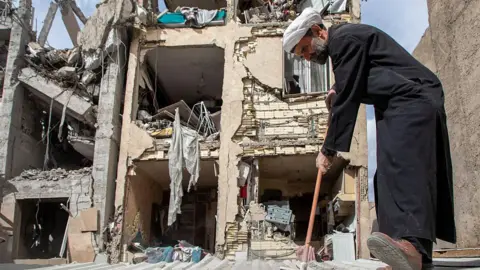
More than 1,200 people have been killed in Lebanon since the start of Israel's most recent campaign, according to Lebanon's Health Ministry.
 Reuters
And Iran's government says almost 2,000 people have been killed by US-Israeli attacks there since the war in Iran began.
Israel's military strategy in the region changed after the Hamas attacks on 7 October 2023, from a policy of 'containing' its enemies with occasional operations, to one of pre-empting attacks.
That shift has pulled Israel into direct confrontation with Iran, but also led to a policy of creating so-called 'buffer zones' in Gaza, Syria and Lebanon – wide areas of territory that Israel has seized from its neighbours for what it terms security reasons; the result of a repeated failure to turn military might into sustainable peace.
On Tuesday, just before the Jewish holiday of Passover, Prime Minister Netanyahu said Israel had inflicted 10 "plagues" on the regime in Tehran, including the establishment of "deep security belts beyond our borders – in Gaza, Syria and Lebanon".
"The buffer zone approach is seen as an insurance policy that gives Israel flexibility and buys it time, linked to the wider change in Israel's security doctrine since the 7 Oct attacks," said Burcu Ozcelik, a specialist in Middle East strategy at UK's Royal United Services Institute (Rusi).
But, she says, there are political fractures within Israel over the purpose of this approach.
"Some think the buffer zones will eventually lead to permanent occupation or the expansion of Israel's borders – an ideological point of view, long championed by the far-right," she said.
"More pragmatic voices argue that what's happening now in Lebanon, Gaza and Syria is a security-driven approach that may be removed once Israel feels safer."
For the past two and a half years, Benjamin Netanyahu has led his country in a continuous rolling conflict with Iran and its allies around the region, each time promising that the next war would restore Israel's security and vanquish its enemies.
Just nine months ago, after Israel's last war on Iran, Netanyahu told his nation they had achieved "a historic victory that will stand for generations", removing the "existential threats" from Iran's nuclear weapons and ballistic missiles.
Despite the rhetoric of imminent victory accompanying every fresh conflict, the reality for many Israelis is a new state of 'perma-war'.
"The grandiose promises of destroying Hezbollah and Hamas and Iran are not coming true," said Dahlia Scheindlin, a Policy Fellow at the Mitvim Institute, a think tank focused on Israeli foreign policy.
And Netanyahu's promise that the war on Iran will lead to new regional alliances for Israel hasn't materialised either, she says, leaving Arab States – including current or potential Israeli allies – worried.
"It never happens because Israel is behaving like an unpredictable warmongering actor that might snatch territory," Scheindlin said. "Israel's attack on Iran and Lebanon, and its encroachment into Gaza, Lebanon and Syria, is creating incredible anxiety that Israel is not a good ally in their shared concern about Iran, but that it is a dangerous ally."
 EPA
EPAIsrael's security has been a political mantra for Benjamin Netanyahu during his decades in office. In the early days of the war in Iran, he said Israel had already changed the Middle East, and its own power within it, but more than a month into the campaign the regime in Tehran is still in power, still firing missiles at Israel, and still in possession of its stockpile of highly-enriched uranium – enough, experts say, to make around a dozen nuclear bombs if further refined.
Support for the war among Jewish Israelis was initially estimated at above 90%, in a poll by the Israel Democracy Institute. Since then, it has dropped by almost 20 points, but the prime minister still enjoys majority backing for the war – even though surveys suggest support for him and his party in the upcoming elections has barely moved.
"The problem is that no political opposition leader is saying something totally different: advancing diplomacy; strengthening states in the region; working more closely with Arab states; solving the Palestinian issue – nobody is offering that," said Dahlia Scheindlin.
Tzachi Hanegbi points out that, while America can negotiate with Iran, Israel's only option is military.
"We cannot reach an agreement with Iran about anything, because they don't recognise our very existence. We only have dialogue through missiles, or whatever they do, and we do."
Israel did agree to earlier ceasefire deals in Lebanon and Gaza, but kept striking specific targets in both.
Hezbollah's decision last month to join the war alongside Iran sparked Israel's return to full conflict there, while Gaza remains stuck in limbo, its progress towards stability and reconstruction blocked by a dispute over how and when Hamas must disarm and Israeli forces withdraw.
Maintaining a military presence on several fronts, alongside a full-blown war in Iran and spiralling violence in the occupied West Bank, is taking its toll on Israel's population.
Its conscript army means most Israeli families are directly exposed to the risks of ongoing war, and its widening military footprint in the region has put hundreds of thousands of reservists on call-up lists. Some reservists have already served five or more tours since the 2023 Hamas attacks, and there are anecdotal reports of that some are refusing to serve again.
The defence budget has now risen to more than $45 billion, and there's little appetite among Israelis for endless war, but without a resolution to conflicts that are seen as existential, Israel's defence policies continue to demand money, men and munitions.
The war in Iran was framed as a chance to tackle Israel's existential threats.
But the lessons from Israel's other wars suggest military might alone may not be enough.