Natural history museum receives £140k for upgrades

 Brighton & Hove Museums
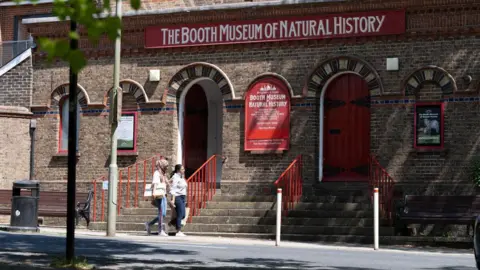
A natural history museum in Brighton has received nearly £140,000 to upgrade its main gallery and put on more displays of exotic plants and animals.
The Booth Museum of Natural History, founded in 1874 by naturalist Edward Thomas Booth, has more than 600,000 specimens, including insects, minerals, fossils and dinosaur bones.
It has been closed since April 2025, and now organisers have confirmed it has received a grant from the DCMS/Wolfson Museums and Galleries Improvement Fund.
Lee Ismail, head of collections management at Brighton & Hove Museums, said the funding was "extremely welcome" as the museum "has had very little investment for the past few decades".
"The last proposed refurbishment was scheduled for 2020 but was unfortunately scrapped due to the pandemic," he added.
Ismail said the funding would go towards removing the archways at the front to make the entrance "more open and welcoming".
"It is important that the historic bird dioramas made by Edward Booth were retained to maintain the Victorian look the Booth is known for," he added.
"The refurbishment will allow us to repaint the bird booth cases to their original black colour and lay flooring that is more reflective of the original wood floors during his time."
Additionally, the museum has plans to include a hub for climate, habitat and biodiversity education.
Ismail said they would display many specimens that have never had a permanent display space before.
These include the golden mole, raccoon, grass snakes, thorny devil (lizard), snapping turtle and the echidna, an egg-laying mammal, which is native to Australia and New Guinea.
Others include the toucan, tropical kingfishers, birds of paradise, emperor scorpions, cicadas, giant African land snails and morpho butterflies.
"We want to educate visitors about how these beautiful and fascinating species are threatened by climate change and human activity," Ismail explained.
"But we also want to focus on success stories, such as animals who have learned to thrive in our cities."
Some of the museum's oldest specimens include shells from the bottom of a 55-million-year-old Mediterranean lagoon.
The museum has yet to confirm when it will reopen.
Follow BBC Sussex on Facebook, on X, and on Instagram. Send your story ideas to southeasttoday@bbc.co.uk or WhatsApp us on 08081 002250.