Shipwrecks of the south coast and how to see them

 Getty Images
As an island nation whose empire once "ruled the waves", ships have played a fundamental role in Britain's history.
But a country so reliant on the sea will inevitably experience its share of disaster on the waters.
There are more than 37,000 known shipwrecks around England's coastline, according to Historic England, reflecting centuries of trade, war and maritime travel.
Here are some of the most famous wrecks off the coast of southern England and how you can see them.
Mary Rose
 Geoff Hunt/Mary Rose Trust
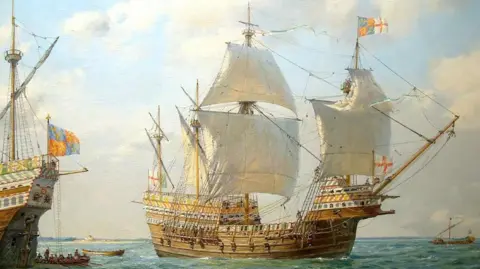
The Mary Rose was the favourite warship of King Henry VIII and became one of the most famous shipwrecks in English history.
Built in Portsmouth in 1510/11, it saw action in wars against France, Scotland and Brittany before sinking between the city and the Isle of Wight during the Battle of the Solent in July 1545
A sailor who escaped the wreck claimed the ship was turning when her sails caught in a strong gust of wind, pushing the open gun-ports below the waterline and flooding the vessel.
But there is no definitive answer, with some claiming it was brought down by a French cannonball.
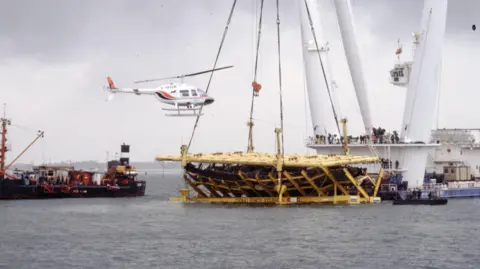
Its excavation was a world-famous operation and set new standards in underwater archaeology and conservation.
The Mary Rose was eventually raised on 11 October 1982, before being returned to Portsmouth Dockyard where it had been built 500 years earlier.
SS Mendi
 Martin Davies
Built in 1905, the SS Mendi was a steamship used to transport troops during World War One.
Mendi was carrying 823 men of the 5th Battalion the South African Native Labour on a dark and foggy night on February 21 1917.
It was in the English Channel, passing the Isle of Wight, when the ship was struck by a large Royal Mail cargo vessel and sank just 25 minutes later.
Almost 650 men died - with historical records indicating that the men aboard met their fates with extraordinary bravery and dignity.
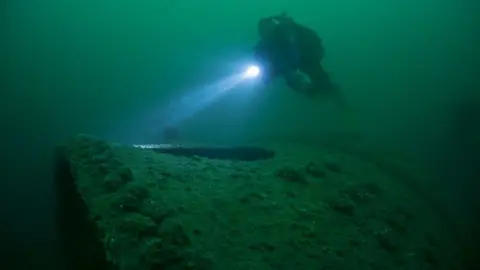
The wreck, which sits upright on the sea floor, was designated a protected war grave by the British Ministry of Defence in 2009 and a protected wreck in 2015.
In 2017, the ship's bell was handed in anonymously to a BBC journalist.
The then prime minister, Theresa May, returned the bell to South Africa during an official visit the following year.
Grace Dieu
Grace Dieu, launched in 1418, was the flagship of King Henry V.
The ship appears to have sailed only once - a disastrous cruise down the English Channel in 1420 that was abandoned after the crew staged two mutinies.
After King Henry V's death in 1422, the ship was laid-up in the River Hamble where, in 1439, it was set ablaze by a lightning strike and sank.
Its remains are still in the river at Bursledon, near Southampton.
The Swash Channel wreck
 Bournemouth University
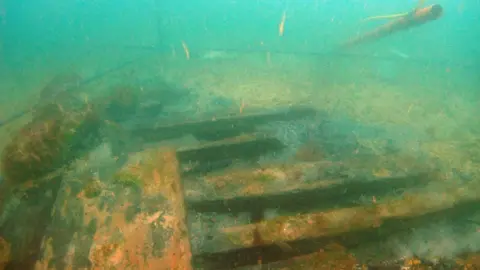
Parts of a 17th Century shipwreck found at Studland Bay in Dorset are believed to be from the Dutch merchant vessel Fame, which sank in 1631.
The wreck was first identified in the Swash Channel in the 1990s, with major excavation work carried out by maritime archaeologists from Bournemouth University in 2013 - the largest underwater excavation since that of the Mary Rose.
Analysis of the ship's timbers suggests it was built using wood from northern Europe, with further research indicating it is most likely the Fame from Hoorn, near Amsterdam.
The heavily armed merchant ship is thought to have been anchored in Studland Bay during a storm before being dragged onto Hook Sands, where it capsized.
More recently, sections of timber believed to be part of the same wreck were uncovered on the beach following winter storms.
Parts of the wreck have been recovered and are being conserved, with artefacts displayed at Poole Museum.
HMS Invincible
Originally named L'Invincible, the 74-gun ship was built for the French navy in 1744.
It was captured by the Royal Navy in 1747 and subsequently deployed as HMS Invincible.
It sank in February 1758 when the ship hit the Horse Tail Sand sandbank, in the East Solent, between Langstone Harbour and the Isle of Wight.
The Invincible remained upright for three days after its grounding, giving the crew the opportunity to safely escape.
Fishermen rediscovered the wreck in 1979 and the ship was designated under the Protection of Wrecks Act in 1980.
Earl of Abergavenny
 Portland Museum Trust
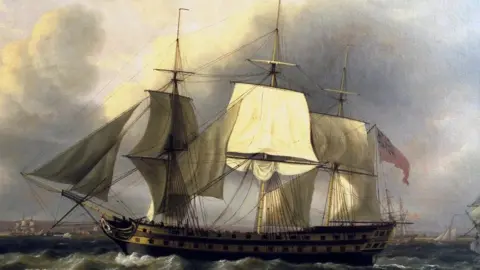
Launched in 1796, the Earl of Abergavenny was built in Northfleet, Kent, to carry cargo for the British East India Company.
The ship embarked on a number of successful voyages and was later commanded by Captain John Wordsworth Jnr - brother of poet William Wordsworth.
On 5 February 1805, the ship struck the Shambles sandbank off Portland Bill, in Dorset, during a storm, before sinking in Weymouth Bay.
Of 402 people on board, 263 people, including Wordsworth himself, lost their lives in the wreck.
The disaster was considered one of the worst maritime tragedies of its time.
The wreck still sits just two miles (3km) from the beach at Weymouth.
In August 2024, the Department for Culture, Media and Sport scheduled the wreck for protection on the advice of Historic England.
HMS Pomone
HMS Pomone was a 38-gun Royal Navy ship that was launched in 1805.
It was part of a fleet of ships known for their speed and reliability, and saw plenty of action in the Mediterranean during the Napoleonic Wars.
The ship successfully captured a number of enemy vessels during its service - but had a relatively short service life.
Returning home from the Med on 14 October 1811, the Pomone struck The Needles, a row of three stacks of chalk that rise out of the sea off the Isle of Wight.
Sir Harford Jones, the British Ambassador to Persia, was on board, as well as some Arab stallions that the Shah of Persia had sent as a present to King George III.
The Pomone is not alone on the site at The Needles, with another wreck - thought to be HMS Assurance - also in the same area.
The site was designated under the Protection of Wrecks Act on 4 April 1974.
How can you see shipwrecks?
 Getty Images
While many of the south coast's most important wrecks lie hidden beneath the water, there are still several ways for the public to experience them.
Some of the most famous wrecks can be experienced through museum displays and recovered artefacts.
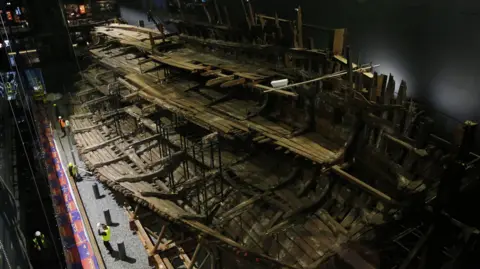
The Mary Rose Museum at Portsmouth Historic Dockyard houses the remains of Henry VIII's flagship, alongside thousands of salvaged Tudor artefacts.
Southampton's SeaCity Museum explores the story of the RMS Titanic, which set sail from the city in 1912.
On the Isle of Wight, the Isle of Wight Shipwreck Centre and Maritime Museum holds a large collection of artefacts recovered from local wrecks.
In Dorset, Portland Museum displays items recovered from the Earl of Abergavenny, including objects from Captain John Wordsworth's cabin.
Poole Museum displays artefacts from the Swash Channel wreck, believed to be the Dutch merchant ship Fame from Hoorn.
Though uncommon, some wrecks can be viewed from land.
The remains of the Grace Dieu, in the River Hamble near Bursledon, can occasionally be seen from the riverside at low tide.
In other cases, coastal landmarks such as The Needles mark areas where multiple wrecks lie just offshore, even if they are not visible from the surface.
And boat trips along parts of the south coast can pass over or near historic wreck sites.
Trips from Alum Bay on the Isle of Wight offer views of the area where several protected wrecks lie beneath the surface, including HMS Pomone.
Some wrecks can be explored in situ by divers.
While experience is usually required, a number of dive operators along the south coast offer guided trips to wreck sites, allowing people to visit them with trained professionals.
Popular dive sites along the south coast include the Kyarra, a World War One cargo ship sunk by a German U-boat off Swanage.
However, access to certain sites is restricted, particularly those protected under the Protection of Wrecks Act, and licences may be required.
Interactive maps can also help people explore shipwrecks from home.
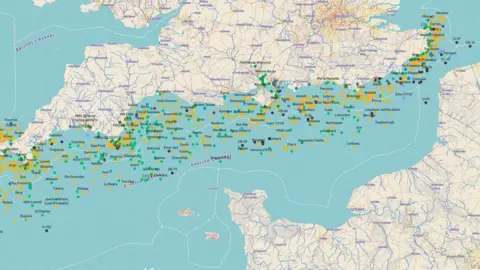
The Maritime Archaeology Trust created a map showing the location of more than 1,100 World War One wrecks off the south coast of England.
The Forgotten Wrecks project allows users to zoom in and learn more about vessels ranging from naval ships to passenger liners and submarines.
 Maritime Archaeology Trust
How are shipwrecks protected?
Many of the south's most significant wrecks are protected under UK law because of their historical and archaeological importance, meaning they cannot be accessed by the public.
There are about 57 designated protected wreck sites in England under the Protection of Wrecks Act 1973, restricting access in order to prevent damage.
Others - particularly military vessels - may also be protected as war graves like the SS Mendi.
This means that, while some wrecks can be explored and viewed, many are carefully managed to ensure their future.