'It's only right that ancient remains were returned for reburial'

 BBC
BBCA thousand years after they were first buried, and eight years after they were found, the remains of nine people have been reinterred.
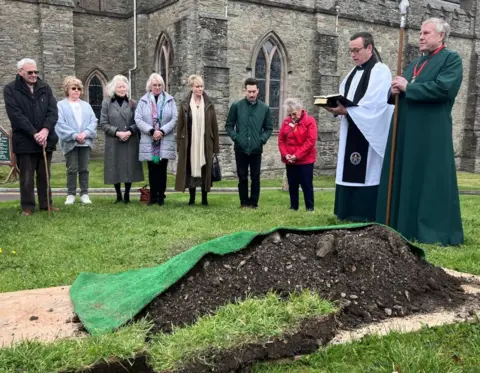
Outside the cathedral, a small grave was dug for the remains of two adults, a young child and six babies to be laid to rest just yards away from what is believed to be the grave of Ireland's three patron saints - Patrick, Brigid and Columba.
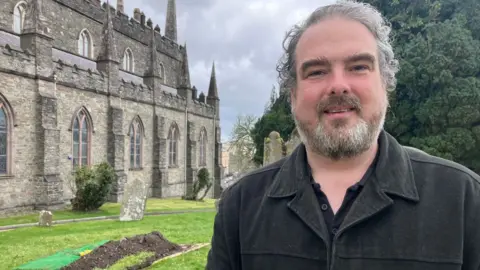
For Queen's University archaeologist Brian Sloan the burial marked the closing of a circle that began eight years ago.
The medieval skeletons were found in the grounds of Down Cathedral in 2018, with the oldest being that of a five or six-year-old child dating back to the 11th Century.
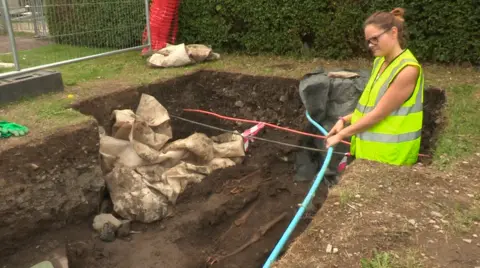
Sloan had been asked by Downpatrick museum to help dig the foundation trench for a high cross in the cathedral's car park.
"That cathedral is such an important site when we consider the archaeology and history of the local area," he said.
"So I came up on that cold, wet February afternoon and started digging the excavation, and it quickly transpired that we were actually on archaeology."
A full dig was carried out that August, uncovering a long forgotten burial ground that gave further insight into what was already a hugely significant site.
"In all we uncovered 14 medieval burials.
"We lifted nine of them because they were in direct danger of being damaged by the foundations of the High Cross," Sloan said.
Those nine remains – two adults, a young child (5-7 years) and six babies were taken back to Queen's University Belfast where they were analysed by Professor Eileen Murphy and her student Lisa White.
"None of them were, what we would call, healthy," Sloan added.
"Every one of the remains had something wrong with them. There was evidence of tuberculosis. There was pectus carinatum or as it's commonly known, pigeon chest, where the sternum kind of projects forward.
"So it's making us think about the cathedral and about the monastic site in a different way. Maybe it was seen during the medieval period as a hospital as well.
"Maybe prayer is medicine, and they came here for some relief."
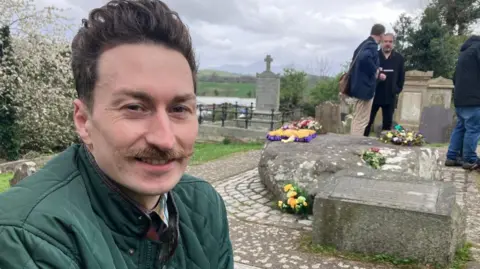
Local historian Duane Fitzsimons said the Cathedral Hill in Downpatrick had "a long and fascinating history" dating back two-and-a-half-thousand years.
"This hill was originally Rath Celtair which if you go back into the Ulster Cycle of mythology – when the Ulaid were pushed further east this is where they centred their kingdom.
"Then the likes of John De Courcy comes in in the 12th Century and he establishes Downpatrick as a really important religious centre.
"What was here seems to have been a hospital, that these people, when they came here were very ill and that being here was part of their treatment or recuperation – but obviously they passed away here."
And there they remained until what had become a small grass verge between the cathedral car park and the new graveyard was dug up in 2018.
This week a special service took place in the cathedral with Dean of Down Revd Henry Blair telling the congregation the remains "represent a half-way stage between us and the time of [St] Patrick."
"Its certainly the most unusual burial I've done in 20 years of ministry," he said. "It's not often we have the interment of bones that have been removed by archaeologists, so it's quite unique.
"We thought that when we were moving them it wouldn't be fitting to put them in the new graveyard but into a graveyard that was from their time.
"I don't think it's possible to comprehend that some of these bones go back to 1000AD."
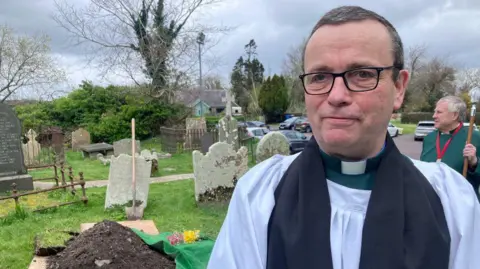
For Brian Sloan the reburial is an opportunity to remember the unremembered.
"We can never put a name to these people, their story had been lost, but now that that story has been told, it's only right that they were returned to the cathedral here today for reburial," he said.
"Now they are in one of the most revered parts of the graveyard and I'd like to think that when people come and visit St Patrick's grave, they'll stop at it for a minute and say a little prayer for these people too."