Veteran who did not talk and slept outside remembered

 Supplied
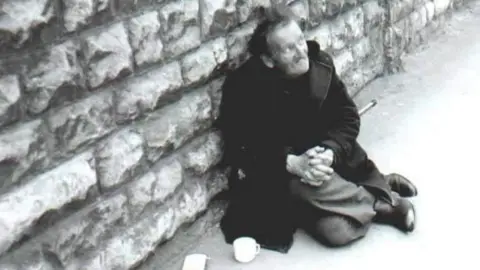
A war veteran who lost his ability to talk and slept on the streets due to a fear of being enclosed has been remembered with a memorial.
William Clements, known as Barton Billy, was captured by the Japanese during World War Two. After his release, his claustrophobia became so severe he could not sleep in his own home in Barton, Gloucester.
He died in 1995, but until Wednesday, when a plaque was laid in Gloucester Old Cemetery in Tredworth, there was nothing to show where his ashes had been scattered.
Author Paul James, who fundraised for a commemorative plaque, said Clements was remembered "fondly" by his peers, who saw him every day and gave him food, drink and company on the streets.
"His experience as a prisoner of war left a long-lasting mark on his life," James said.
"He couldn't bear to be inside, he lost the power of speech."
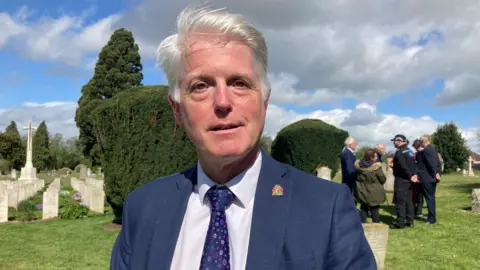
"Lots of people used to see him on a day-to-day basis and the community helped him a lot by giving him food and drink and clothing and even free haircuts," he added.
"Lots of people would remember him fondly. That's why we wanted to make sure we had a visible tangible memory of his life."
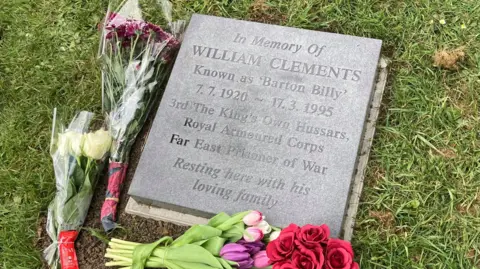
Friends, colleagues from his battallion, police officers and people from the Royal British Legion attended the plaque's unveiling.
Kevin Price, who was a police officer in 1967, said Clements would often sleep in doorways and explained "some people where frightened of him, but he was harmless".
"A lot of them when they came back from the war, they'd been so ill treated," he said.
"The local people took him into their hearts - he became a local character."
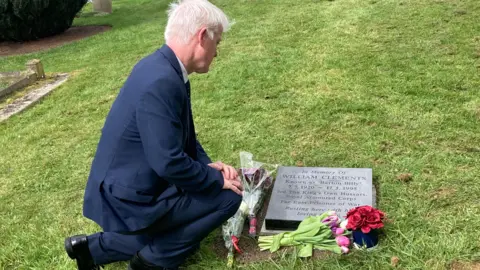
Reverend Pat Gifford, said it was "a huge privilege" to hold the memorial service for him.
"I met Billy long before I went into ministry I've lived in our community for 53 years," she said.
"Many years ago I worked in our local pub. One evening I was there on my own, Billy came in. He sat down, I thought I'd take him over a pint of orange juice.
"When he finished, he got up, walked over to the bar and I wondered what would happen. He put the pint glass down and shook my hand and off he went.
"What I realised that night is it wasn't a drink that he wanted, it was company on his own terms.
"Still today people here look out for each other and look after each other and don't judge and I think it's because of people like Billy we've learnt that over the years."
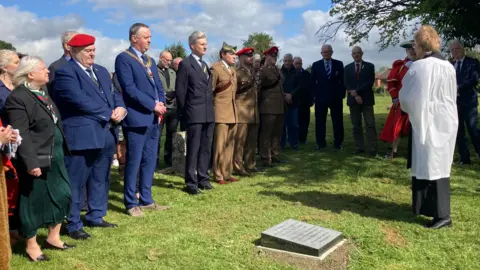
James said it was "remarkable" to see more than 60 individuals donate to the fundraising campaign more than 30 years after his death, with dozens visiting the ceremony.
"As well as people who knew Billy we've had representatives of his regiment, the Royal British legion were here and former police officers.
"I'm sure he would have been very touched," he added.
Follow BBC Gloucestershire on Facebook, X and Instagram. Send your story ideas to us on email or via WhatsApp on 0800 313 4630.