Fuel protests cause 'significant disruption' to travel

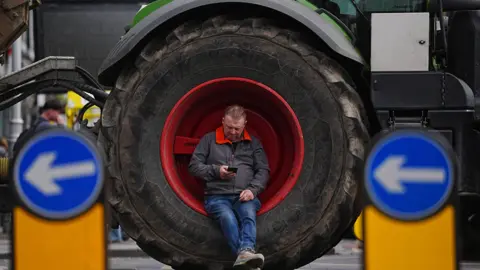 Brian Lawless/PA Wire
Cross-border travel has been affected for the second day in a row by fuel protests in the Republic of Ireland.
Slow-moving convoys protesting against high fuel prices caused by the US and Israeli war against Iran are in Dublin and various locations on main roads leading to the city, as well as near other large urban areas.
Gardaí (Irish police) said O'Connell Street and O'Connell Bridge in Dublin were at a standstill.
Dublin Airport advised passengers to allow extra time for their journey while Translink said cross-border services were subject to delays and disruption.
All of the public transport provider's X1/X2/X3/X4 services will terminate at Dublin Airport until further notice.
There are also a number of delays and diversions to Dublin Express coach services between Dublin and Belfast.
The company advised customers to allow "significant extra time" for their journeys.
The protests started on Tuesday morning.
Allow X content?
An Garda Síochána said although the protests were peaceful, they were "causing significant disruption".
"An Garda Síochána have received reports of emergency workers being delayed or not being able to travel to their work, of people not being able to attend hospital appointments or visit loved ones who are ill," a spokesperson said.
The conflict in the Middle East has caused rapid price rises for both petrol and diesel.
Some 20% of the world's oil trade, the raw ingredient for producing both petrol and diesel, has been halted by the closure of the Strait of Hormuz.
Prices in the Republic of Ireland have surged to about €2.14 (£1.86) a litre for diesel and roughly €1.91 (£1.66) a litre for petrol, with higher prices in some places.
Tánaiste (Irish Deputy Prime Minister) Simon Harris is holding a meeting on Wednesday dedicated to the issue of energy.
'Gardaí have to start taking action'

Fuels for Ireland chief executive Kevin McPartlan expressed disappointment in the Irish government and the An Garda Síochána.
"We were warning officials over the weekend that we felt that this was a possibility and we were assured that measures were in place to ensure that there would be access to and from the fuel depots, that hasn't come to pass," he said.
McPartlan said two out of Fuels for Ireland's five fuel terminals were blocked and his organisation could not operate on its Galway site because of the protesters.
"I think now that Gardaí have to start taking action," he said.
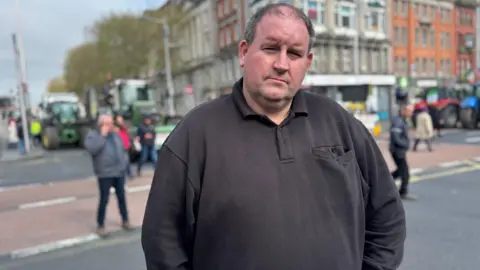
Many protesters slept overnight in their tractors, trucks and bus coaches and some didn't sleep at all.
Agricultural contractor Christopher Duffy from County Meath said his feet and back were sore but he was "feeling strong".
He said he did not sleep "a wink" last night and sat in his tractor.
"Bluntly, in two month's time, I'll be out of business. There is no point putting any gloss on it," he told BBC News NI.
"You can't continue on in business when your costs are going up at this rate.
"The government are blocking up this city and blocking up towns all over this country because they won't make one phone call.
"We have requested a meeting, letters, emails gone in and they haven't even replied.
"One phone call to tell us we have a meeting with government to get the fuel price down, and the city is clear."
 Maelisa McGettigan
Maelisa McGettigan, of McGettigan's Travel, led a convoy out of Letterkenny in County Donegal on Tuesday.
She described the price of fuel as "absolute madness" and said the protesters wanted the Irish government to cap the cost.
Speaking on Radio Foyle's North West Today, she said: "Our overheads have gone through the roof to a point were we're just wondering how we're going to afford to go back after the Easter break."
Taoiseach Micheál Martin said the government did "understand the pressures that people are under", but also said that it was not acceptable to turn O'Connell Street into a car park, RTÉ is reporting.
He said the protests were preventing "people from accessing livelihoods, medical appointments, [and] disrupting day-to-day activities".
Irish Justice Minister Jim O'Callaghan met senior members of An Garda Síochána on Wednesday.
He said while the government respected the right for people to protest, "that right must be exercised lawfully and must respect the rights of others to earn a livelihood or to move freely".
The Dublin Fire Brigade have appealed to all those involved in the protests to ensure emergency vehicles can pass.
A spokesperson said they experienced "significant delays" in their response to emergencies earlier on Wednesday, but the situation had now eased.
"We continue to work with the other emergency services to ensure operational readiness and emergency access, and we ask all involved to be extra vigilant and compliant when they hear emergency sirens approaching."
What roads have been affected by the convoys?
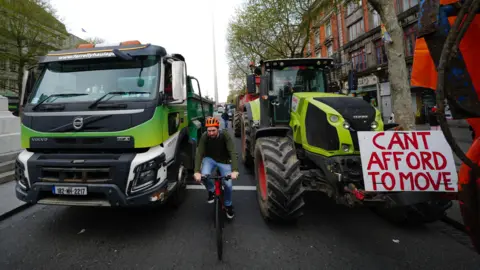 Brian Lawless/PA Wire
Roads the convoys have caused delays on include:
- Dublin city centre (including O'Connell Street, O'Connell Bridge and both the north and south quays)
- County Limerick- N21 from Adare towards Limerick city
- County Limerick- Ballysimon Road
- County Cork- Macroom bypass in both directions
- Galway Docks, Galway city
- County Tipperary- M8 Junctions 6-9 Northbound
- County Cork- M8 Junction 18 Glanmire
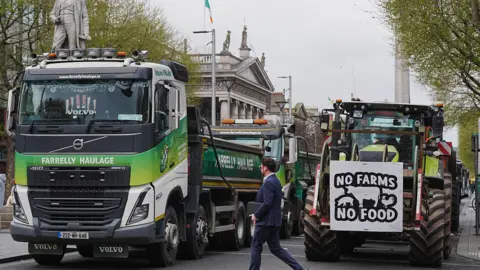 Brian Lawless/PA Wire
Analysis by Gabija Gataveckaite, BBC News NI Dublin Correspondent
Irish government leaders, Taoiseach Micheál Martin and Tánaiste Simon Harris, as well as independent minister of state Seán Canney, are meeting on Wednesday.
However further cost of living measures are unlikely to be announced.
Even though the Irish government is saying all measures are being kept under review, ministers are privately hoping to avoid any further costly measures.
The Irish government has already cut excise duty for petrol and diesel, expanded the fuel allowance for social welfare recipients, suspended the NORA levy and put in place targeted supports for hauliers in a package of measures which cost about €250m (£218m).
But protesters say the impact measures, announced several weeks ago, has already been lost due to rising prices.
Additional help with the cost of living by the government is expected at Budget time, which will be in October.
However, protesters are insistent they want a meeting with the Government for further supports.
Talks are already ongoing between the Irish Road Haulage Association and the government, with the association not taking part in these protests.