US eases sanctions on state-run Venezuelan banks

 Marco Bello / Reuters
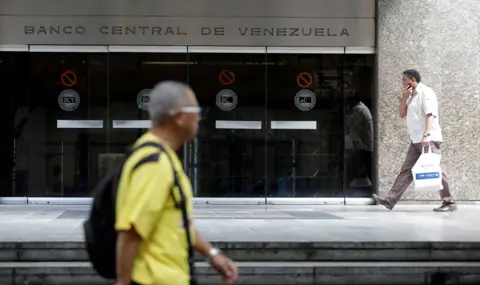
The US has eased sanctions imposed on Venezuela's central bank in the latest sign of improving relations between the Trump administration and the interim Venezuelan government led by Delcy Rodríguez.
The move comes just over three months after US military forces seized Venezuelan leader Nicolás Maduro in a raid in the capital, Caracas, and took him to New York to stand trial on drug trafficking charges.
The US treasury department issued a licence authorising commercial links with the Venezuelan state-run central bank and a number of other major state-run Venezuelan financial institutions.
It means that they will be able to legally use US dollars and re-enter the global financial market.
The sanctions, which had been in place since 2019, had made it very hard for the affected banks to process and move money in the international financial system.
It could also pave the way for the revenue generated by the sale of Venezuelan oil to the US to reach Venezuela.
The change was announced by the US Treasury's Office of Foreign Assets Control (OFAC) in a statement on Tuesday.
Its director, Bradley T Smith, signed two licences which loosen the sanctions on the Central Bank of Venezuela, Banco de Venezuela, Banco Digital de los Trabajadores and Banco del Tesoro.
However, the licences constitute a temporary easing of sanctions, not a complete lifting.
Delcy Rodríguez, who was Maduro's vice-president and who has been serving as interim president since his ouster, has been lobbying for the complete lifting of all US sanctions.
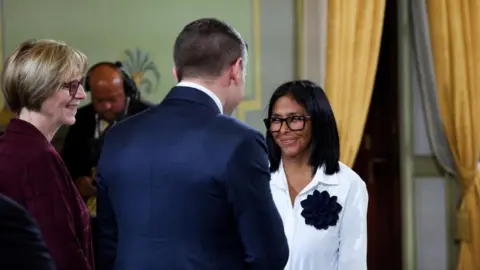
At a meeting in Caracas, Rodríguez told US Assistant Secretary of Energy Kyle Haustveit and the US Chargé d'Affaires in Venezuela, Laura Dogu, that "a licence does not provide legal certainty over time because it is temporary".
 REUTERS/Leonardo Fernandez Viloria
The Trump administration has praised Rodríguez for co-operating with the US, pointing to the fact that under her leadership, Venezuela has opened up its oil and its mining industry to foreign investment.
However, opposition politicians in Venezuela say that the power remains firmly in the hands of Maduro loyalists.
They say that while she has removed some leading Maduro allies from key posts in government, those posts have been filled with people who are close to her, who also happen to be staunch members of Maduro's PSUV party.
Critics say that Rodríguez's appointment of former defence minister Vladimir Padrino as agriculture minister shows that she is merely moving key figures with close links to Maduro to different posts, rather than sidelining them.
General Padrino had held the defence post for more than a decade and had been viewed during his time in office as a major pillar of military support for Maduro.
Writing on social media, Gen Padrino thanked Rodriguez for naming him as agriculture minister, writing that "I am leaving my rifle to take up my plow".
With additional reporting by BBC Monitoring's Pascal Fletcher in Miami.