'Children with maths dyslexia are set up to fail'

 Nathan Turvey/BBC
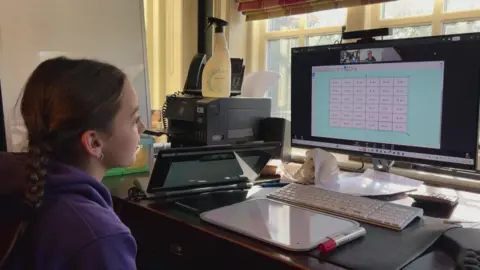
Thousands of children are being "set up to fail" because of a lack of understanding around dyscalculia - or "dyslexia of numbers", according to a North Yorkshire mum.
Lucy McGill, from Bedale, has lived with dyscalculia all her life - and her 11-year-old daughter Ava was formally diagnosed last year.
Dyscalculia, a learning disability that makes it difficult to work with numbers, affects about one in 20 people, according to the Dyscalculia Network.
The Department for Education (DfE) said it aimed to deliver "the most ambitious SEND training programme ever seen in our schools and support staff to adapt teaching to meet a wide range of needs in the classroom".
Ava had a private assessment at a cost of £1,200 because there is currently no government funding available.
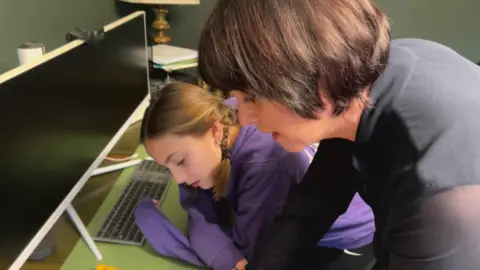
She has also been having some private tuition with a specialist teacher and expert in dyscalculia.
 Nathan Turvey/BBC
Ava described finally having the diagnosis as "life-changing".
She said that beforehand, she felt she was "not part of the clever team".
"I really wanted someone to recognise this condition, it was like something smashed my confidence, that I couldn't deal with anything at all," she said.
Her mum Lucy said: "It does form part of the Equality Act 2010 - yet it's not recognised by the government.
"So I'm just trying to shout as loud as I can - because I'm not having my child struggling like I did, when I had to sit five GCSE maths."
Lucy is also campaigning for children with dyscalculia to be allowed to use calculators and their personal notes or work books, something she described as Ava's "maths bible," in SATs tests and GCSEs.
"For Ava, her working norm is a calculator and work book, they can write their little formulas in there and that needs to follow them throughout life in the school system," Lucy said.
She has raised her concerns about this with her local MP, former Prime Minister Rishi Sunak, because Ava is due to sit her SATs in a few weeks.
Lucy said the only adjustment currently being offered was extra time, despite her dyscalculia diagnosis.
She said many private school students were assessed with calculator-supported IGCSE exams, while state school pupils were often denied the same support and had to sit tests and exams without help.
Lucy described this as "Britain's hidden maths inequality" and said assistive technology support should be "granted immediately".
 Nathan Turvey/BBC
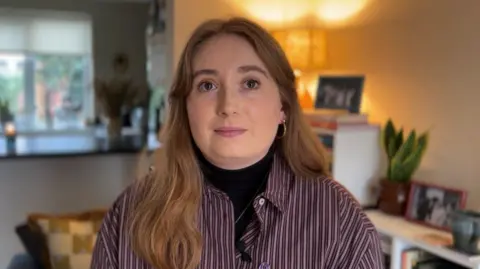
Emily Lynn, from Altofts near Normanton, said she really struggled with maths at school - but was never formally assessed for dyscalculia until last year.
The 31-year-old described getting the official diagnosis as "really healing".
She said: "It confirmed to me that my problem with numbers throughout my entire educational life was because of dyscalculia.
"All I needed was support and I didn't get that support because there was no support available."
'Humiliating and mortifying experience'
Emily said her school years were "a really confusing time" because she excelled in all other subjects.
"I just couldn't - for the life of me - fathom maths," she said.
She remembered how her maths teachers would put her "on the spot" by asking her to do mental arithmetic in front of the whole class.
She said that as a dyscalculic student that was a "really humiliating and mortifying experience".
Despite this, Lynn went on to gain a degree and a PHD - and is now an adult advisory board member at the Dyscalculia Network.
 Nathan Turvey/BBC
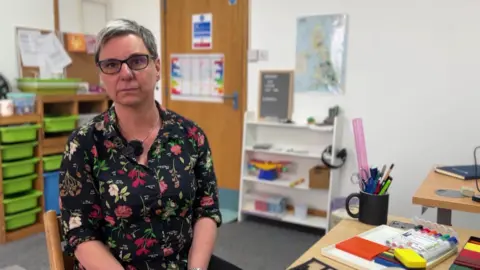
Marijke Walters is based near Rotherham and specialises in teaching and assessing children and adults with dyscalculia.
She agreed it must be taken as seriously as dyslexia.
She said: "Most of the time you'll get: 'Don't worry about it, it's alright, I'm not very good at maths and see where I am.'
"There should be a system where the difficulty gets picked up sooner - and then the help can be put in place a lot earlier."
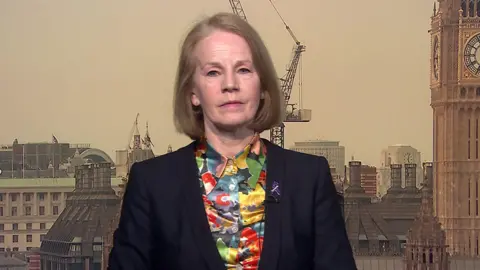
Crossbench member of the House of Lords Baroness Bull has raised dyscalculia in Parliament several times in recent years, and agreed with Lucy that children were being "set up to fail".
The peer said: "There is a lack of reference to dyscalculia in educational policy, in teacher training - and therefore children with dyscalculia, we think it's about 6% of the population, their needs are not being identified and they're not being met, and that ricochets throughout their lifetime."
Last month, Baroness Bull asked the government what steps were being taken to raise awareness of dyscalculia among educators, including special educational needs co-ordinators, and to ensure dyscalculic pupils had specialist support.
She asked ministers why specialist maths teachers were not routinely trained to recognise dyscalculia, and whether the government planned to establish a formal definition.
In response, Labour peer Baroness Blake of Leeds said she accepted "some children face real challenges in maths, particularly those with dyscalculia" - and went on to say the government was supporting schools through its national maths hubs - as well as "improving inclusivity and expertise" in mainstream schools.
However, she said there were currently no plans to introduce a national definition of dyscalculia.
A DfE spokesperson said: "Our once-in-a-generation reforms are overhauling a broken, one-size-fits-all SEND system that has failed children for too long.
"Backed by £4bn to ensure every child gets the right support, in their local school, at the earliest possible stage, without having to fight for it.
"This means children with SEND receive the right support early on as standard, wherever they go to school - so every child can achieve and thrive.
"We're making sure every child is able to achieve and thrive, including by investing £200m to deliver the most ambitious SEND training programme ever seen in our schools and support staff to adapt teaching to meet a wide range of needs in the classroom, as well as £1.8bn to widen access to specialists in every local area."
Listen to highlights from North Yorkshire on BBC Sounds, catch up with the latest episode of Look North.