Woman without a womb helps to deliver her own baby

 BBC
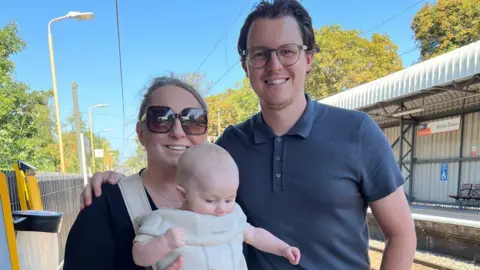
BBCA woman who was born without a womb and told she would not have children of her own went on to help deliver her biological son - who is about to celebrate his first birthday.
Laura Folan from Sutton Coldfield feared she would never have a family after learning as a teenager she had a rare condition called Mayer Rokitansky Küster Hauser syndrome (MRKH).
But thanks to IVF treatment and a surrogate mum, not only did Laura, in her words, "get the gloves on" and "catch" baby George when he was born, she and partner Daniel Clarke are planning for baby number two with the same surrogate.
"It's incredible, it's just the most selfless act," Folan said. "We can't really thank [our surrogate] enough."
She was 16 when she was told she had MRKH, which the NHS says affects one in every 5,000 women.
She visited doctors when her period had not started in puberty and after tests, they found much of her reproductive system was missing.
Medics explained at the time, she said, that she would never carry a child, and her only options to become a mum were adoption or surrogacy, with chances slim it would be her own child who was delivered.
Later examinations seemed to confirm that if surrogacy was the route, it would not involve her eggs.
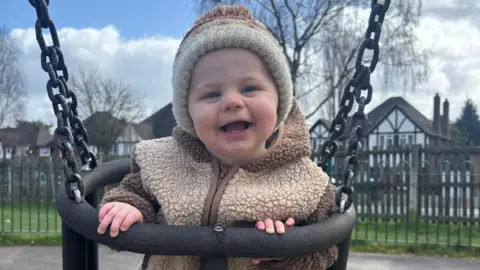
Folan said she had met her partner in 2017 and her MRKH was one of the first things she told him about.
As the relationship progressed over a few years, they sought more information about what starting a family may involve for them.
It was at this point that Folan was told her ovaries were inaccessible, meaning she was never going to be able to produce any eggs.
"That was heartbreaking. It felt like being diagnosed all over again," she remembered.
"It's one thing not being able to carry your own child, but then not being able to have your own biological child felt like a whole new thing to deal with."
But then came a breakthrough.
Initially resigned to the assessment they had been given, the couple joined Surrogacy UK in the hope of finding a surrogate who would be willing to use their own eggs.
But Folan and Clarke learned of an IVF treatment at Liverpool Women's University Hospital that had been successful for women in Folan's position.
She underwent fertility treatment to try to stimulate her ovaries to produce as many eggs as possible. It proved to be successful, although a surrogate would still be needed.
After meeting prospective surrogate Annie Peverelle at an earlier Surrogacy UK event, they got to know each other and Peverelle offered to carry the couple's baby for them.
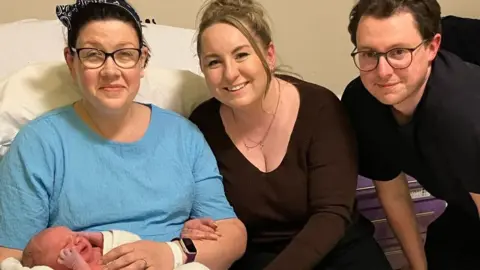
Peverelle, from Rugby, said: "We just really hit it off. It was just amazing getting that positive [pregnancy] test.
"I really love being pregnant... and it was a really easy pregnancy."
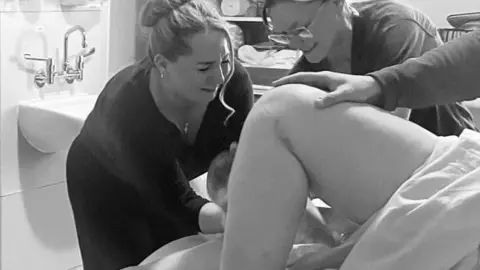
Nine months later an unforgettable moment came as Folan helped to deliver her own baby.
She recalled: "The midwife said, 'come on, put the gloves on, you're going to have a baby now'.
"All of a sudden he just landed in my hands... it was amazing but also quite scary at the same time.
"Then we heard that scream and luckily he hasn't screamed too much since."
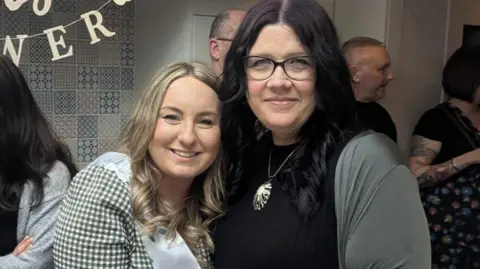
"We can't really thank [Peverelle and her husband] enough…no words can ever describe what we feel about them and what they've done for us," Folan said.
Clarke added: "It's been a journey but an amazing journey and an exciting one for the last year.
"George is an amazing little boy."
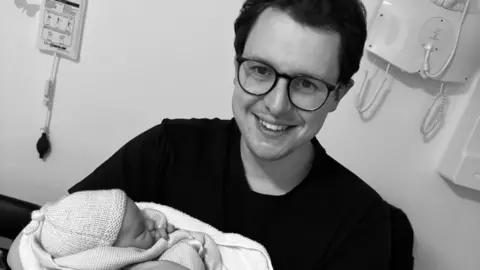
The family of three could soon become a family of four, as Peverelle, 47, who has previously had five babies for other couples, has agreed to carry another baby for them.
"If it all goes to plan they'll be two under three, which will be fun," Folan said.
"Annie is just so amazing to offer to help us again. She's absolutely incredible."
Prof Andrew Drakeley, consultant gynaecologist and subspecialist in reproductive medicine at The Hewitt Fertility Centre under Liverpool Women's NHS Trust, said: "We are quite blessed in our field of work... it is really gratifying to do this part of medicine and the patients are so grateful when it works - it does make it worthwhile [doing the job]."
Follow BBC Birmingham on BBC Sounds, Facebook, X and Instagram.