Can rural communities survive without young people?

 BBC
BBC"The only thing that's growing in many rural communities…are the graveyards."
That's the stark assessment of one rural primary school governor.
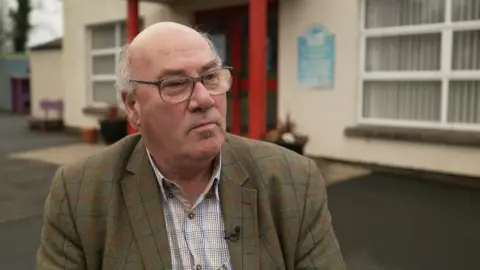
Jim Lennon is chair of the board of governors at the 33-pupil St Joseph's Primary in Caledon, which is earmarked for closure in 2027.
The school is described as the "heartbeat" of the 500-person village. It is set to become one of the more than 40 small primary schools in County Tyrone to have closed their doors over the last 25 years.
The education minister has warned that with a 13% decline expected in enrolments, further closures across Northern Ireland are inevitable.
The birth rate is falling and people are moving away from rural areas.
But those campaigning to save small schools say they are an essential ingredient to the life of a rural community.
"Any viable community needs access to education provision," Lennon said.
"The minute you take that out, you're saying to the population, we don't have a place for young families with children."
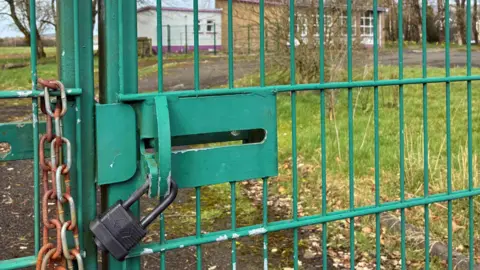
Lennon said rural communities felt let down by Stormont's NI Executive.
"It has a range of policies that have good objectives in themselves,"he said.
"But if you restrict planning because of either a lack of infrastructure or lack of investment or because of a housing in the countryside policy, if you reduce small schools, if you take away post offices, the net effect is you're making it a much less attractive place for young families to set up to sustain rural life."
Northern Ireland's rural affairs minister is currently developing a long-term rural policy.
Lennon's message for Andrew Muir is simple: He wants action.
"There are things that can be done, and they can be done within the current envelope of public expenditure," he said.
"It's just using your imagination."
GAA challenges
In Gaelic football, loyalty to your club and county is everything, but changing demographics have led some of Tyrone's smallest clubs to make some big decisions about the future.
When Derrytresk GAA club got to the All Ireland Junior Club final in 2012, the team included "four or five sets of brothers.
Now, just 14 years later, club chairman Cathal O'Neill says: "If you get one or maybe two from a household you're doing well."
Numbers are so low that many of the club's underage teams have now merged with a neighbouring club.
"Your club is your club and that's who you align to, but there does come a time where you have to say: 'There's not going to be a club in a future years if we don't take drastic action'," O'Neill said.
"The number of young families in the area is dwindling every year. You can't kick the can down the road and hope things are going to change when you know it's not going to change anytime soon."
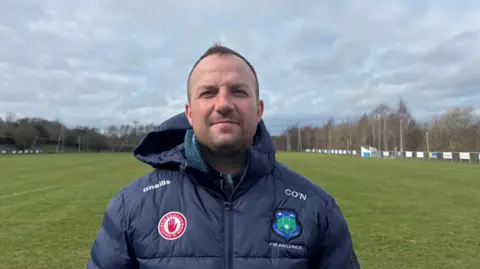
With the club's 125th anniversary on the horizon in 2028, O'Neill said some people were worried for the future - even if they don't say it out loud.
"Anybody would be if they're honest about it. They'd tell you a lie if they weren't. I'm sure there's plenty of clubs in the same shoes."
Fermanagh marching bands
It's a similar picture for those in County Fermanagh.
Simon Wiggins, who represents marching bands there, says: "Historically, there were more bands in this area years ago, some have disappeared completely. Others may help each other out more and more. It really keeps this tight knit community together."
He said many of the young people move to Belfast or Great Britain and never return.
"That's probably because there are opportunities in the big cities, and I feel like these rural areas and border communities are lacking the jobs and opportunities that exist elsewhere.
"People need affordable housing as well.
"If the jobs aren't there and the houses aren't being built, people are not going to choose to live in these rural communities."
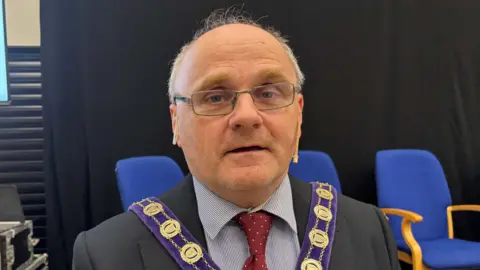
Fermanagh and Omagh District Council has acknowledged rural depopulation as one of the key issues it faces.
Speaking to BBC News NI's The View programme at a rural parliament event in Newtownbutler, council chairperson Barry McElduff put some of the blame on Stormont's planning policies which he described as "too restrictive".
"At the minute, people are finding it almost impossible to secure planning permission in the countryside, and that's something I feel very, very strongly about. There's a cohort of people who are being forced into towns and cities away from the place where they call home.
"I think Stormont needs to respond to that and create more rural friendly planning policy to allow people to live where they were reared and where their identity is very, very strong."
It's a position backed by the local Democratic Unionist Party MLA, Deborah Erskine.
"I always have to shout that little bit louder for a rural constituency, because policies that are created in Belfast are Belfast-centric. The policies and strategies that come out of Stormont sometimes do not actually look at the rural areas in the way that they need to. Stormont needs to do better to support rural communities."
Erskine said rural areas "will be decimated, there won't be any young people" there in 10 years.
"When young people as young as four years of age are not able to go to school within their local communities, what hope and what chance have they got to remain in a small rural town when they reach the age of 30?"
Planning policy is devolved to local councils but the regional policy is set by Stormont's Infrastructure Department, which told BBC News NI: "Within the Local Development Plan framework, councils may tailor their policy approaches, where these are supported by evidence and contribute to achieving an appropriate balance between regional planning objectives, while continuing to support sustainable development."