Harrow Court reopens after three years

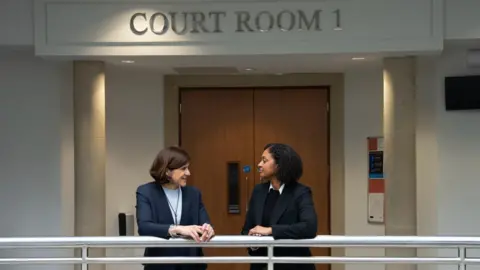 Robert Thom / Ministry of Justice
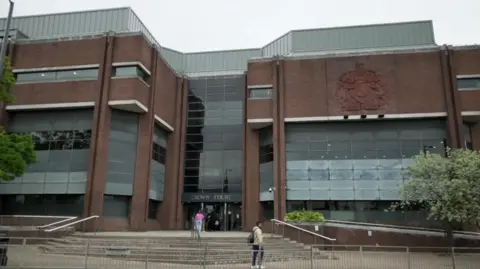
Harrow Crown Court reopened on Monday after closing almost three years ago following the discovery of potentially dangerous concrete.
The building was shut in August 2023 after reinforced autoclaved aerated concrete (RAAC) was found. About £26m has been spent on safety and further improvement works at the court.
At the time, the closure was only expected to last for between six and nine months, but the reopening was delayed several times.
This forced criminal trials to be held elsewhere, adding to pressure on court backlogs which have grown to more than 19,000 in London alone.
Hundreds of cases would usually be heard at Harrow Crown Court each year, but had to instead be held at Hendon and Willesden magistrates' courts and the Crown Courts in Southwark, Wood Green and the Old Bailey.
This has resulted in some victims being told they will have to wait till 2030 for their case to be heard, raising concerns that some may abandon their pursuit of justice as a result.
The Ministry of Justice said the reopening of Harrow Crown Court's eight courtrooms on Monday was a "key milestone" in the government's drive to modernise courts and deliver justice more quickly.
'Shameful' case delays
"When you enter a court it can be really daunting and that's not helped if what you see around you are crumbling estates," a spokesperson said.
"As a government, we are making record investment in court maintenance, in rebuilding courts like this one, and in brand-new courts which we're opening soon in central London, all to transform the citizen's experience of the justice system so that we can have a London justice system fit for the 21st Century."
She said a further £287m would be invested this year to repair and modernise other courts across England and Wales.
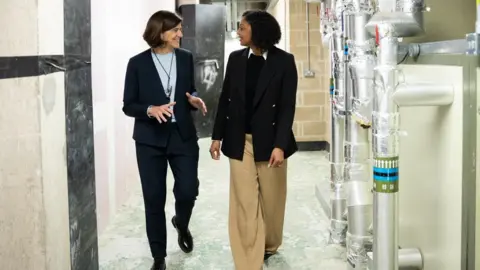 Robert Thom / Ministry of Justice.
During a tour of the Harrow Crown Court this week, Sackman was shown new visual and audio equipment which she said would allow evidence to be viewed digitally, instead of juries potentially being faced with huge bundles of papers.
She said the technology was being rolled out across the Crown Court estate and would make proceedings more "efficient".
When asked what she would say to a victim who had been told they must wait till 2030 to have their case heard, she said that such delays were "absolutely shameful".
"It's why as a government we are pulling every single lever to get those delays down," she said.
London's victims' commissioner Andrea Simon welcomed the reopening of Harrow Crown Court but previously warned of how many Londoners are dropping out of pursuing justice due to long delays.
She said the state of buildings played an important role in how victims felt when they came to court, which could be a daunting or traumatising experience.
"If you have a safe, supportive environment, it will help victims to feel that they are able to give their best evidence when they come to court that will support their case and that will help them to stay engaged in the system.
"I think we are now starting to see the modernisation of our courts, they're making those courts fit for purpose and that is going to help victims to have a better experience," she added.
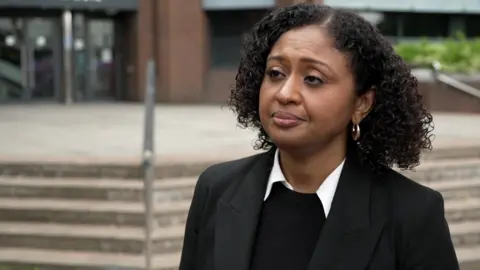
Bob Blackman, Conservative MP for Harrow East, said the reopening was "welcome news" and that the closure had been tough on residents having to travel further afield.
He added: "Obviously there's a huge backlog of cases... and I hope that not only will the court be open but all of the courts will be fully operational going forward."
Riel Karmy-Jones KC, chair of the Criminal Bar Association, said the "state of dilapidation into which it (the court) had been allowed to fall" was the "consequence of successive governments' chronic underfunding of the court infrastructure".
"However, Harrow is not the only court that has suffered, and there are many more that need serious investment and essential repairs to make them safe for all who work and appear in them," she added.
In September, a survey of solicitors by the Law Society highlighted how poor conditions in courts appeared to be adding to delays in cases being heard and called for "sustained investment".
The society found a number of examples of delays caused by disrepair and other issues in court.
One respondent said their client was set for sentence at Harrow Crown Court only to have their case adjourned six times, firstly due to staff sickness, "and then due to a lack of court time/capacity caused by the continued closure of Harrow Crown Court".
The report also said that staff at Snaresbrook Crown Court had been unable to turn the heating off until May, resulting in it becoming "extremely hot and making it difficult to concentrate".
Elsewhere in the capital, a new City of London Law Courts is currently under development in Salisbury Square, which includes 18 courtrooms to be dedicated to economic and cybercrime cases. It is due to open next year.
The Central Criminal Court, better known as the Old Bailey, is also using new strategies to get through the backlog. It is due to begin using two courts to run "blitz hearings", which will see dozens of cases focused on assaults against emergency workers fast-tracked in one day.
Justice Secretary David Lammy has already set out other reforms to tackle the court backlog following recommendations from a review by Sir Brian Leveson.
Listen to the best of BBC Radio London on Sounds and follow BBC London on Facebook, X and Instagram. Send your story ideas to hello.bbclondon@bbc.co.uk