City's gruesome history explored in new podcast

 Hulton Archive via Getty Images
From marauding pirates to man-eating lions, Bristol has no shortage of sinister stories in its history.
Several of them are explored in a new podcast series, called Bristol: It's Criminal, organised by members of a theatre troupe who tell the stories out on the streets of the city.
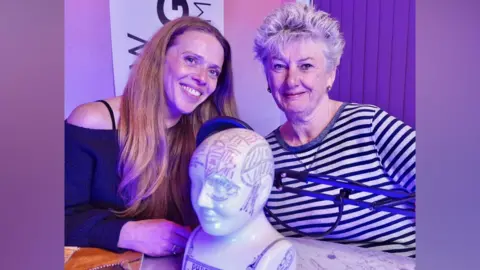
"Isn't life extraordinary? Aren't people extraordinary? Bristol has amazing stories that people might not know," said creator Sheila Hannon from Show of Strength Theatre Company.
The podcast examines some of the city's best‑known macabre legends, as well as lesser‑told episodes. Here are three of the stories featured.
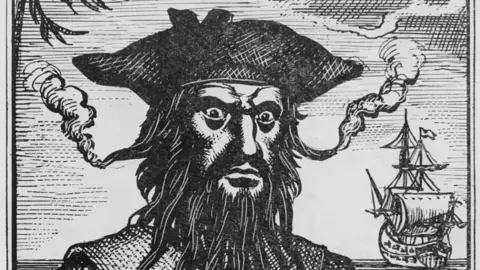
The notorious pirate Blackbeard
 Sheila Hannon
Arguably one of the most well-known pirates, Blackbeard was born in Bristol, but the details of his life are contested.
"It's fascinating how he was portrayed in drawings with the immense hair and beard," said Ms Hannon.
"He's said to have put gunpowder in his beard and set it on fire when he boarded a ship, it was like he was the devil, but there's not much evidence of him actually killing people before his final battle.
"There are stories that he lived in Redcliffe, but the house he was said to have lived in was built in 1718, the year he died."
The legend forms an important part of the Blackbeard to Banksy tour, run by Luke Sargeant, which attracts about 12,000 visitors each year.
"It's important to Bristol history to celebrate him," he said.
"The tour highlights two renegades who went against the grain, and when you frame that into what happened with various riots over the centuries, even up to the Colston statue going in the harbour, it's all ingrained in Bristol's culture."
According to the Royal Maritime Museum, Blackbeard died in 1718, when the HMS Pearl tracked his ship down.
His head was put on a stake at Chesapeake Bay, and several members of his crew were hanged.
The man whose skin became a book binding
 Alan Bryant
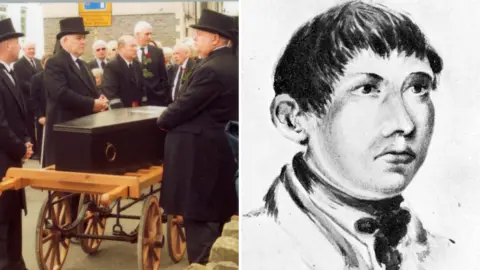
In 1821, John Horwood became the first man to be hanged at the Bristol New Gaol, seen by an estimated 40,000 people.
He was tried and convicted for the murder of Eliza Balsum, an older girl with whom he had became infatuated, and had threatened to kill.
Horwood was accused of throwing a stone which hit her head, eventually leading to her death.
The prosecution attempted to use phrenology, or measuring skull shapes, to prove Horwood's guilt.
After his death, his body was dissected by the surgeon who testified against him at his trial, Dr Richard Smith.
Horwood's skin was used to bind a book containing details of his trial, and his skeleton was left hanging in a cupboard at Bristol University with a noose around its neck.
The Kingswood Heritage Museum now owns the cabinet that the skeleton hung in.
Joint curator Alan Bryant said: "It's so tragic, because two people died.
"It's one of the really rich stories from the area, and although it's a gory story, when people come to visit the museum, they can't believe it.
"Dr Smith is the criminal in this for taking the skin off the body.
"He boasted that he was a grave robber and kept part of Eliza's skull in his cabinet of curiosities," he added.
The lion in the pub beer garden
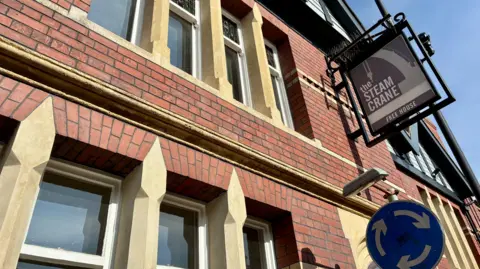
In 1827, a travelling zoo was touring Bristol.
"Mr Rochester's Caravan of Wild Beasts was playing at The Bull pub, now called the Steam Crane," said Hannon.
A new assistant, Joseph Kiddle, had just started work with the zoo, when a group of visitors arrived to see Nero, the lion, who was then asleep.
As they had paid money to see the animal do more than just sleep, Mr Kiddle entered the cage, and "he didn't come out in one piece," said Ms Hannon.
"Health and safety was very different in 1827, and it took a long time before they could get the lion off him.
"There are tales of a blacksmith arriving with a red hot iron and it still took a while.
"Nevertheless, according to the newspapers, Mr Rochester's Caravan of Wild Beasts reopened the very next day."
Follow BBC Bristol on Facebook, X and Instagram. Send your story ideas to us on email or via WhatsApp on 0800 313 4630.