Why ceasefire deal with US has unsettled Iran's hardliners

 EPA
EPAOnly days ago, Islamic Republic hardliners running the city of Tehran put up a gigantic banner at one of the busiest intersections in the Iranian capital.
"The Strait of Hormuz will remain closed," it declared.
This was meant to signal an edict from Iran's new Supreme Leader, Mojtaba Khamenei, who has not been seen in public since being named leader last month.
But that banner may now have to be taken down after Iran agreed to a two-week ceasefire and the reopening of the Strait as requested by Pakistan, which has been mediating between the US and Iran.
That is despite Iran repeatedly saying it would not agree to a temporary ceasefire and that it wanted a permanent end to the US and Israeli war on Iran.
The hardliners are not happy. They have been emboldened by Iran's ability to close the Strait and cause havoc to countries in the Gulf with missiles and drones - maintaining that Iran should have continued the war as it had the upper hand against the US and Israel.
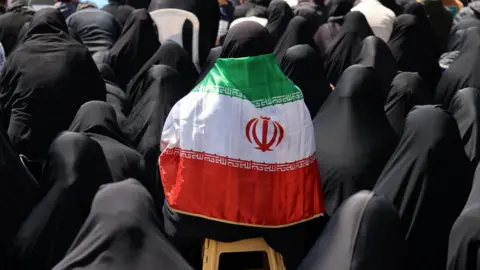
Reports from Tehran said they set fire to US and Israeli flags after the announcement of the ceasefire agreement on Tuesday.
A group of men from the Basij volunteer militia, which is controlled by the Islamic Revolutionary Guard Corps (IRGC), marched to the foreign ministry in the middle of the night to oppose the decision.
A few hours later, the editor of the hardline newspaper Kayhan wrote that agreeing to the ceasefire was "a gift to the enemy", allowing it to restock and continue the war.
The decision to accept the request from Pakistani Prime Minister Shehbaz Sharif and his army chief was made by the Supreme National Security Council (SNSC) - Iran's country's highest decision-making body under the supreme leader, which is headed by moderate President Masoud Pezeshkian.
The SNSC declared that safe passage would be possible through the Strait of Hormuz for a period of two weeks in return for a ceasefire from the US and Israel, while Washington and Tehran engaged in talks.
Reports say China played a significant role in convincing Iran, its close ally, to agree to Pakistan's request.
Temporary relief?
 AFP via Getty Images
Iran has suffered a great deal of destruction in the 40-day war.
More than 3,000 people have been killed, human rights activists say, and US President Donald Trump had threatened further deaths and destruction on an even greater scale.
Even among the hardliners, it was becoming clear that a way out had to be found before Iran's critical infrastructure was further destroyed.
Only hours before the announcement of the ceasefire, the hardline Chief Justice, Gholamhossein Mohseni Ejei, told Iranian state TV that Iran was seeking an end to the war while still maintaining an upper hand.
He was broadly repeating what the country's former foreign minister Mohammad Javad Zarif, a moderate, had written a few days earlier in an article in the US publication Foreign Affairs.
The SNSC has portrayed the ceasefire agreement as a victory for Iran, calling on regime supporters to remain united.
According to Iranian media, the Speaker of Parliament, Mohammad Bagher Ghalibaf, is to lead the Iranian delegation in talks with the US in Islamabad, directly negotiating with US Vice President JD Vance.
This is another departure from the hardline script. Direct negotiations with the US had always been banned by the former Supreme Leader, Ayatollah Ali Khamenei, who was killed in an Israeli strike on his home at the outset of the war.
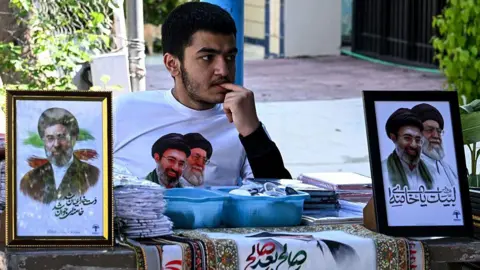
This direct contact appears to have been sanctioned by the new leader, who is his son.
Despite the ceasefire, Iran and the US remain far from a lasting peace.
The war could resume if the talks break down. That is a prospect some Iranians who supported the war, seeing it as a way to remove what they consider a vile regime, may be hoping for.
For many others, the ceasefire offers much needed relief from the death and destruction around them.