JD Vance to lead US team in talks with Iran in Pakistan
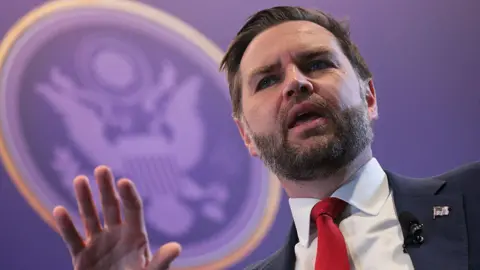
US Vice President JD Vance will lead a delegation in talks with Iran in Pakistan beginning on 11 April, according to White House Press Secretary Karoline Leavitt.
In a briefing for reporters, Leavitt said the ceasefire between the US and Iran has created an "opening" that could be the start of a long-lasting peace in the region.
But details on the various peace proposals which will be discussed remain murky, as is the current state of shipping traffic through the strategically vital Strait of Hormuz.
Earlier, Iranian forces warned ships in the area that they would be "destroyed" if they attempted to pass through without permission.
Leavitt, however, said that what Iran is saying publicly is "different privately".
During the relatively short briefing at the White House on Wednesday, Leavitt declared an American "victory". Leavitt said the primary military goals of Operation Epic Fury - including the destruction of Iran's navy, drone and ballistic missile programmes - were achieved.
With the ceasefire in place, Vance, along with special envoy Steve Witkoff and Jared Kushner, will head to Pakistan for in-person negotiations with their Iranian counterparts.
The details of those talks and the exact proposals being discussed remain unclear.

 Getty Images
Leavitt described media reports of a 10-point Iranian proposal as inaccurate, adding that an initial "fundamentally unserious" Iranian proposal was discarded. Tehran offered a "modified" proposal in response to Trump's vow that a "whole civilization will die" if a deal was not reached, Leavitt said.
"The idea that President Trump would ever accept an Iranian wish list as a deal is completely absurd," she said.
Additionally, Leavitt told reporters that Iran agreed to open the Strait of Hormuz, despite Iran's warning to ships passing through the area.
Asked about the apparent disconnect between the White House's triumphant statement and the Iranian message to ships, Leavitt said that Trump will hold Iran "accountable" and that he expects the Strait opened "quickly and safely".
The ceasefire announcement on Tuesday came just hours after Trump posted a message on Truth Social vowing that Iran's "civilization will die" unless it agreed to a deal to end the war and unblock the Strait of Hormuz.
The message drew critics from both sides of the US political spectrum and prompted concerns about the humanitarian impact of widened US strikes on Iranian infrastructure.
Leavitt defended the president's comments, saying he retains the "moral high ground" over Iran's "rogue regime".
"His very tough rhetoric and his tough negotiating style is what has led to the result you are all witnessing today," she said.
The US president is scheduled to meet with Nato Secretary-General Mark Rutte later on Wednesday.
Leavitt said it would be a "very frank and candid conversation" at a time of increasing tensions between the alliance and its most powerful member state.
Trump has repeatedly criticised Nato, saying it did not come to America's aid during the Iran conflict or help re-open the Strait of Hormuz.
"Nato was tested and they failed," Leavitt said, directly quoting a letter from President Trump.
Leavitt added that Trump has "discussed" the possibility of leaving Nato, although she did not provide any further details.
Trump has previously said several Nato allies told him that they do not want to get involved in the war, a conflict many of them view as unnecessary.
Trump's relationship with Nato soured even before the conflict in Iran had broken out, partly as a result of disagreements over the fate of Greenland, a Danish territory that Trump has set his sights upon despite vocal protests from European allies.