Experts dispute US account of deadly Iran sports hall strike in Lamerd

 BBC
BBCMultiple weapons experts have disputed a US claim that Iran may have been responsible for a deadly strike on the town of Lamerd on the first day of the war.
Six experts - who examined footage of the strike and all commented independently - contested the US suggestion that it was an Iranian missile, citing the missile's visual features, the way it exploded, its trajectory and the number of strikes in the area as the basis for their analysis.
Iranian officials have said 21 people, including four children, were killed.
BBC Verify originally reported on the strikes on 28 March, citing experts who said it was likely a US Precision Strike Missile (PrSM) was used. The US Central Command (Centcom) - which oversees US military operations in the Middle East - declined to comment for that report.
Centcom then released a statement on 31 March denying it was a US missile, instead saying that footage of the attack was consistent with an Iranian Hoveyzeh cruise missile.
"US forces do not target civilians, unlike the Iranian regime which has attacked civilian locations in neighboring countries more than 300 times," the statement added.
When BBC Verify went back to Centcom with the experts' analysis, it said it had "nothing to add" to its original statement.
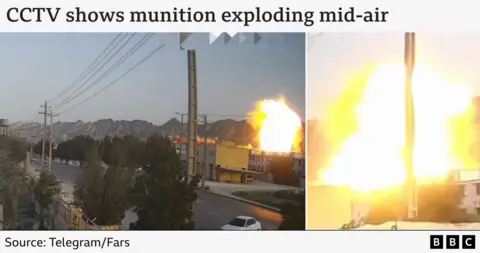
Lamerd, a town in southern Iran, came under attack on 28 February. CCTV footage published by Iranian state media - which was authenticated and geolocated by BBC Verify - showed a munition moments before it exploded above a residential area. Experts identified it as likely being a US missile, based on its appearance, the size of the blast and the distance from potential US launch sites in the Middle East.
In BBC Verify's initial report, three analysts at the defence intelligence company Janes and an expert at McKenzie Intelligence all said the missile seen in the footage was likely a PrSM - a brand new missile manufactured by Lockheed Martin for the US military.
A New York Times report also found that a PrSM likely hit Lamerd.
On Tuesday US Navy Capt Tim Hawkins said in the statement: "After looking into the reports, U.S. Central Command has confirmed the accusations are false."
"U.S. forces did not launch any strikes at any time into the city of Lamerd or anywhere within 30 miles during the opening day of Operation Epic Fury," adding that it "does not show a Precision Strike Missile (PrSM)".
"The munition depicted in the video appears to be twice as long, consistent with the dimensions and silhouette of an Iranian Hoveyzeh cruise missile," Capt Hawkins said.
Multiple weapons experts have disputed Centcom's claims, noting the Hoveyzeh has a number of distinctive features which they say are not visible in the Lamerd strike footage.
On the same day nearly 400km east, strikes hit an Iranian school and a nearby military base in Minab, killing 168 people according to Iranian officials. Expert video analysis suggests a US Tomahawk missile struck the military compound.
US Defence Secretary Pete Hegseth said the incident was under investigation, adding that US forces "never target civilian targets".
PrSM vs Hoveyzeh missile
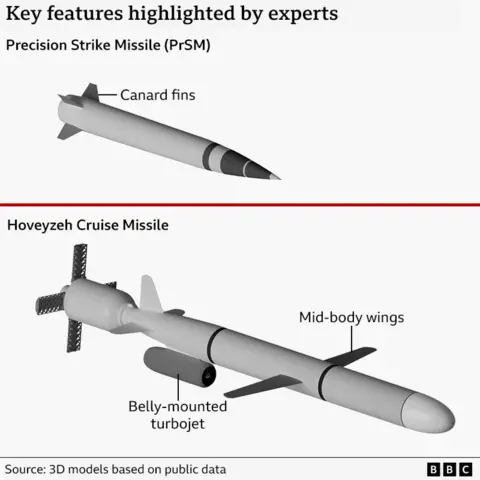
Amael Kotlarski, a weapons analyst at Janes - a defence intelligence company - said that the Hoveyzeh missile has a belly-mounted turbojet and a pair of mid-body wings.
"Crucially, no matter the angle from which the missile is viewed from, the wings and the turbo jet would be visible. None of that is clearly distinguishable from the footage," he said.
Another munitions expert from McKenzie Intelligence also said the missile seen in the video had no wings or external engine. They said that distinctive "canard fins", consistent with a PrSM, are visible in the footage.
"I remain convinced that the weapon seen is a PrSM and not a Iranian Hoveyzeh Cruise Missile - the two are vastly different in appearance," they added.
Trevor Ball, a weapons expert with the investigative outlet Bellingcat said in a post on X that the length of the missile was "much more consistent with the PrSM" than a Hoveyzeh missile.
"The Hoveyzeh silhouette is also much different, with wings and a visible engine depending on angle," he added.
Airburst warhead
In the verified CCTV footage, the munition appears to explode mid-air above a Lamerd residential area. Experts say this is consistent with the airburst feature of a PrSM, where a weapon explodes above the ground to disperse fragments over a wider area, which is seen in some technologically advanced missiles.
Despite the footage being low resolution, a mid-air explosion is clearly visible. Experts say this is not a known capability of the Hoveyzeh missile.
The manufacturer, Lockheed Martin, describes the PrSM as an "optimized warhead" which contains pre-formed fragments that explode outwards. This, it says, "increases lethality" and "maximizes area effects".
Intelligence expert and ex-National Crime Agency (NCA) investigator Chris Proops said the mid-air explosion was more consistent with a PrSM than any Iranian cruise missile currently in service.
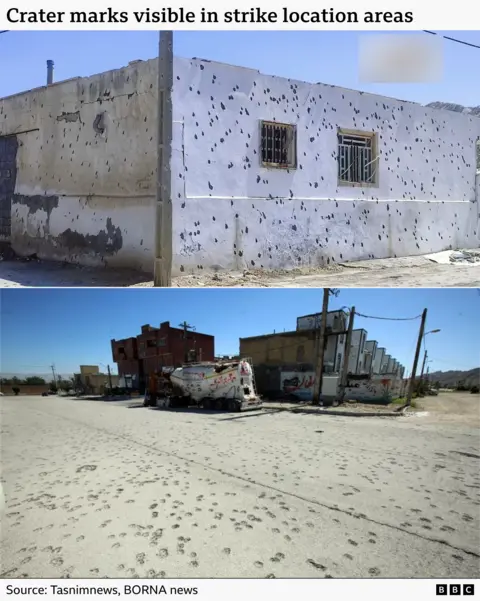
Images taken after the strike further support the assessment that an airburst munition was used. It shows the walls and ground covered by small tightly-packed impact marks which match the spread of fragments from an airburst warhead like a PrSM, according to expert analysis.
"Those pock marks are witness marks of a fragmentation munition," an analyst from McKenzie Intelligence said.
Kotlarski from Janes added: "To put it simply, the warhead behaviour and effect from the Lamerd strike displays a level of technical sophistication that we have not observed, so far, from any Iranian cruise or ballistic missile."
He said that while there is "little solid data" on the Hoveyzeh's warhead, it is thought to use a more "primitive" impact-fuzed high-explosive warhead, meaning it would detonate on or after hitting a target.
The three verified strikes
Since our initial investigation, BBC Verify has confirmed additional footage that shows there were three separate strikes on a sports hall, a residential area and near an educational centre in Lamerd that day.
"While it is feasible that an Iranian cruise missile could malfunction, it is a bit beyond credulity to have a number of them fail above the same location at the same time," said an analyst from McKenzie Intelligence.
Experts also say the munition in the verified CCTV footage does not appear to be damaged, malfunctioning or intercepted.
N R Jenzen Jones, director of Armament Research Services, said although it's difficult to positively identify the munition, "it appears to be correctly aligned for the terminal phase of its flight".
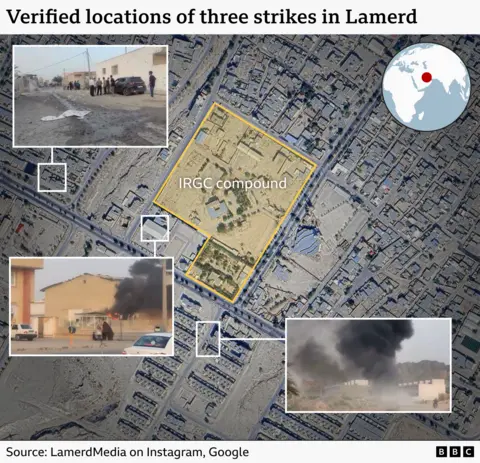
Newly published footage, shared by pro-government local media and confirmed by BBC Verify, shows that a small primary school which is located next to the sports hall was also damaged.
Debris and warped metal which may be munition fragments can also be seen on a street in the residential area. But multiple experts BBC Verify spoke to could not identify the fragments.
The intended target on the day may have been an Islamic Revolutionary Guard Corps (IRGC) compound adjacent to the sports hall. BBC Verify has reviewed dozens of photos and videos of the aftermath of the strike and has not yet seen any on-the-ground footage of the IRGC base after the attack. The base also appeared to be undamaged in high-resolution satellite imagery on 9 March.
Centcom's statement says US forces did not launch any strikes at any time into the city of Lamerd or anywhere within 30 miles during the opening day of Operation Epic Fury.
But the US Department of Defense has previously posted an illustrative map captioned "First 100 hours" of the US-Israeli war with Iran, marking the locations of US-Israeli strikes and Iranian air defences along Iran's southern coast, including the area around Lamerd.
The Israel Defense Forces (IDF) also told BBC Verify that it was not aware of any Israeli strikes in that part of Lamerd on 28 February.
BBC Verify asked Centcom for further details about its assessment of what happened in Lamerd, but it did not provide any additional information.
Additional reporting by Peter Mwai and Matt Murphy.
