'This has got me worried': Iranians fear what comes next after US strike on Karaj bridge

 WANA via REUTERS
US President Donald Trump has warned Iran that there will be strikes on its bridges and electric power plants if its leaders do not agree to his terms to end the war.
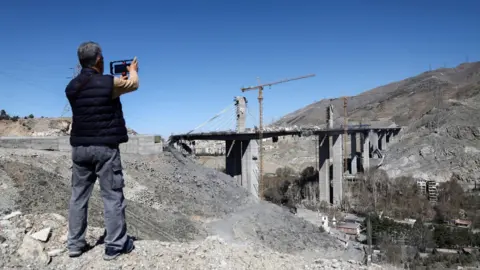
It came after Iranian media said eight people were killed and almost 100 injured when a bridge under construction in the city of Karaj, west of Tehran, was bombed on Thursday.
Many people had been picnicking near the B1 suspension bridge for the 13th day of the Nowruz holidays when it was targeted twice by US warplanes.
"Our Military, the greatest and most powerful (by far!) anywhere in the World, hasn't even started destroying what's left in Iran," Trump wrote on Truth Social.
"New Regime leadership knows what has to be done, and has to be done, FAST!"
However, Iranian Foreign Minister Abbas Araghchi said on his X account that "striking civilian structures, including unfinished bridges, will not compel Iranians to surrender".
He declared that the strike on the bridge "only conveys the defeat and moral collapse of an enemy in disarray", and that "damage to America's standing" would "never recover".
Araghchi also responded separately to Trump's earlier vow to bomb Iran "back to the stone ages", asking whether the president was sure he wanted to "turn back the clock" to a time when "there was no oil or gas being pumped in the Middle East".
It is still very difficult to contact people inside Iran amid the internet blackout imposed by Iranian authorities, which has now entered day 35.
However, some people have managed to connect using satellite internet systems such as Starlink and other methods, though it comes at a high cost. Using or possessing Starlink can lead to up to two years in prison.
All of those who spoke to BBC Persian from inside Iran were against the current establishment.
A woman in her 20s in Tehran expressed deep concern about the attack on a bridge in Karaj and what might be targeted next. She started crying midway through the voice message.
"I feel helpless. [Trump] posts shamelessly about attacking our bridge. I don't know how much further this is going to go," she said.
"Why is no-one standing up to him? He's really taking us back to the Stone Age."
A Tehran resident in his 20s said: "We'll end up with a ruined country. I am more disappointed and saddened that I am in the middle of a situation where I see Iran being destroyed and I can't do anything. My country is being destroyed more and more every day."
The strike on the bridge in Karaj also worried one local resident who described himself as "pro-war".
"That bridge could have reduced the traffic in the city... it was destroyed in the second strike. This strike has got me worried. I don't know why they hit it," said the man in his 20s.
A woman in her 40s in Tehran, who also supports the US-Israeli military campaign, said: "I was really surprised that they hit a bridge… but I think they must have a reason for it."
The strike in Karaj and Trump's comments were also condemned by hardline, pro-establishment Iranians on social media.
Many demanded that Iran's armed forces retaliate by targeting bridges in neighbouring countries with US bases.
Others warned that the strike on the bridge was another sign that the goal of the US and Israel was the "destruction of Iran" rather than its military assets.
The BBC understands that some officials, pro-establishment users, and journalists still have access to the internet despite the ongoing blackout.