Teachers vow to 'fight censorship' after school book row
 Getty Images
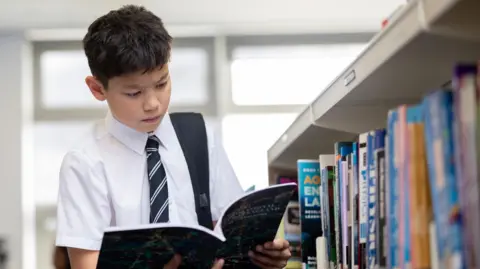
Teachers say they will "fight censorship" of books in school libraries in order to promote "intellectual freedom and children's rights".
The National Education Union (NEU) said school librarians had reported "internal and external censorship".
Its members voted to oppose any censorship as part of a "fight against the far right" during its annual conference in Brighton.
It comes after reports that books were removed from a school library in Salford at the end of last year, resulting in a librarian resigning.
One librarian told the NEU's conference she had heard several accounts from colleagues who were "having to take art books off the shelves because they have historic paintings and sculptures of nudes".
"Literature is an art form, and we need to be making sure that we're not eroding it and we're not censoring it," she said.
Daniel Kebede, the union's general secretary, said "any move to censor books in school libraries, based on misinformation and fearmongering, should ring alarm bells".
"Children's access to a wide range of literature is a fundamental good that the NEU is proud to defend," he said.
He said there have been examples of countries, including the US and Hungary, which have banned books in schools and have primarily targeted books by women, black people and LGBT authors.
"The NEU is clear this is not a path we are prepared to follow in the UK."
The union said it would work with other organisations to "develop a toolkit for librarians" and "fight censorship as part of our fight against the far right".
It comes after the Index on Censorship reported that a school in Salford, subsequently named as the Lowry Academy, had removed books containing "inappropriate content" from its library. It said they included Nineteen Eighty-Four by George Orwell and Twilight by Stephenie Meyer.
The organisation reported that the librarian was "threatened with disciplinary action" and resigned.
The school said it had not "banned" any books but had carried out an "audit" after "concerns that a number of books within the library were neither age nor content appropriate".
"Following this, books have been placed into age-appropriate categories and returned to the shelves," it said in a statement.
"A very small number of books were deemed inappropriate even for older children due to their content and have been removed."
Research from University College London last year found that "book-banning and censorship attempts are becoming increasingly prominent within UK school libraries".
Victoria Dilly, CEO of the School Library Association, said there had been a "small increase" in enquiries from members "about issues of censorship, particularly relating to age-appropriateness and collection management".
She said she would like a "clear framework for handling any concerns about specific titles".