Village at the heart of the race for longitude

 Neil Hall/EPA/Shutterstock
His inventions shaped the world as we know it – and famously made Del Boy rich.
Carpenter and clock-maker John Harrison died 250 years ago in March 1776, on his 83rd birthday.
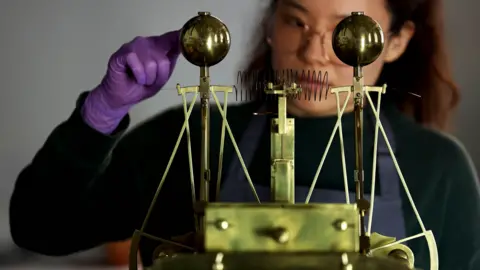
He is known today for the marine chronometer, a device that solved the age-old problem of calculating longitude – how far east or west a ship is – while at sea.
It helped to transform navigation and led to safer and faster voyages across the oceans.
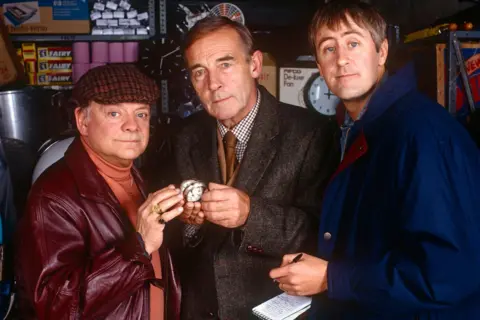
And for a generation of TV viewers, Harrison's work was the device that finally made the Trotters millionaires in Only Fools and Horses, when Del and Rodney sold one of his long-lost timepieces at auction, in the 1996 episode Time on Our Hands.
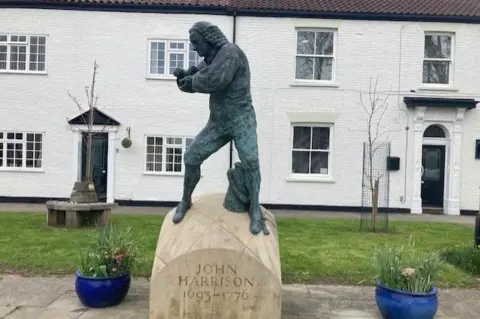
In Barrow-on-Humber, North Lincolnshire, a statue of Harrison stands in the marketplace, near the remains of the wall of his workshop. Nearby, a real ale pub is, predictably, called Harrison's.
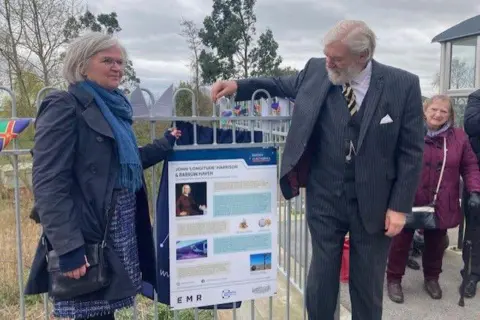
The latest tribute to the village's most famous son is a plaque at the railway station, which commemorates his life and work.
It was unveiled on Tuesday by Howard Boyd, a sculptor and Harrison enthusiast who lives locally.
"I was absolutely fascinated by this man," Boyd tells the Secret Lincolnshire podcast. "He was quite a metallurgist.
"An absolute, an utter genius."
The 18th-Century search for ways to calculate longitude at sea captivated the nation.
The complex conundrum baffled scientists as they attempted to accurately measure exact points east and west from a fixed meridian line.
For decades from 1714, experts and enthusiasts submitted their ideas to the Board of Longitude in the hope of winning a £20,000 prize - worth about £3.5m in today's money.
The son of a carpenter, Harrison was born in Nostell, near Wakefield, in 1693. His family moved to Barrow when he was a small boy.
He spent his early years creating clocks entirely from wood. Later, Harrison realised that the solution to calculating longitude was creating a reliable clock that could keep the time of a reference place, such as Greenwich, and provide an accurate local time.
He created his first marine timekeeper, the H1, in 1735 and it was tested in the Humber Estuary off Barrow Haven. By 1759, he had developed the watch that won the Longitude prize.
But despite his genius, Harrison was known as a difficult character to deal with, Boyd says.
"He was a bit of a rascal, you know, he was an irascible man.
"He was very awkward in his dealings with the Board of Longitude. He had no patience with them at all and he said as he thought, which didn't go down very well."
Fortunately, his son, William, took over negotiations with the board.
"He was awarded half the prize," Boyd explains. "The other half was withheld."
It wasn't until William appealed to the king, himself a keen amateur clock-maker, that Harrison received the rest of the prize.
Incredibly, Harrison is not only credited with the life-saving marine chronometer.
While developing the watch in Barrow, he needed to find a way for its workings to be unaffected by variations in temperature and for it to function on board a constantly moving ship. That meant inventing the bimetallic strip, which is now used in hundreds of devices, including thermostats, fire safety devices and the humble kettle.
Harrison is also credited with inventing the caged roller bearing for his "sea watch", which has gone on to become an important element in modern machinery.
So what would the modern world make of Harrison, a man who did so much to create it?
"Well, he's a very crabby old fellow," says Boyd, 81. "I mean, cranky, I'm getting that way myself.
"Where would he have been? He would have been into technology and everything else, but his precision and his draftsmanship were incredible, it's perfect for his time."
And given what he invented, what would the world be like without him?
"Where would the Industrial Revolution be without those inventions?
"We owe him a lot and, in my opinion, he ought to be on a plinth in Trafalgar Square."
Listen to highlights from Lincolnshire on BBC Sounds, watch the latest episode of Look North.
Download the BBC News app from the App Store for iPhone and iPad or Google Play for Android devices