Everything you need to know about Nasa's Artemis II mission

 NASA
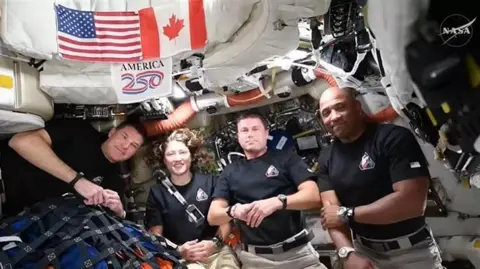
NASAThe Artemis II astronauts are on the final leg of their journey home after conducting a historic lunar fly-by, which took them further from Earth than any humans have ever been.
As planned, the four-person crew did not land on the Moon but their mission sets the stage for a future human landing for the first time since the 1960s and 70s.
The astronauts are due to splashdown in the Pacific Ocean off the west coast of the US at 20:07 eastern US time on Friday 10 April (01:07 BST Saturday 11 April).
What happened during the Artemis II launch?
The Orion space capsule is crewed by four astronauts: Americans Reid Wiseman, Victor Glover, Christina Koch and Canadian Jeremy Hansen.
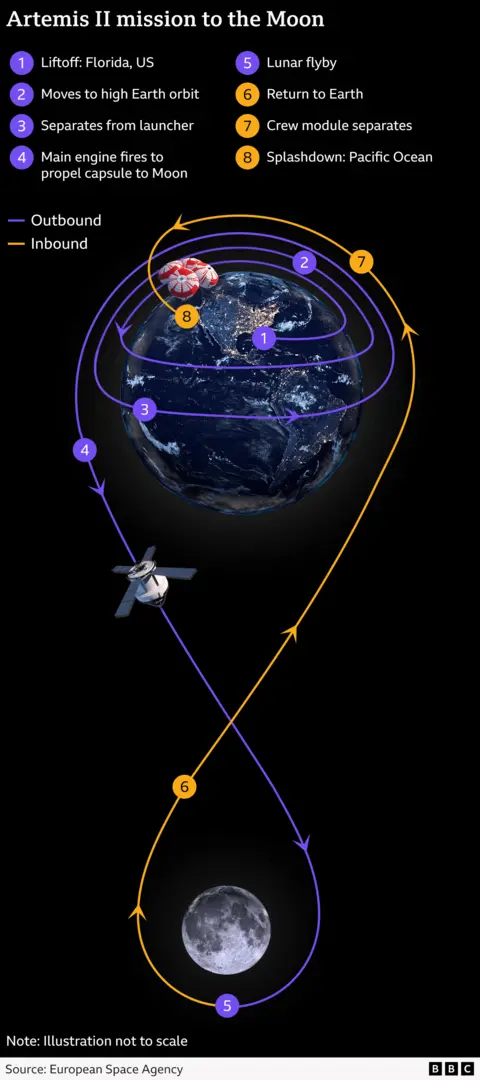
The 10-day mission launched on 1 April at 18:35 CDT (23:35 BST) after a delay caused by a range of technical issues.
These included problems with both the flight termination system - designed to destroy the rocket if it goes off course - and a battery for the launch abort system, which would pull the crew capsule away from danger in case of an issue.
Astronauts shared their pre-launch messages from inside the Orion crew capsule during the 10-minute countdown to lift off.
"We are going for all humanity," said mission specialist Hansen.
Cheers erupted among jubilant crowds gathered outside the Kennedy Space Center, as Nasa technicians monitored the ascent.
Observers also watched as various milestones were achieved, like seeing the twin rocket boosters separate from the rocket after helping it reach a speed of more than 10,000mph (16,100km/h)
Once Artemis II entered the upper atmosphere, Orion commander Wiseman declared it was a "great view".
The crew officially entered orbit when they crossed the Kármán line – the boundary between Earth's atmosphere and space.
After launch, there was a short-lived comms issue, which meant ground control could not hear the astronauts.
A temporary problem with the toilet was also fixed.
What are the Artemis crew doing during the mission?
 NASA/Reid Wiseman
During the mission, the astronauts are testing how Orion handles.
This involves manually flying the capsule in Earth orbit to practise steering and lining up the spacecraft for future Moon landings. They are also checking the spacecraft's life‑support, propulsion, power and navigation systems.
Orion reached its maximum distance from Earth - 252,756 miles (406,771km) - during the lunar fly-by.
The crew had already broken the previous record for the furthest distance humans have travelled into space.
As expected, the astronauts lost connection with Nasa for about forty minutes while behind the Moon.
"It is so great to hear from Earth again," said mission specialist Koch as she broke the silence from the spacecraft.
US President Donald Trump spoke directly to the astronauts. "Today, you've made history and made all America really proud, incredibly proud," he told them.
The crew also witnessed a total solar eclipse, and observed several small craters on the far side of the Moon.
They proposed naming one of these "Carroll", after Commander Wiseman's late wife, who died of cancer in 2020 at age 46.
The crew is working in weightlessness inside a small cabin. Radiation levels are higher than on the ISS, which is in low‑Earth orbit, but still safe.
On return to Earth, the astronauts will experience a bumpy return through the atmosphere and a splashdown off the west coast of the US, in the Pacific.
Why didn't Artemis II land on the Moon?
This mission is to lay the ground for a lunar landing by astronauts in the Artemis IV mission, planned for 2028.
Ahead of that, Nasa plans another crewed test mission, Artemis III, in 2027, to rehearse Orion's rendezvous and docking with one or more lunar landers and to try out the new spacesuits if they are ready in time.
Nasa has picked two rival commercial landers for Artemis: SpaceX's Starship and a craft designed by Jeff Bezos's company Blue Origin, and will decide closer to the time which vehicles fly which missions.
When Artemis IV finally flies, the astronauts will be heading to the Moon's south pole.
After this, the aim is to have another landing later in 2028 with the Artemis V mission, to build up the capability for a sustained human presence on the Moon.
Nasa has paused work on its planned Gateway station in lunar orbit. Further Artemis missions will focus on building up a Moon base and flying crews regularly to the surface, with more landings, new surface modules and robotic rovers to follow.
More countries will join the effort, with astronauts from a widening group of nations living and working on and around the Moon for longer stays.
When was the last Moon mission?
The last crewed Moon mission was Apollo 17, which landed in December 1972 and returned to Earth later that month.
In all, 24 astronauts have travelled to the Moon and 12 of them have walked on its surface, all during the Apollo programme. Of the 24 to have been to the Moon, five are still alive.
America first went in the 1960s, primarily to beat the Soviet Union to assert its geopolitical and technological dominance. Once that goal was achieved, political enthusiasm and public interest ebbed, as did the money for future Moonshots.
The Artemis programme grew out of a desire to return humans to the Moon, but this time for a longer-term presence built around new technology and commercial partnerships.
Do other countries plan to send astronauts to the Moon?
Several other countries have ambitions to put people on the Moon in the 2030s.
European astronauts are set to join later Artemis missions and Japan has also secured seats.
China is building its own craft, targeting a first landing near the Moon's south pole by 2030.
Russia continues to talk about flying cosmonauts to the surface and building a small base sometime between about 2030 and 2035. However, sanctions, funding pressures and technical setbacks mean its timetable is highly optimistic.
India has also expressed ambitions to one day see its own astronauts walking on the Moon.
Following the success of Chandrayaan 3's landing near the lunar south pole in August 2023, India's space agency set out a goal of sending astronauts to the Moon by about 2040. This would be part of a push to move its human spaceflight programme beyond low Earth orbit.
Additional reporting by Kevin Church and Emily Selvadurai.