Interstellar A&E: The Scottish doctor of space medicine

 BBC
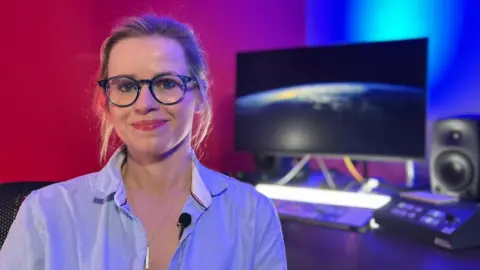
BBCAs well as working as an A&E doctor in Glasgow, Dr Christina Mackaill is also an expert in space medicine.
With no hospitals, ambulances and often no doctors available in space, the Scottish medic has been working with Nasa on how to keep astronauts medically safe in space and when they arrive back on Earth.
She has also been teaching emergency departments across the world about the large impact space travel can have on an astronaut's body, including the immune and cardiovascular systems.
"Aviation and space medicine is a growing speciality and it is going to become bigger and bigger as more people go into space," Mackaill says.
 Christina Mackaill
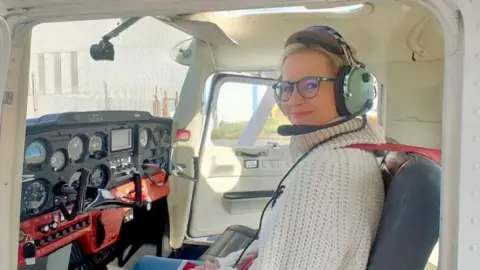
Mackaill, who founded Scotland's first space medicine society in 2016, became interested in space medicine while studying at university.
The Edinburgh-born medic's first space medicine project was working with physician and space expert Dr Thais Russomano in Brazil on a gravity-defying method of performing the life-saving emergency technique, CPR (Cardiopulmonary Resuscitation).
She says there had already been a lot of research on CPR in microgravity, for example at the International Space Station (ISS), but not on how to do it on the moon.
The pair developed the Mackaill-Russomano method, which teaches astronauts how to perform CPR on the surface of the moon and Mars, where gravity is weaker than on Earth.
The method gives the rescuer stability and a better position for good quality CPR by allowing the arms to be bent and compensating for reduced body weight in low gravity.
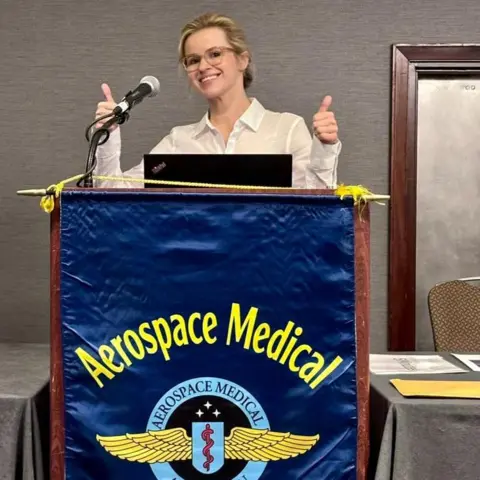
Mackaill has presented the technique to both Nasa and the European Space Agency.
 Christina Mackaill
The 35-year-old doctor says it is important for astronauts to be taught life-saving skills such as CPR before space missions.
She says for shorter missions or the ISS, it might be possible to bring astronauts back in the case of an emergency.
But as crews venture further afield to the moon and Mars, medical evacuation would not be an option and astronauts would need to have broader medical skills and be surgically capable.
As well as the distance involved, the human body also changes in lower gravity, Mackaill says.
"Depending on how long you are in space, there are a lot of different changes that happen to the body," she told BBC Scotland News.
"Fluid from the lower body can shift upwards during missions because there is no gravity, and muscle mass and bone density can decrease as they are not weight bearing.
"If astronauts are up in space for a couple of months, the fluid shifts can even put pressure on the back of the eyes and cause visual changes."
Mackaill is now working with Nasa's chief health and medical officer Dr James Polk on developing guidelines for doctors on how to treat astronauts, who have experienced these changes or trauma on return.
"Astronauts lose about 15% of their circulating plasma volume, which means when they come back, their blood pressure can drop and they might need additional fluids," she says.
"If they had trauma coming back and came into hospital, the astronauts could require blood products quicker or be at an increased risk of fractures."
She also says with the recent Artemis II mission and future projects going deeper into space than ever before, there is also higher chance of radiation exposure and solar flares from the sun.
"Astronauts' immune systems could be affected from the radiation, which can lead to viruses, such as glandular fever, when they come back," Mackaill says.
"It's important to know about the physiological changes because doctors could do harm if they are not aware of how astronauts physiology changes in space with the amount of fluid in their body, their immune system or their risk of fracture."
 Christina Mackaill
With commercial space flights becoming more possible and more space missions in the works, Mackaill thinks her research will become vital very soon.
"Astronauts are screened very meticulously before going to space but with commercial flights, these people are paying to go so the medical screening will likely be much less," she says.
"It is a lot about preventive medicine just now because there are limited medical supplies in space but with commercial flights, there could be a higher medical risk."
After spending almost a decade researching space and seeing the Artemis II mission, which arrived back from its journey around the moon last week, Mackaill says she would love to go space.
She says: "Watching the Artemis crew, who have been to space several times, and seeing how overwhelmed they are at the images of the Earth and the moon, it's unbelievable.
"I don't think I would be keen on going to Mars but the moon, definitely, I think it would be so cool."