Irish cabinet meeting to be held to discuss ongoing fuel protests

 PA Media
The Taoiseach (Irish prime minister) has said a cabinet meeting will be held on Sunday where an update on the ongoing fuel crisis talks will be given.
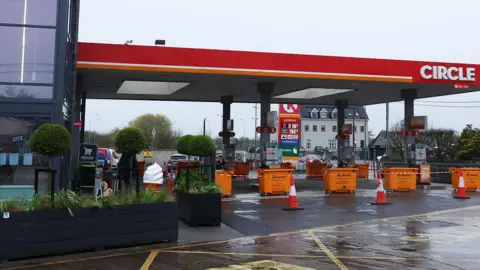
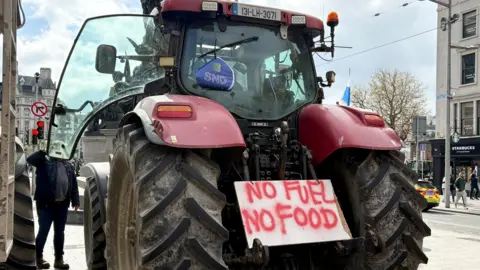
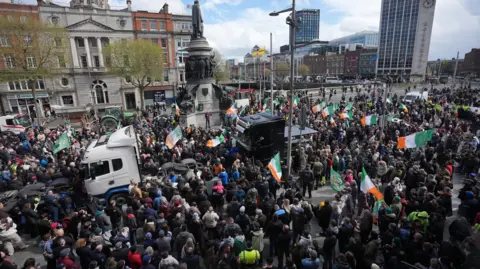
Hundreds of petrol stations in the Republic of Ireland have run out of fuel as the protests and blockades - involving slow-moving convoys made up of vehicles including tractors - continued for a fifth day.
Meetings between government ministers and representatives of farmers and hauliers to finalise a new government funding package have been ongoing since Friday.
On Saturday, fuel trucks regained access to an oil refinery in County Cork that had been subjected to a days-long blockade.
Protesters who had been blocking trucks leaving the Whitegate Refinery were pushed back by gardaí (Irish police) using pepper spray, in an operation supported by the Irish Defence Forces.
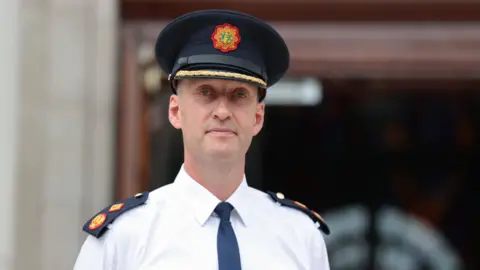
The Garda Commissioner said a number of arrests were made during the operation.
He added that blockades are illegal and "not a legitimate form of protest".
"We gave these blockaders fair warning that we were moving to an enforcement phase and they chose to ignore that and continue to hold the country to ransom," Justin Kelly said.
 PA Media
He added that gardaí are aware that there has been intimidation of fuel tanker drivers.
"Offences such as threats to kill or cause serious harm carry sentences of up to 10 years," he said.
"My message is clear - blockaders must immediately cease blockades of critical infrastructure and road networks or face the full rigours of the law."
 Reuters
The harbour master at Rosslare Europort told Irish broadcaster RTÉ that they may have to turn away ferries due to a road blockade outside the facility.
Tom Curran said the port will have reached capacity by Sunday afternoon with freight stuck and unable to move.
Protesters have set up a blockade at the nearby village of Kilrane about one mile from the port.
A spokesperson for Iarnród Éireann (Irish Rail) said the situation could come to a head late on Sunday night or early on Monday morning.
Public transport has also been affected, with some services suspended and major disruption in Dublin.
Bus Éireann said it would try to serve Dublin Airport passengers where possible, while people travelling to Shannon and Dublin Airports are advised to allow extra time.
An Garda Síochána has declared an "exceptional event" in response to the fuel protests, allowing it to double the number of officers available to work.
 PA Media
The National Emergency Coordination Group (NECG), which brings together government departments and state agencies to coordinate emergency response, said fuel supplies for emergency response vehicles, including the ambulance service and fire service, are under "increasing pressure".
Taoiseach (Irish Prime Minister) Micheál Martin said the blockades meant the country was "on the precipice of turning oil away from the country" during a global oil supply crisis.
Speaking in Dublin on Saturday, Mary Lou McDonald the leader of Sinn Féin, said the Irish Government had allowed a "difficult situation" to escalate and urged it to engage with protesters to negotiate an end to the blockades.
Why are the protests taking place?
The conflict in the Middle East has caused rapid price rises for both petrol and diesel.
Some 20% of the world's oil trade, the raw ingredient for producing both petrol and diesel, has been halted by the closure of the Strait of Hormuz.
Diesel in the Republic of Ireland has risen from about €1.70 (£1.48) a litre to €2.17 (£1.89) on many forecourts in recent weeks and petrol is now up to 25 cents more per litre at many pumps.
The protests started on Tuesday morning.