Apollo v Artemis: How the Earth changed in 58 years


 Nasa
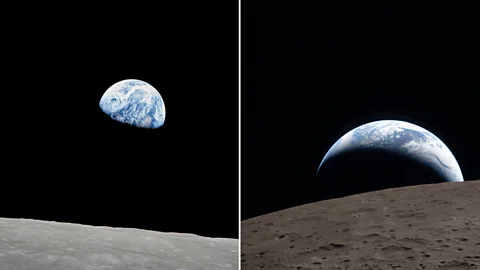
NasaAfter the Apollo 8 crew captured the iconic Earthrise photo in 1968, Artemis astronauts have recreated the image, revealing changes to our fragile blue planet.
When the commander of Apollo 8, Frank Borman, first saw the far side of the Moon from his spacecraft window in 1968 he was struck by its desolate appearance.
"The lunar surface was terribly distressed with meteorite craters and volcanic residue," he told me during a BBC interview in 2018. "It was either grey or black or white – there was absolutely no colour on the lunar surface, and it was messed up beyond belief."
But as the spacecraft completed its fourth lunar orbit, suddenly, a very different view appeared.
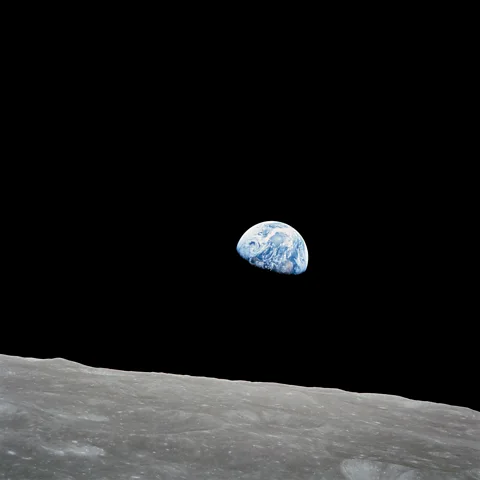
"We looked up and there was the Earth in the background coming over the lunar surface, and Bill Anders took the picture that became probably one of the more significant pictures that humans have ever taken," Borman said.
"The Earth was the only thing in the entire Universe that had any colour, it was a remarkable sight – we're very, very fortunate to live on this planet."
This Earthrise picture, as it was soon named, became one of the most reproduced images of all time. Showing our planet in the context of the lunar wasteland and vast oblivion of space, it galvanised the environmental movement, leading to the creation of Earth Day in 1970. (Read more about the 1968 photo that changed the world).
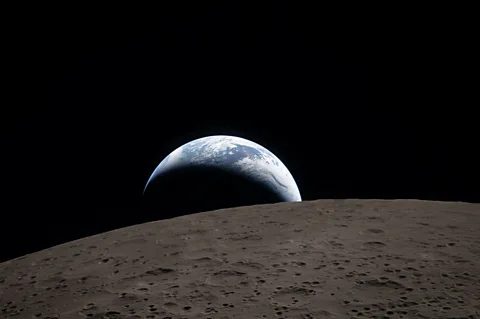
Fifty-eight years later, Nasa astronauts have taken another striking photo of the Earth dipping below a barren lunar landscape: "Earthset". During their fly-by of the Moon earlier this month, the Artemis II crew captured the new image of our fragile blue planet in the vast expanse of space. (We don't know who took the picture this time because the four astronauts have chosen not to credit photos to individuals but to the whole crew).
In geological terms, just over half a century is barely the shadow of a blink of an eye. But climate change has altered the Earth's surface significantly over the past six decades. Experts tell the BBC about the visible differences between the Earthrise and Earthset photos and what these tell us about our planet then and now.
 Nasa
NasaDespite its impact and legacy, what's so surprising about the Earthrise picture is that no one at Nasa had seen it coming. "They caught it by accident, right?" says US astronaut Sian Proctor, the pilot for the first wholly "civilian" mission to space (named Inspiration). "Apollo 8 changed the way we saw our planet and that's the kind of thing I feel like we need right now, more inspiration."
When I asked a question at the press conference following the Artemis launch about plans for a new Earthrise picture, it was clear that, this time, Nasa was not going to be caught out.
"We're going to do everything we can to try and make that happen," said Lori Glaze, who leads the agency's Exploration Systems Development Mission Directorate.
The Earthset photo was captured through the Orion spacecraft window 18:41 Eastern Daylight Time (23:41BST) on 6 April, during a seven-hour flyby of the Moon.
"The Earth's sunlit side shows white clouds and blue water over the Oceania region, while the dark areas are experiencing nighttime. The image also shows incredible detail of the Moon's surface and its overlapping craters and basins," Nasa notes in its description of the image.
Unlike in 1968, numerous satellites take thousands of images of our planet each day in 2026. They measure and monitor our oceans, land and ice in all shades of the electromagnetic spectrum – from microwave to ultraviolet – not just what we can see with our eyes. There is a continuous video feed from the International Space Station and robotic spacecraft have even captured the Earth from the vantage point of the Moon and beyond, but the fact that Earthset was taken by humans sets it apart.
 Nasa
NasaCraig Donlon, who oversees the plans for the next generation of satellites at the European Space Agency (Esa), says humans give us a different perspective.
"The images that you get from a human are framed, focused, and there are choices that are made subconsciously and consciously by the astronaut when they press the shutter, they've got something in the back of their mind," Donlon says. "That forces some kind of emotion, which says, 'Well, wow, okay, little old Earth there, but that's where we live, that's it, that's everything.'"
But it's not just the human connection that makes the Earthrise and Earthset images significant. Despite being snapshots taken some 58 years apart, they can also help reveal how the Earth has changed in that time.
"Since Earthrise, atmospheric carbon dioxide levels have risen by about a third and global temperatures have warmed rapidly, by at least 1C," says Richard Allan, a professor of climate science at the National Centre for Earth Observation at the University of Reading in the UK.
"The planet has transformed as human activities alter the texture of our land as seen from space, expanding cities, clearing dark forests for replacement by bright agricultural lands and contributing to the desiccation of the Aral Sea which has shrunk to less than 10% of its 1960s size."
Some of that change can even be seen in the images themselves, even though the Earth is shrouded in cloud.
"Although they're of different parts of the Earth, the one thing that does show up in both images, although you're looking at different parts of it, is Antarctica and the Southern Ocean," says Benjamin Wallis, a glaciologist at the University of Leeds in the UK. "The Antarctic Peninsula is one of the most rapidly warming parts of the Earth and 28,000km of ice shelf have collapsed in between the original image and the latest image."
Studies suggest these changes in the ice around Antarctica are unprecedented in the last 10,000 years. Other areas of the Earth where water exists in a solid form – known as the cryosphere – have been similarly affected.
"We really have seen some dramatic changes," says Petra Heil, director of science at the British Antarctic Survey. "We have now seen in both hemispheres a dramatic decrease in the seasonal sea ice cover, and in North America, Eurasia and Asia, we have seen much later seasonal snow cover, and we also see it melting earlier."
"I think we are pretty confident based on the observations but also the numerical models to assign probably 90-95% of the change to human activities," Heil says.
But while all this might make for grim reading, it's worth remembering that in 1968 – despite appearances from deep space – we had already caused damage to the planet.
More like this:
• The images showing 50 years of change on Earth
• Mercury to Artemis: The evolution of mission control
• The astronaut school inside a Swiss mountain
"[Earthrise] left many people enthralled with the idea of how beautiful the Earth was and how much damage was being done," says Kathleen Rogers, president of the Earth Day network. "I remember at the time you couldn't see across the street in LA at rush hour because of smog and our rivers were on fire."
"From so far away, the Earth looks so perfect and so beautiful and then as you drew closer, you could see the ravages of 150 years of, let's call it, progress," says Rogers. "But it did inspire a generation of people to really step it up and become part of a movement."
Borman died in 2023, but the legacy of his Apollo 8 mission still endures and his words are just as relevant today for a new generation of lunar astronauts: "I don't think any of us have paid any attention to the fact that we would be going all the way to the Moon and be more interested in looking at the Earth".
--
For essential climate news and hopeful developments to your inbox, sign up to the Future Earth newsletter, while The Essential List delivers a handpicked selection of features and insights twice a week.
For more science, technology, environment and health stories from the BBC, follow us on Facebook and Instagram.