Why was an EasyJet plane too heavy for take-off?

 PA
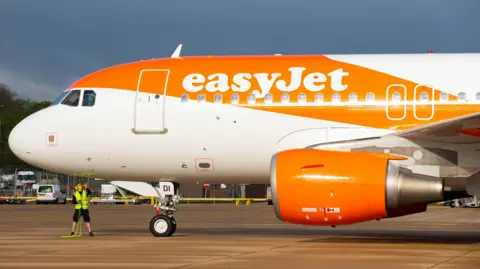
PAOn 11 April five passengers volunteered to leave an EasyJet plane travelling to Malaga from Southend Airport because the aircraft was too heavy for take-off. The airport said it was not the first time it had been necessary to disembark passengers, but why does it happen?
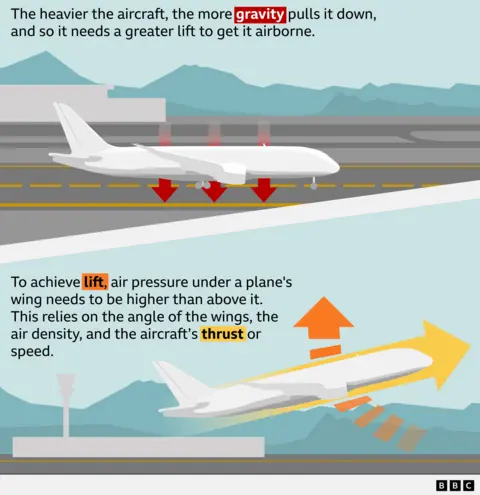
For a heavy passenger plane to take-off it requires a balance of several forces, including gravity, lift, thrust and drag.
The weather can change that balance as the heavier the aircraft, the more gravity pushes it down to Earth and it needs a greater lift to become airborne.
To achieve lift, the air pressure under a plane's wing has to be higher than above it, which depends on the angle of the wings, the air density and the aircraft's thrust or speed.
In hot weather air molecules are further apart, which can cause the aircraft's combustion engines to achieve less thrust for take-off and there are fewer air molecules to lift the aircraft.
Why was the plane unable to take-off?
The direction and strength of the wind can also affect lift and Guy Gratton, a professor of aircraft test and evaluation at Cranfield University, believes this was the problem for EasyJet's flight EJU7008 from Southend.
"The wind, being 50° off the runway heading, would give almost no headwind. Headwind is usually there - in England the wind is usually from the south-west, [which is] aligned with Southend's runway, which points at 230°, and helps shorten take-offs," he says.
"On this occasion, it wasn't and there may as well have been almost no wind at all. This would be quite unexpected and can indeed cause problems," he adds.
The problems were spotted when the safety calculations were done, the airport says.
One way to overcome the problem, Gratton adds, is for the aircraft to travel further along the runway to give it time to reach the necessary thrust.
At Southend Airport, however, this was not possible as although the runway was extended in 2012, it is still relatively short at 1,856m (6,089ft).
By comparison, Stansted Airport's runway is 3,049m (10,003ft) and Luton Airport's is 2,162m (7,093ft).
Gratton says another way to address the issue is to make the plane lighter, which usually mean passengers disembarking or removing luggage.
He adds it is a "straightforward solution and it was quite right that EasyJet's dispatcher and captain would not take-off until the airplane was within limits".
How often does this happen?
While removing passengers and luggage for take-off is not a regular occurrence, it does happen, particularly at airports with shorter runways.
In 2014 a number of passengers travelling the same route from Southend to Malaga were asked to disembark the aircraft.
Sometimes aircraft are made heavier by the need to carry extra fuel to allow them to deal with changing weather conditions while flying.
Airlines do not routinely weigh passengers before a flight and instead work on standard average weight for each passenger.
The European Union Safety Aviation Agency carried out a study in 2022 that concluded the mean passenger weight, including carry-on luggage, was 84kg.
In the case of flight EJU7008 it appears the estimated weight was not sufficient to prevent overload.
Why wasn't it spotted earlier?
Jeremy Spake, who has worked in the aviation industry for 30 years and featured in Airport, a BBC programme that documented life at Heathrow Airport in the 1990s, said that "saving almost 600kg in weight might not sound much but it can be the difference in getting off the runway without issue".
Gratton says what is "slightly unusual" for flight EJU7008 is that the issue "wasn't realised earlier on".
"Usually, passengers will be asked [to switch flights] before they ever board. However, with the rush of an early morning tourist flight, it's perhaps not totally unexpected that this didn't occur earlier," he adds.
Spake agrees, adding "managing it in the terminal before people have their bottoms on the plane is so much easier".
"On the upside, if you're denied boarding, you're legally entitled to compensation, which for a flight to Malaga would be around £350. If your journey wasn't urgent that could be quite attractive," Spake says.
How will climate change impact flights?
Climate change is expected to bring more extreme weather events, including hotter summers and wind changes in the UK, which Gratton says could make flights struggling to take-off more likely.
"Almost all main airport runways were built aligned, as best as they could, with historical average winds.
"Climate change is moving the wind out of alignment with the runways, and thus reducing the useful headwind," he adds.
Gratton says he has researched the issue at Greek airports and found "significant differences for airports with short single runways, like Southend has".
As airlines have no control over the weather or the length and direction of runways, in future, he says, they may have to build more generous margins into the weight estimates of aircraft to minimise these last-minute problems for passengers.
Do you have a story suggestion for Essex? Contact us below.
Follow Essex news on BBC Sounds, Facebook, Instagram and X.