'It's so chaotic': Humpback whales are forming super-groups

 ChrisFallows.com
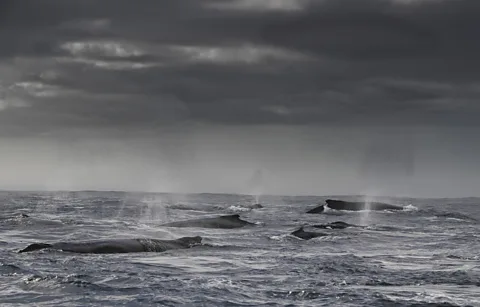
On a misty morning in December 2025, two photographers captured the images of 304 individual humpbacks – the highest number of large whales ever identified in a single day. Their pictures tell a story of a remarkable return from the brink.
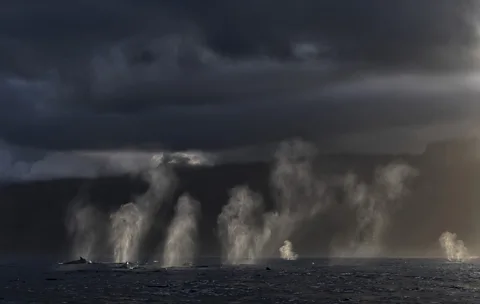
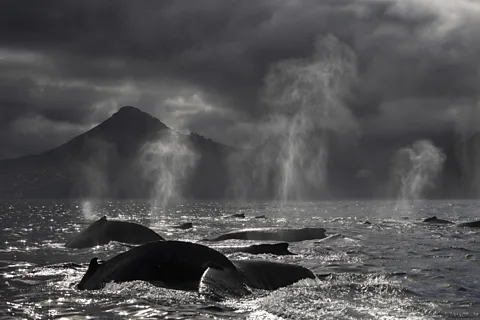
When you have 200 humpback whales or so close to each other, says Monique Fallows, their blows appear "like a Manhattan skyscraper skyline".
Humpbacks dive to feed then resurface for air. Bursting from their enormous lungs at over 300mph (483km/h), a humpback whale's blow can rise up to 7m (23ft) into the air. "The sound is like a big bellows," says Monique, a nature photographer and author, who has documented humpback super-groups multiple times.
The smell is also strong for anyone nearby. "You feel the breath of the whales falling on you," says Monique. "The whales burp and fart all the time – on a ginormous scale. The smell is pungent. It's very fishy."
Over two days in December 2025, Monique and her husband, fine art photographer Chris Fallows, photographed several different humpback "super-groups" off the west coast of South Africa. The couple captured 208 individual humpback whales on the 29 December, and a whopping 304 the following day. That, says Chris, is the greatest number of large whales ever identified in one day in our planet's history.
"This truly is a testament to their recovery," says Chris.
Intense industrial whaling during the 20th Century virtually wiped humpbacks out, leaving less than 5% of pre-whaling numbers in the ocean. But 40 years ago, a global whaling moratorium came into force and populations began to recover.
Today, while some humpback populations remain endangered and for others the rate of recovery is uncertain, globally humpbacks are on the rise. In the southern hemisphere, humpbacks have shown a strong recovery, with an increase in numbers of up to 12% per year. Now, South Africa's recent humpback super-group bonanza could indicate a turning point in the resurgence of the humpback whale.
Sightings of super-groups – defined as groups of 20 or more humpback whales that are within five body-lengths of their nearest neighbour – are also skyrocketing.
Experts aren't yet sure why we're seeing this sudden surge in these gatherings. It could be a change in prey availability, or an increase in the numbers of whales elsewhere prompting exploration of new feeding strategies or areas. Or perhaps this is something they've always done, but only now are we witnessing it as populations recover.
Being surrounded by such a huge number of inconceivably large animals is "a complete sensory overload", says Monique. "They're exhaling all the time. When you first smell it, you're like 'Oh, God, what is that?'"
You can see the moment Monique and Chris Fallows met a super-group of humpbacks in the video below.
Humpbacks usually only come together in small groups to feed or mate, spending much of their lives in solitude. During the austral summer months, however, upwelling of cold, nutrient-rich water from the deep ocean leads to enormous blooms of phytoplankton and the whales' favourite meal of euphausiids – or krill – follows. That's when super-groups now come to feed.
Humpback whales live in all the world's oceans. Each year, they make some of the most epic migrations of any mammal on the planet, as far as 5,000 miles (8,000km), from the warm waters of their breeding grounds to colder water where they feed. In the process they transport huge amounts of nutrients across the globe, which plays a vital role in the health of marine ecosystems.
The recovery of humpbacks is "really the conservation success story", says Simon Elwen, a marine biologist at the University of Stellenbosch, South Africa. "It is phenomenal."
In just five years, from 2015 to 2020, humpback super-group sightings off South Africa's west coast soared from 10 to 65 per year.
When Elwen's team was doing surveys in the early 2000s, "we were so excited to see one or two whales", he says. Today, seeing a single whale during the summer months is no longer a novelty – it is not seeing multiple whales that is rare. "Seeing groups of hundreds of whales in a day is perfectly normal these days – because we've had that exponential growth," says Elwen. "It still catches us by surprise sometimes."
 ChrisFallows.com
Elwen likens the humpback population explosion to the spread of a virus. "You have the very long, slow period of not much happening, but there is growth and then it eventually goes 'whoop!' and increases rapidly."
It was on the brink of New Year when Monique and Chris, together with their three dogs, slept in sheltered anchorage on the deck of their small boat in the hopes of photographing a super-group. They had heard from whale watching companies in the area that whales were gathering, and their aim was to photograph as many as possible of them and then submit their images to Happywhale, a citizen science project that aims to photo-ID marine mammals globally.
The couple awoke at 03:45, before sunrise, in pursuit of the best possible lighting for their subjects. Then, in the mist of early morning, they set off.
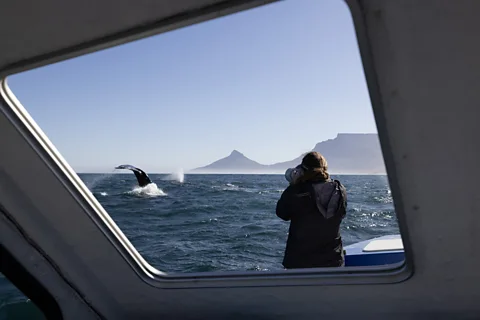
They moved slowly, turning the boat's engine off every few minutes to "simply drift and listen", says Chris. "When the whales breach you can hear them from miles away, so we would head in that direction. As we got closer those breaches sounded like huge bombs going off as the 40-plus tonne whales leapt out and then crashed into the ocean."
Next came the smell of the whales' breath drifting on the sea breeze. Then the sound of deep exhalation. "We heard the breathing of over a hundred whales," says Chris, "followed by the visual confirmation of flukes, flippers and bodies."
Now, the game was on.
Chris was concentrating on capturing beautiful fine art photography, although both he and Monique had fun competing to see who could take the most identification shots.
 ChrisFallows.com
"We didn't go out with the intention of breaking a record," says Chris. "There were just so many whales around us. Monique and I were laughing, because there was just so much going on that you didn't even know what to photograph. It was like rapid fire."
The 512 whales they photographed over two days contained some duplicates, bringing the total number of individual animals identified over the course of their trip to 372.
This was a "phenomenal number of whales", says Ted Cheeseman, a marine conservationist who founded Happywhale in 2015. Of those 372, only a handful had been previously photographed, he adds, and only in the past few years.
More like this:
• The whale graveyards that transform the deep sea
• The strange deep-sea creatures that eat whales
• The 'mind bomb' photos that led to a global whaling ban
"We don't know the age of the whales. We use their sighting history as a proxy for age," says Cheeseman, "but I think the great majority of those whales are under 10 years old – I say that with great confidence – and a high percentage may be under five years old.
"These are new whales. This is a population rebounding."
Humpback mayhem
Imagine hundreds of 10-tonne toddlers all trying to fetch themselves a snack, all at the same time. That's what these super-groups resemble, says Cheeseman. "It's so chaotic, and so crazy. There are whales everywhere."
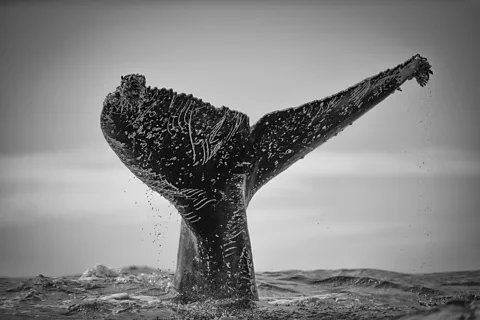
Happywhale lets members of the public upload their images of whale tail flukes or dorsal fins. Then, using advanced AI image recognition, the project identifies individual animals. It now hosts a collection of almost 1.5 million photographs, allowing scientists to track the health and population status of species and observe migration patterns across oceans.
 ChrisFallows.com
Usually, humpbacks hunt in a highly sophisticated, social way. Take "bubble net feeding", for example. This is where humpbacks blow bubble nets around fish to trap them in a small space. The whales appear to coordinate their movements using complex communication. "If you could hear what's going on underwater while they're feeding – I mean, it makes my skin tingle. You can literally hear the whale say, 'Okay, it's time. Go.' And then all the whales come up together." (Watch whales bubble net feed and listen to them chat on BBC Reel.)
During super-group aggregations, however, "there are so many fish, and whales are going everywhere", says Cheeseman. "It's just mayhem."
The age profile of the group adds to the apparent chaos. "Younger animals don't necessarily have the same physiological capacity as adult animals," says Jennifer Jackson, a marine ecologist at the British Antarctic Survey, the UK's polar research institute. Plus, the chosen hunting technique will depend on what prey they're chasing, as well as ocean conditions and the depth at which they are hunting.
"Humpbacks are an incredibly adaptable species," says Jackson. "They can even prey switch and feed on different things, depending on what's around."
 ChrisFallows.com
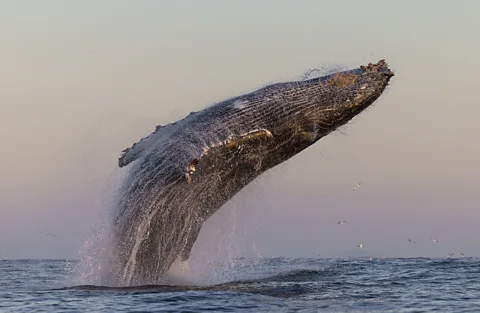
When their prey is near to the surface of the water, humpbacks will often engage in intense lunge feeding. This is where the whale propels itself at speed through a concentrated ball of krill or fish, scooping them up in its cavernous mouth. If it lunges vertically, the whale's head will rise straight up out of the water.
This is the hunting technique Elwen observed when studying South Africa's humpback super-groups in 2015. After breaching the surface of the water, rising upwards at near vertical angles, the whales often surfaced with their mouths still full of water.
"We had a group the other day of 100-plus animals," says Elwen. "They were very vocal, making a constant array of sounds." So, Elwen suggests what may appear as chaos is, in fact, "controlled chaos". "They know exactly what they're doing," he says.
 ChrisFallows.com
More whales is good news for ocean health, climate change mitigation and human food security. Yet, even as humpbacks increase in abundance across much of the world, the species still faces threats from entanglement in fishing gear, vessel strikes, underwater noise pollution and warming seas.
Chris and Monique have spent over three decades exploring the ocean and say they have seen "seismic changes". Now, Chris says, they are already planning their next visit "to the most incredible whale gathering on the planet".
--
For essential climate news and hopeful developments to your inbox, sign up to the Future Earth newsletter, while The Essential List delivers a handpicked selection of features and insights twice a week.
For more science, technology, environment and health stories from the BBC, follow us on Facebook and Instagram.