There's something special about Kangeroo island's koalas

 Ana Norman Bermudez
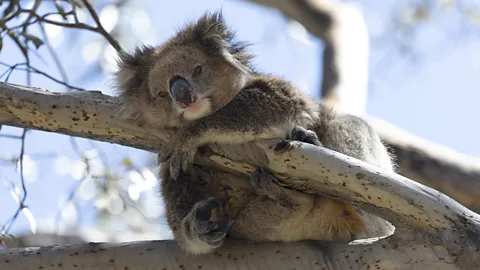
Inside the island colony being tapped to help save Australia's koalas from deadly chlamydia.
Brandishing long plastic poles, a small team of researchers are trying to coax a female koala down from the gum tree she's comfortably perched on.
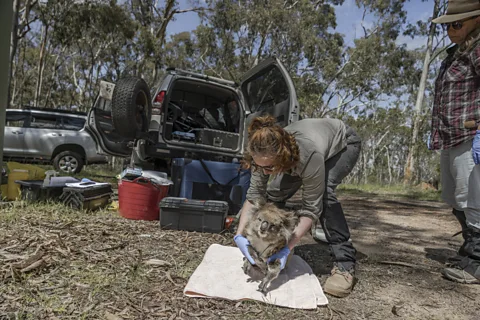
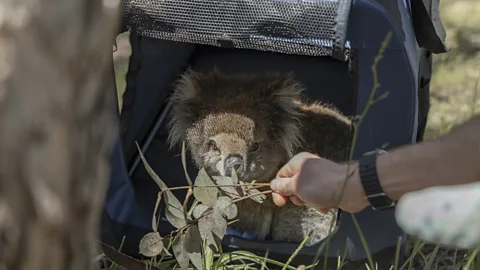
At first, she seems unfazed. Then everything happens quickly. She clambers down the trunk, leaps onto the grass, and lets out a deep growl before rolling onto her back, claws raised in defence. In a series of well-practiced steps, the experts carefully lift her into a crate. Once sedated, she is laid on a towel for a routine health check.
"I think she has chlamydia," says Karen Burke Da Silva, a conservation biologist at Flinders University in South Australia. Chlamydia has become a major epidemic among koalas, affecting up to 88% of individuals in some mainland populations. Caused by the bacterium Chlamydia pecorum, it can lead to blindness, infertility, pneumonia and – unlike chlamydia in humans, which is rarely fatal – often death.
Chlamydia has swept through the mainland, and this captured koala is one of about 40 inside South Australia's Belair National Park, near Adelaide, collared by scientists studying their health and genetics.
Yet on a nearby island, the disease has never been recorded. Kangaroo Island is thought to host the world's largest chlamydia-free koala population, offering something of a living insurance policy for the species. Still, these koalas are under a pressure of their own: more than a century of isolation has left them deeply inbred and genetically fragile.
This is what brings Burke Da Silva and her colleague Julian Beaman to study koalas in the region. They hope that by first improving the genetic diversity of Kangaroo Island's koalas, then introducing them to other low-chlamydia areas of Australia, they can help tackle the current plight facing the species.
Death by a thousand cuts
Native to eastern and southeastern Australia, koalas are listed as vulnerable by the International Union for Conservation of Nature. Though still numerous overall, with a population of between 398,000 and 569,000 according to official estimates, they have been declining steadily for decades and now mostly survive in small, fragmented populations. This has lowered their adaptability to the effects of climate change, habitat loss and disease.
"In each of those pockets, you get inbreeding and random population fluctuations that raise the risk each one will go extinct," says Beaman. "If we're not careful, it will be death by a thousand cuts."
 Ana Norman Bermudez
Kangaroo Island is separated from Australia's southern coast by just 13km (eight miles) and is the country's third largest island and a biodiversity hotspot. A short ferry ride from the mainland, the island's rugged coastline makes way inland for a patchwork of sheep-dotted grassland and dense native bush.
The koala population living here is entirely descended from a small group of around 20 individuals introduced from the mainland in the 1920s, at a time when conservationists feared that the fur trade would wipe out the species. By 2019, the population had exploded to 50,000, so many that they were often described as a pest. "People talk about them negatively," says Beaman, as we walk through a native eucalyptus forest on the island. "But it was actually a highly successful introduction."
As chlamydia runs rampant through mainland populations, the island's isolation has shielded its koalas from infection. Natasha Speight, a koala researcher from the University of Adelaide and co-author of a 2019 study which found the Kangaroo Island population remains free of chlamydia, says this makes it "the largest population in Australia with this status".
While chlamydia may have existed in Australia before Europeans arrived in the late 18th Century, research suggests that Westerners' livestock introduced new strains. Combined with habitat loss and shrinking genetic diversity, this has fuelled an epidemic that today threatens the species' survival.
Chlamydia can be cured with antibiotics, but treatment is far from straightforward – it requires koalas to be captured, can fatally affect their ability to digest eucalyptus leaves, and provides no protection against reinfection. A vaccine approved in 2025 offers genuine hope, cutting mortality in wild populations by 65% – but vaccinating wild populations at scale remains a formidable challenge.
Researchers including Speight, though, think that protecting Kangaroo Island's koalas and using them to help repopulate the mainland could, alongside the new vaccine, ultimately ensure the survival of the species.
Black Summer aftermath
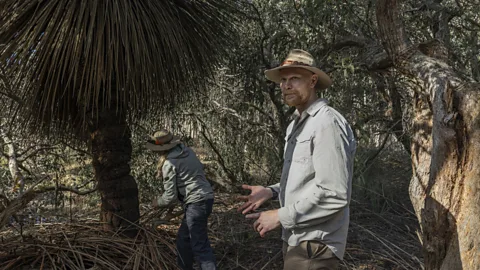
Living on an island has not shielded these koalas from other threats. Kangaroo Island's otherwise green forests are punctuated by the charcoal-black stems of Xanthorrhoea grass trees – neither grasses nor trees but succulents that develop trunk-like protective coatings in response to fire. They are visible reminders of Australia's 2019-20 Black Summer bushfires, which devastated the island and killed around 80% of its koalas, reducing the population to 10,000.
 Ana Norman Bermudez
Flinders Chase National Park, a 32,800-hectare (81,000-acre) wildlife haven on the western edge of the island, was especially hard hit.
Soon after the fires, Burke Da Silva and Beaman began to study Kangaroo Island's changing koala ecology. As the park's forests turned to ash, surviving koalas fled into nearby blue gum (Eucalyptus globulus) plantations in search of food, recalls Burke Da Silva.
But in 2021, Kiland, a logging company that owns over 18,000 hectares (44,000 acres) on the island, began clearing its blue gum trees and converting the land to agriculture.
"Suddenly, they started clearing the plantations where our tracked koalas lived," says Burke Da Silva. Many died from injury or starvation. "It was horrific."
In 2024, with support from environmental philanthropist Alan Noble, who donated funds in memory of his late wife, Beaman and Burke Da Silva bought a 530-hectare (1,300-acre) tract of plantation land bordering the Flinders Chase National Park, before it could be cleared by Kiland. Together with Noble, they co-founded The Koala Sanctuary, securing the habitat of roughly 1,000 koalas – around 10% of the island's remaining population.
A Kiland spokesperson told the BBC that its contractors operate under a South Australian government-approved plan which aims to minimise impacts on koalas. The company remains supportive of The Koala Sanctuary's conservation work, they added.
The sanctuary will open to tourists in spring 2026, providing vital funding for its research and conservation work, says Burke Da Silva.
It's also here that researchers are using a koala conservation approach never before attempted at this scale.
A genetic bottleneck
At Flinders University's biology lab in Adelaide, molecular biologist Katie Gates opens a small white box from a deep freezer. Vapour spills from the test tubes inside. "These are tissue samples from Kangaroo Island's koalas," she explains. The scientists have sequenced DNA from these samples – tiny pieces of skin collected from the koalas' ears – to measure the population's genetic variation.
The results confirm what the team had already suspected: Kangaroo Island's koalas show very low genetic diversity, "We've found males with one testicle, or none," says Beaman. "And we've seen spinal deformities."
This makes Kangaroo Island's koalas highly vulnerable to a phenomenon geneticists call the "extinction vortex", Beaman says. In small, isolated populations, the random loss of genetic variation accelerates, while at the same time inbreeding brings harmful mutations to the surface. As numbers fall, random demographic swings become more significant, increasing the risk of sudden decline.
"All the data we have shows this population is highly inbred," says Carolyn Hogg, chair of the Australasian Wildlife Genomics Group at Sydney University. It means, she says, that genetic rescue is critically important for the koalas on Kangaroo Island.
 Ana Norman Bermudez
Genetic rescue involves introducing unrelated, genetically healthy individuals to reduce inbreeding and is increasingly recommended as a conservation strategy. But it has typically been reserved for very small populations on the brink of extinction. While koala translocations are relatively common in Australia, they have historically been driven by population management and habitat loss rather than genetic considerations.
Burke Da Silva and Beaman plan to restore the genetic health of Kangaroo Island's koala population. "It's the first time [genetic rescue] will have been done for koalas at this scale," says Hogg. If successful, the project would be a critical step to establishing the only large koala population that is both genetically healthy and chlamydia-free in Australia.
Diversifying genes
The first step will be to bring genetically diverse, chlamydia-free male koalas from the mainland to breed with local females in the sanctuary. Rather than managing breeding in captivity, which would be impractical at this scale, the team plan to fence off patches of forest where animals can interact naturally. Gates programmed to respond to radio collars will eventually allow only the genetically rescued animals to enter Flinders Chase National Park.
"The aim would be to get as many first-generation individuals out in the new population as possible without there being many inbred animals in the area of release, which is why post-fire is a good time to do the genetic rescue," says Burke Da Silva.
More like this:
• A rogue mushroom is tearing through US forests
• The deep cave bacteria resistant to modern medicine
• The former Soviet reserve where snow leopards roam
Genetic rescue attempts can backfire if poorly planned, for example by undermining the genetic integrity of either population. Recent studies suggest those risks have been overstated, but Beaman and Burke Da Silva are taking precautions.
For the first translocation, planned for the second half of 2026, the team has identified a wild koala colony near the border between South Australia and Victoria with particularly high genetic diversity. To test whether they are a genetically diverse match, males from this colony have been paired with Kangaroo Island females at Cleland Wildlife Park, near Adelaide. The DNA of their joeys is currently being sequenced.
The researchers are also building a computer simulation to test how the characteristics of the koala groups chosen to breed together might shape outcomes."You can look at how big the population target and source are, sex ratios, age structure, and workshop those different scenarios to see what matters most," says Beaman.
If diversity remains too low, a second cohort from a different mainland population will follow. "We'll need to analyse the genetics after the first round and use the models to decide whether another introduction is needed," says Burke Da Silva.
 Ana Norman Bermudez
Once the required diversity is achieved, the plan is to introduce these genetically healthy, chlamydia-free koalas to the mainland in areas where chlamydia rates remain low. (Exposing any of the koalas involved to infection could undo the conservation gains entirely.) The government of New South Wales, where koalas are declining rapidly, has already expressed interest in using these koalas for future reintroductions, according to Burke Da Silva.
A conservation long-game
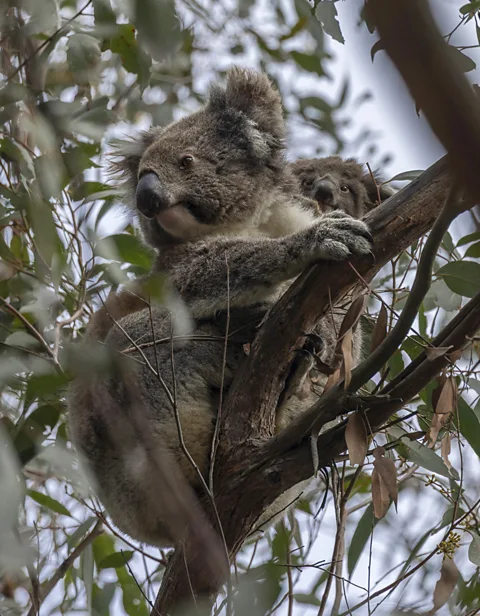
A cool wind moves through the trees at The Koala Sanctuary as Burke Da Silva and Beaman walk through a patchwork of former plantations and pockets of native forest. Over the coming years, they plan to gradually restore the land to indigenous vegetation. They stop beneath a native brown stringybark tree, where a female munches on leaves.
"She has a joey," says Beaman, pointing to the tiny ears peeking out from her back.
Restoring the genetic health of Kangaroo Island's koalas will take years. But by 2027, Burke Da Silva and Beaman hope to have begun repopulating both Flinders Chase National Park and parts of mainland Australia with disease-free and, by then, genetically resilient koalas from the island.
Carbon Count
The emissions from travel it took to report this story were ~53kg CO2. The digital emissions from this story are an estimated 1.2g to 3.6g CO2 per page view. Find out more about how we calculated this figure here.
The project is "more than achievable with careful planning", despite the unprecedented size of the population they hope to rescue, says Hogg. Preserving Kangaroo Island's reservoir of chlamydia-free koalas will also complement broader national efforts, she says, including habitat protection, planting of genetically diverse trees for the koalas' food, a robust chlamydia vaccine, and genetic rescue of other populations with low diversity.
If it succeeds, the project could serve as a model for managing other genetically fragile wildlife populations before they reach crisis point. Despite numbering in the hundreds of thousands, Australia's koalas are "fragmented, isolated and genetically vulnerable", notes Beaman. "What we're doing here is testing how to manage that before it's too late."
Burke Da Silva and Beaman also want the sanctuary to model a wider ethic of coexistence. They are working with the Ngarrindjeri community and other Aboriginal groups for whom Kangaroo Island holds deep cultural significance, sharing access to the land for ceremonies.
For Burke Da Silva, that idea sits comfortably alongside the sanctuary's scientific mission. "Ultimately, it's not just on us to heal nature," she says. "We need to rediscover what it means for us to be healed by nature as well."
--
For essential climate news and hopeful developments to your inbox, sign up to the Future Earth newsletter, while The Essential List delivers a handpicked selection of features and insights twice a week.
For more science, technology, environment and health stories from the BBC, follow us on Facebook and Instagram.