'When nothing was taboo': 10 intimate images of a lost, decadent 1930s Paris

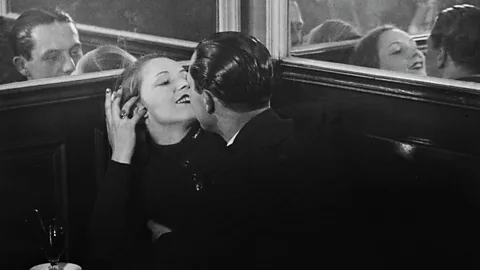 Estate Brassai/ Succession Philippe Ribeyrolles copy
Moving "effortlessly from slums to exclusive salons", the legendary photographer Brassaï captured the brothels, gay bars and backstreets of Paris's hazy night-time in its radical inter-war years.
Brassaï's photographs of lovers in cafes, the gargoyles of Notre Dame and the lamplit streets of Montmartre are some of the most iconic ever produced of Paris. A pioneer of night-time photography, he has shaped the view of the city as a place for romance, forever caught in a hazy twilight world of shadow. "The Paris you dream of, that's Brassaï's Paris," Anna Tellgren, curator of Brassaï: The Secret Signs of Paris at the Moderna Museet in Stockholm, tells the BBC.
But there is far more to his oeuvre than the select group of images reproduced on postcards.
Born Gyula Halász in 1899 in Brassó, Transylvania, then part of Hungary, Brassaï began studying art in Budapest in 1918 and continued his studies in Berlin. He arrived in the French capital in 1924, where he embraced the secret nightlife of the city during the interwar years, an era when nothing was taboo. Finding himself instinctively drawn to the city's outcasts, he ventured into balls for homosexuals, gay bars and brothels, portraying their inner worlds with no sense of voyeurism or moral judgement. "He was one of the first who went in there and documented these milieux. It's very early documentation of queer life," says Tellgren.
Brassaï published a selection of his work in Paris de Nuit (Paris by Night) in 1933, which brought him instant fame. Shortly after World War Two, however, restrictive censorship prevented him from publishing his more intimate photographs. He would have to wait until 1976 to publish Le Paris Secret des Années 30 (The Secret Paris of the 1930s). The two books combined offer a fascinating window into a world lost forever. Here we look at 10 of his most evocative images of the city.
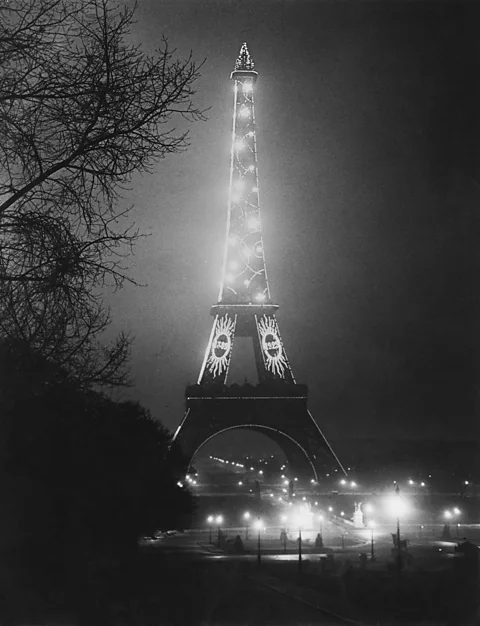
1. The Eiffel Tower illuminated (La Tour Eiffel éclairée (1931))
 Estate Brassai/ Succession Philippe Ribeyrolles copy
This stunning image of the Eiffel Tower showcases Brassaï's skill in nocturnal photography, which in the 1930s involved much trial and error on the ground and ingenuity in the darkroom. As Philippe Ribeyrolles, Brassaï's nephew tells the BBC over email, the production of such images "involved glass plates in a Voigtländer Bergheil camera on a tripod, which allowed for long exposures, different brands of cigarettes as light meters, and a knotted string as a rangefinder. Above all, it required extensive darkroom work, which, through a skilful interplay of contrasts and half tones under a safelight, enhanced his keen sense of composition."
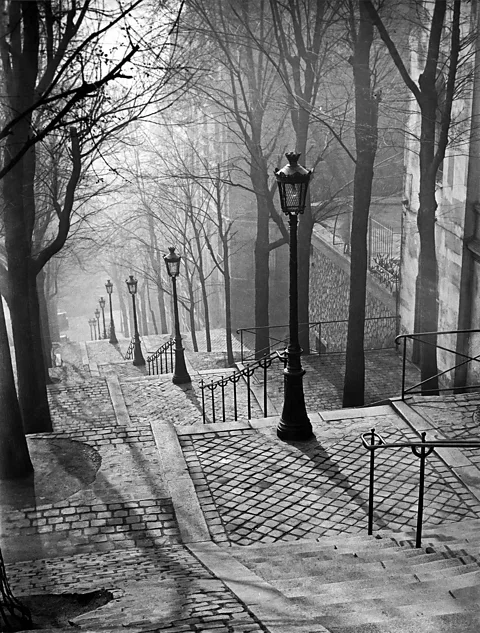
2. Steps of Montmartre (Escalier de la Butte Montmartre (c 1937))
 Estate Brassai/ Succession Philippe Ribeyrolles copy
Brassaï's images, whether of Montmartre's vertiginous tree-lined steps descending into a shadowy world below or the multiple characters that made the night their own, were never simply snapshots of a particular scene. They "do not seek to document an environment, but to extract a latent truth from it," says Ribeyrolles. "The night acts like the developer in the photographer's darkroom: it simplifies forms, sculpts light, isolates bodies, and transforms urban space into a theatre of apparitions. What Brassaï captures are states of being, whether of solitude, desire, or aimless wandering, but also situations, those moments we experience and then struggle to describe."
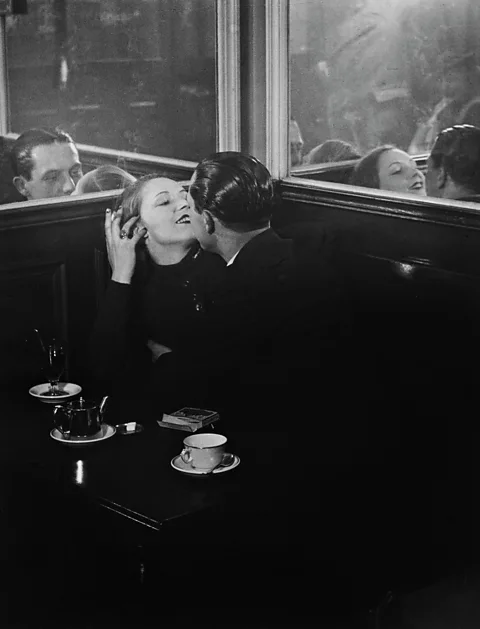
3. Lovers in a small Paris cafe, quartier d'Italie (Couple d'amoureux dans un petit café Parisien, quartier d'Italie (c 1932/ printed c 1970))
 Estate Brassai/ Succession Philippe Ribeyrolles copy
The two lovers gazing into each other's eyes with their enamoured expressions reflected in the mirrors behind them is probably Brassaï's most famous image. Like many of his photographs, it was staged, and it's likely that he had taken time to build up a rapport with the couple in order to obtain the shot. "His method was to be introduced to the bars by someone so that he was accepted when he photographed," explains Tellgren. "He always had some photographs with him to show people what he was working on," and would often give his subjects copies of the images he took, she says.
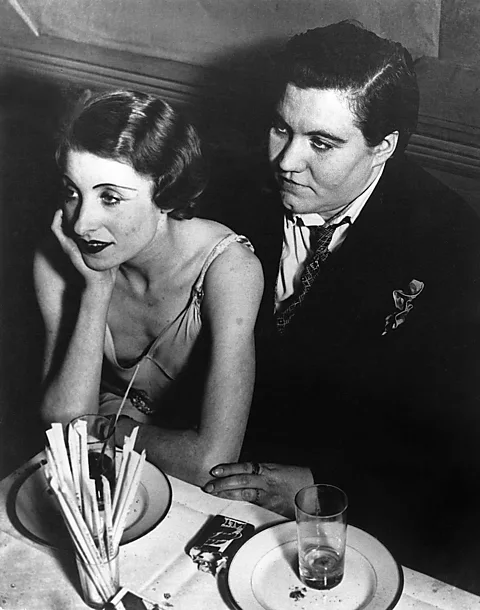
4. Fat Claude and her girlfriend at the Monocle (La grosse Claude et son ami, au Monocle (c 1932))
 Estate Brassai/ Succession Philippe Ribeyrolles copy
Brassaï' took several images of the clientele at La Monocle, one of Paris's first lesbian bars and undoubtedly its most famous. Marlene Dietrich was a visitor and Edith Piaf's mother sang in the cabaret. "Fat Claude", seen here with her girlfriend, was a particularly notable customer. She "was a renowned athlete and quite well-known at the time," says Tellgren. However, her life took a shocking turn during the war. "She became an informer for the Nazis and was murdered by the Resistance in 1944," Tellgren says.
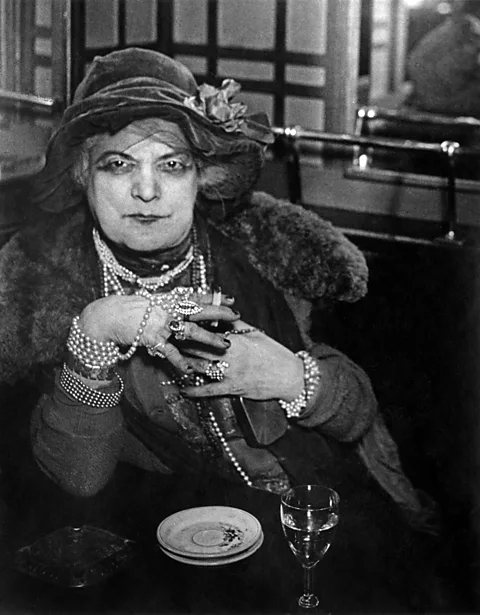
5. 'Bijou' at the Bar de la Lune, Montmartre ('La Môme Bijou' au Bar de la Lune, Montmartre (1932))
 Estate Brassai/ Succession Philippe Ribeyrolles copy
With her striking attire, elaborate jewels and somewhat haughty air, it's easy to see why Brassaï' was captivated by the mysterious figure known as La Môme Bijou. He "saw her in one of the bars, alone with a glass of wine and was totally fascinated by her. Apparently she was an ex-courtesan. He was told that in the years around 1900 she had been a very wealthy woman and then she became older and lost everything," says Tellgren.
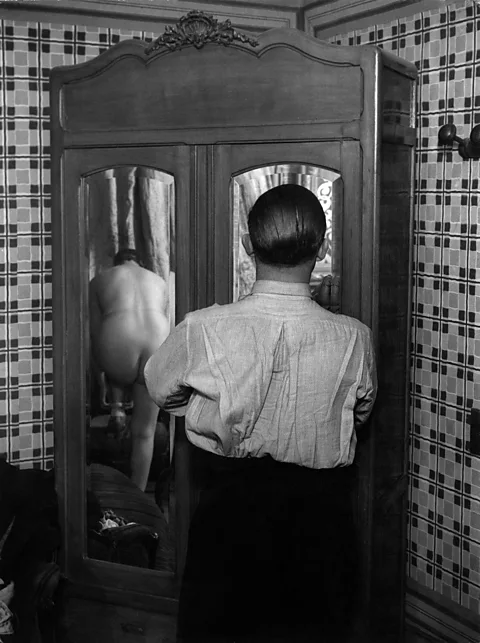
6. Getting Dressed at a Brothel, Rue Quincampoix (Toilette dans une maison de passe, rue Quincampoix (c 1932))
 Estate Brassai/ Succession Philippe Ribeyrolles copy
Brassaï' ventured into a number of Parisian brothels during his night-time explorations but his interest was never prurient. "He was interested in the people he met and I think that's something you see in, for example, the portraits of the prostitutes. You can feel they have in a way accepted him," says Tellgren. The same was evidently not true of the brothel clients who it seems did not wish to be photographed. In order to obtain images such as this, Brassaï' had to draw on his assistant to pose as a customer, although this fact did not come to light until after his death.
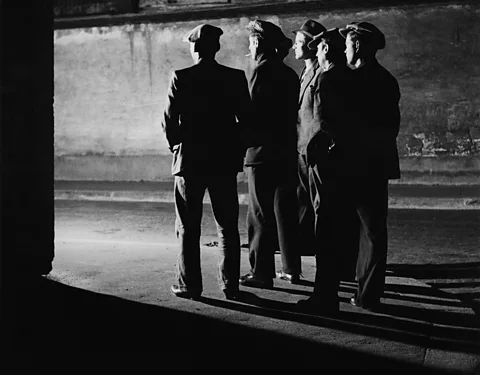
7. Big Albert's Gang, quartier Italie (La bande du Grand Albert, quartier Italie (c 1931−32))
 Estate Brassai/ Succession Philippe Ribeyrolles copy
Brassaï' "always had to gain the trust of those he wished to photograph: obtaining their permission, but above all, without ever compromising the authenticity of the scenes," says Ribeyrolles. However, "sometimes he had no other choice but to use material means to obtain the cooperation of difficult-to-approach people such as Grand Albert, a crime boss".
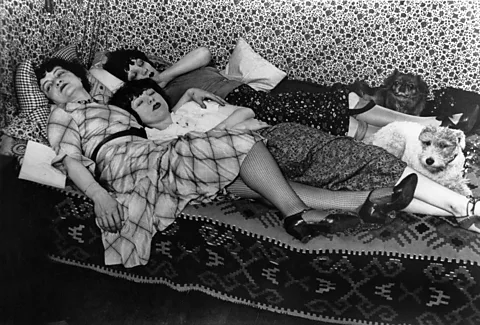
8. Kiki de Montparnasse with her Friends Thérèse Treize de Caro and Lily (Kiki de Montparnasse avec ses amies Thérèse Treize de Caro et Lily (c 1932))
 Estate Brassai/ Succession Philippe Ribeyrolles copy
At the same time that Brassaï was exploring Paris's underworld he was also hanging out in bohemian artistic circles. "What makes Brassaï unique is his ability to move effortlessly from the slums to the most exclusive salons of Paris while rubbing shoulders with the artistic elite," says Ribeyrolles. Seen here, reclining on the sofa in a chequered dress, is Kiki de Montparnasse, a painter, singer, cabaret artist, and legendary figure in the Parisian avant-garde. A one-time lover of Man Ray, she was the model for many of his most iconic works including Le Violon d'Ingres.
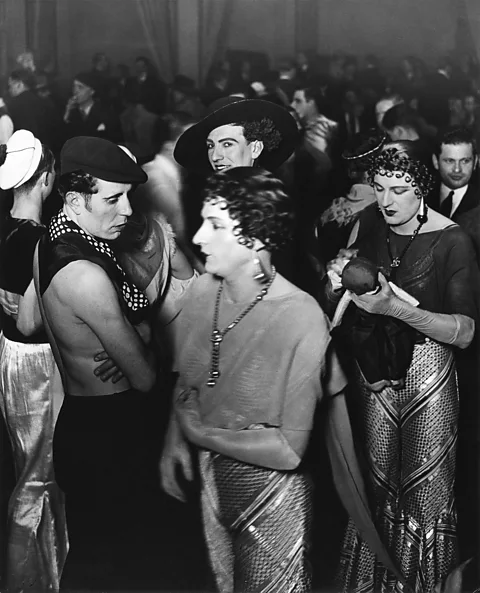
9. Magic-City Dance Hall, Rue de l'Université (Bal au Magic-City, rue de l'Université (1931))
 Estate Brassai/ Succession Philippe Ribeyrolles copy
Some of Brassaï's most evocative photographs are of the drag balls which took place twice a year on the eve of Shrove Tuesday and the third Thursday in Lent, known as Mi-Carême (mid-Lent), at the Magic-City Dance Hall. For these occasions, the police prefecture gave special permission for men to dress in drag as part of the carnival tradition of reversing hierarchies of class or gender identity. Although dressing in drag was not actually prohibited at other times, men dancing together when dressed in feminine attire was. Ribeyrolles tells the BBC that Brassaï' was introduced to the Magic City community by a figure known as Antoine, the King of Hairdressers. The password "Friend" guaranteed entry.
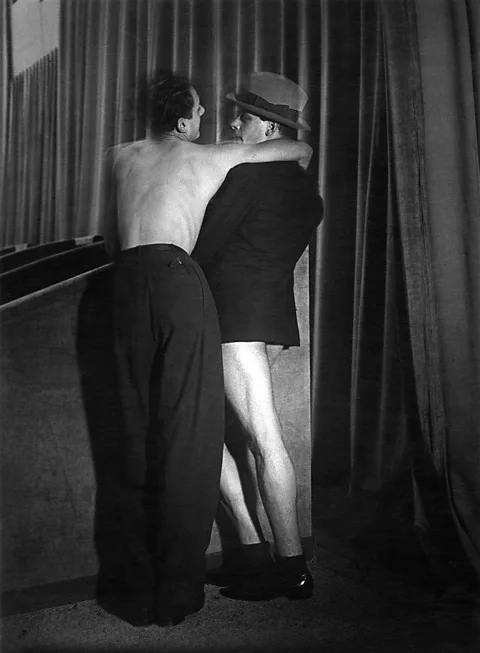
10. A Two-in-One Suit, the Magic-City Dance Hall (Un costume pour deux, bal du Magic-City (1931))
 Estate Brassai/ Succession Philippe Ribeyrolles copy
Not all sections of society were as open-minded as Brassaï. In 1934 the Mi-Carême ball was prohibited after pressure from the far-right groups Action Française and La Liberté. Although it returned in the late 1930s it was generally considered to be a more subdued affair than in its heyday. Post-war Paris would prove to be more strait-laced. Although it would be tempting to see Brassaï's work as a conscious attempt to document an era on the brink of oblivion, Ribeyrolles thinks that is missing the point. "His images are not so much a premeditated act of preservation as the testimony of a fascination with people passing by, fleeting moments, and changing atmospheres. It is this attentiveness that gives his photographs a retrospectively melancholic dimension, as if they unknowingly carried within them the memory of a world destined to disappear."
Brassai: The Secret Signs of Paris is at Moderna Museet in Stockholm until 4 September.
--
If you liked this story, sign up for The Essential List newsletter – a handpicked selection of features, videos and can't-miss news, delivered to your inbox twice a week.
For more Culture stories from the BBC, follow us on Facebook and Instagram.