'An awful experiment': Cash boost for families as two-child limit scrapped

 BBC
BBCWith six children, a busy home, and barely a spare moment, Heather MacMichael's life is hectic before she even begins to think about money.
The 35‑year‑old from Dunfermline has learned to stretch every pound while raising her family on a tight benefits budget - more so under the Universal Credit two-child limit, which excludes support for most of her children.
With that policy set to be scrapped on 6 April, Heather is preparing for a shift that could bring a welcome £1,200 extra a month into her household.
It is a change she believes will ease daily pressures and open up new possibilities for her family.
Life has been tough for Heather with six dependents all under 15.
"I'm not going to sit back and say that it was easy and that we just sailed through it all - because we didn't," she said.
"When people say 'that might stop folk from having more kids because, oh, I'm not going to get money for them' - it didn't stop us.
"We've budgeted around that family, and so we've always made sure that it works for us."
 Getty Images
The two-child limit was introduced by former Conservative chancellor George Osborne in 2017.
He said there would be "no more open chequebook" for out-of-work families.
For nine years it meant many low-income families did not receive further benefits after having a third or subsequent child. Universal credit or tax credits only applied to the first two children.
Labour Chancellor Rachel Reeves announced last November that her party did "not believe that the solution to a broken welfare system is to punish the most vulnerable children", and scrapped the rule.
The Conservatives criticised the decision, arguing people on benefits should have to make the same financial choices about having children as everyone else.
But from Monday, third or subsequent children born after 6 April 2017 will receive Universal Credit and tax credits.
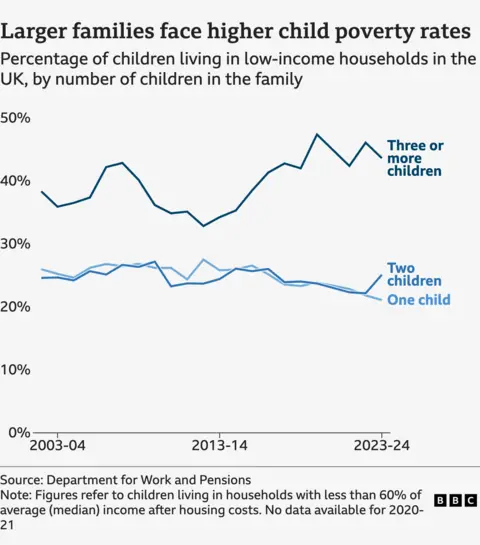
The Department for Work and Pensions (DWP) said about 1.6 million children in larger families had been losing out on these means-tested benefits as a result of the policy.
The change will lift many out of poverty.
The DWP said it would benefit 95,000 children living in 27,000 households in Scotland, predominantly helping working families - about 60% of households affected by the two-child limit have a parent in work.
Heather said money felt tighter with every new child but it didn't stop her from growing her family.
"We always make sure the necessities are done first and then if we've got some left, we've got some left," she said. "We've always lived within our means."
With rising food costs and energy bills, the 35-year-old says the extra money will take the pressure off and allow her family to do more.
Removing the two child-limit across the UK will cost £2.3bn in 2026-27 and £3bn in 2029-30, according to the Office for Budget Responsibility (OBR).
John Dickie, director of the Child Poverty Action Group (CPAG) said it was an "exceptionally good use of public money".
"The two-child limit really has been quite an awful experiment, causing real hardship for children and families across the UK," he said.
"Here in Scotland, there was already commitment to fully mitigate it, but it's far better that it's been abolished at source and that all children across the UK will now benefit from the financial support that they need."
He added: "The limit is absolutely arbitrary based on the number of children, not based on the needs of the family. So abolishing it is hugely welcome."
"It will make a big impact to families, transformational in many cases."
Another policy - the benefit cap - will remain in place.
It limits the total amount of benefits working-age people can get which the DWP says ensures fairness for taxpayers and maintains the incentive to work.
The cap is about £22,020 annually for families outside London - with some exceptions.
The extra money families receive through the lifting of the two-child limit could push them over that cap - meaning they don't receive the increase they are entitled to in their Universal Credit in full.
Heather receives adult disability payment due to a long-term health condition, meaning she is exempt from the benefit cap but others in Scotland may have to apply to councils to make up the difference.
Campaigning charities such as the Child Poverty Action Group would like to see the benefit cap abolished.
"It's great that the Scottish government is committing further resources to mitigate the UK benefit cap through discretionary housing payments to affected families but it really needs to be abolished at source," John Dickie said.
'A genuine shot at life'
Heather said it did not sit well with her that the benefit cap could affect some Universal Credit child payments.
"How's that fair if other people get it and other people don't?", she said. "Surely, with it being for children, everybody who's got children should get it regardless if you've got a disability or not?"
Speaking about the lifting of the two-child limit, Secretary of State for Work and Pensions Pat McFadden said: "This is about changing the story of children's lives. It's about giving every child a genuine shot at life – so they can do well at school, stay healthy, and go on to contribute to their community as adults.
"By scrapping the two-child limit and alongside our child poverty strategy, we will lift 550,000 children out of poverty by the end of this parliament.
"That is an investment worth making – for those children, for their families, and for the whole country."