The Hong Kong rape allegation that led to blackmail conviction

 BBC
BBCIsabel Rose, a 25-year-old woman from east London, is adapting to life inside Hong Kong's oldest maximum security women's prison.
On 3 March, Rose was convicted of blackmail and perverting the course of public justice, after first reporting a rape in Hong Kong. She is now awaiting sentencing on 22 July and faces up to seven years in prison.
She says she is adjusting to the sound of banging gates and jingling keys at Tai Lam Correctional Institution - a complex of concrete and razor wire that overlooks a thin strip of water. She spends her time making notes on her verdict and reading about post rape trauma inside.
"I don't feel sad, just numb," she said, adding that she felt the whole experience of reporting the allegation left her feeling like her dignity was "stripped away".
Campaigners say the case raises wider questions about how allegations of sexual assault are assessed and the judgements made on behaviour following this type of trauma.
The allegation was reported to Metropolitan Police which told the BBC that it could only pursue the claim once the complainant returned to the UK.
Rose grew up in east London, but attended boarding school in Eastbourne. She worked in creative marketing.
In late 2023 Rose left the UK to teach English in Vietnam.
She then travelled to Thailand where she met a British banker on holiday. They stayed in touch over WhatsApp.
While she was on holiday in Goa, he invited her to Hong Kong, offering to pay for her flights.
Rose alleges that 12 hours after arriving on 31 January 2024 she was attacked and raped by him in his apartment.
The following day, she said he offered her compensation, that she initially refused, then later accepted.
She reported the allegation to police on 3 February.
Hong Kong police first arrested the man, but within hours released him and arrested Rose, charging her with blackmail and later with perverting the course of public justice.
The man cannot be named for legal reasons. The police said there was insufficient evidence to pursue the rape claim.

Rose was released on bail but was unable to work or leave Hong Kong for two years while awaiting trial.
"I'd just gone to the police to report rape and within about 30 hours there were six or seven police officers at my door," she told the BBC while on bail.
"It takes a lot to report something like that, to then be treated as a criminal. I felt like my dignity was stripped away," she told the BBC.
She was not given anonymity when the case was heard in court.
During the hearing, the judge rejected Rose's evidence and pointed to inconsistencies in her testimony.
In a 300-page judgement, the judge said Rose had used a romantic connection to manipulate the man, had made escalating demands for money and knowingly made a false allegation that led to his arrest.
At the centre of the case were WhatsApp messages exchanged between Rose and the man she accused in the hours and days after the alleged rape.
In one message, Rose wrote: "You violated me last night, I didn't wanna have sex."
He replied: "I'm really deeply sorry, I was slightly drunk and I misread your signals, it's no excuse and I know it doesn't make it any better."
He told the court he understood this as a reference to "emotional violation" and not a rape. He said that he read the message in two parts.
The court heard that Rose later asked for money.
"Can you send me the money you owe me," she wrote in a message.
He transferred £5,000 to Rose. She later asked for £10,000 which he attempted to send but was stopped by bank checks.
Rose said that the payment was compensation he had offered for flights, accommodation and medical costs.
She later sent a message saying: "You've given 10% of what I'm owed. 100% of my soul gone."
The judge said that Rose demanded £100,000 and threatened to go to the police, claims that Rose denied in court. The prosecution argued the payments amounted to blackmail and that her report of rape to the police was false.
In other WhatsApp exchanges, the man described an experience where a past partner asked him to indulge in non-consensual sex fantasies.
The judge said Rose's behaviour before and after the allegation was "wholly inconsistent with rape".
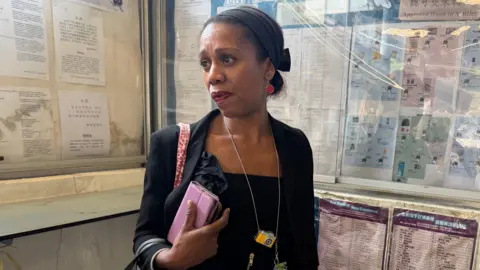
Women's rights groups say trauma responses do not follow the pattern that the public, police or courts may expect.
Ngozi Fulani, from Sistah Space, a London based charity which supports women of African and Caribbean heritage affected by domestic and sexual abuse, said behaviour following trauma was often misunderstood.
"Trauma does not follow a script," Fulani said.
"After sexual violence, survivors send texts that sound normal. They may stay in contact. They minimize. They struggle to give consistent accounts when retelling events."
She said research indicated that black women were less likely to be seen as vulnerable victims of sexual violence.
Advocates say the case raises wider questions about how rape cases are assessed in Hong Kong.
Rape myths 'prevalent'
Hong Kong is in the process of reforming its sexual offences laws, many of which were established in the 1970s. This year the government is planning a public consultation on the reform of the laws.
Rainlily, a sexual violence crisis centre in Hong Kong, said a very small number of reported rapes ended in conviction. According to its research, less than half of rape victims in Hong Kong report their cases to the police.
Cheryl Yip, is an advocacy officer at Hong Kong's Association Concerning Sexual Violence Against Women.
She said that "dated laws continue to be a common challenge for victim-survivors", adding that rape myths shape public opinion, police responses and judgements in court.
"Our dated laws enable this, especially with common questioning that draws relation from the victims clothing, drunkenness, and if they resisted vigorously," added Yip.
"Re-traumatisation and rape myths swim through every corner of Hong Kong's criminal justice system."
'Blindsided by the money'
Rose said there were problems while reporting the allegation.
She said she had to repeat her accusation to multiple police officers over 12 hours, and no recording was made of her statement.
She said there was no translator present and her forensic tests were conducted by a male doctor. Later the results were inconclusive, neither proving nor disproving the alleged sexual assault.
Rose said after she was arrested she was taken to a police cell and then a hospital, where she was handcuffed to a bed.
She said she was told to take medication and was threatened with being taken to a mental institution. Hong Kong police declined to comment.
 Lilly Crick
Each morning Rose's mother Bell, travels away from the city's high rises to visit her daughter in prison.
Bell has been living in Hong Kong for two years supporting her daughter. She says that she has spent tens of thousands of pounds on legal fees and accommodation.
"They have made her look like she is a desperate young girl hustling for people's money," she said.
"It's far from that. She is educated. She has a good job. I wanted her to have opportunities in life."
She said the alleged rape was not properly investigated.
Michael Polak, a UK based lawyer from Justice Abroad, said: "The police were blindsided by the money."
In 2024 Bell travelled back to London to report the alleged rape to the Metropolitan Police.
Under the UK law, police can investigate certain sexual offences committed oversees by British nationals.
Correspondence seen by the BBC showed that the Metropolitan Police opened a case in 2024.
The man was treated by the force as a suspect. Bell was later told the case was paused and that they needed Rose to return to the UK in order to make a statement.
She was then told the Met feared the Hong Kong police would not cooperate.
"They do have a duty to investigate him. Not just for my daughter," she said.
In a statement, the Met told the BBC that "enquiries remain ongoing".
The force added: "Currently, due to a lack of jurisdiction in the relevant country, the Met Police are unable to pursue relevant enquiries until the victim returns to the UK."
'No hiding'
Rose's MP, Dame Meg Hillier, said she had raised the case with the Foreign Office.
"The outcome of this case could further discourage women from reporting sexual assaults in Hong Kong, which is already an issue indicated by the low level of sexual assault reports," she said.
"It took two years for the Hong Kong authorities to bring Isabel Rose's case to court for a conviction.
"After reporting a serious sexual assault in Hong Kong, her case was dismissed and instead she faced a counter accusation of blackmail," she added.
The Foreign Office said: "We are supporting a British woman in Hong Kong and are in contact with the local authorities."
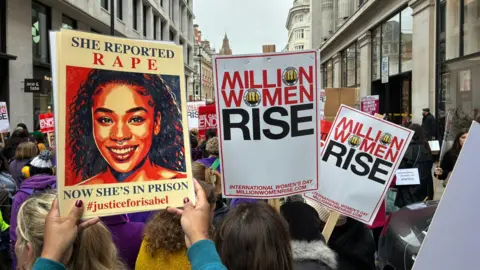
On International Women's Day, a group of supporters printed banners of Rose and marched through the streets of central London.
Inside Tai Lam Correctional centre, Rose awaits sentencing. Bell is calling for support from the British government.
"Carrying that and not saying anything would have destroyed her more," she said.
"She is in prison. But she is in power no hiding, no shame," she said.
Listen to the best of BBC Radio London on Sounds and follow BBC London on Facebook, X and Instagram. Send your story ideas to hello.bbclondon@bbc.co.uk