MSPs need to work together to reform council tax - SNP

 Getty Images
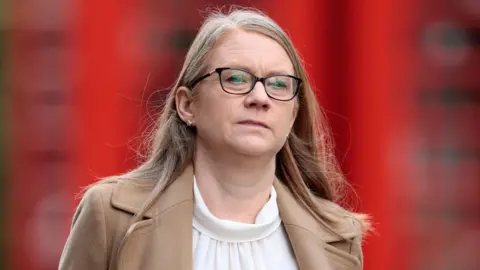
Politicians will need to work together if council tax reform is to be delivered, according to the SNP's Shirley-Anne Somerville.
She told BBC Scotland's The Sunday Show that the tax was a challenging issue as, although everyone agreed reforms were needed, there was no consensus at Holyrood on what that should look like.
The SNP came to power almost two decades ago promising to scrap and replace the tax, but changes made since have stopped short of a major overhaul.
Council tax is a compulsory charge on properties, with the rate set individually by Scotland's 32 local authorities.
Councils are responsible for providing public services, including education, social care, planning, rubbish collection and street lighting.
They also maintain other services, such as libraries and swimming pools.
Somerville said the lack of consensus among MSPs at Holyrood had made it difficult for her party to introduce reforms since the SNP came to power in 2007.
She said parliamentarians would have to rise to the occasion after the election and work together to come up with a solution.
However, she insisted that, despite increases, bills were lower in Scotland than they were in England.
Labour's Paul O'Kane said broad reforms were needed.
He also said it would be up to the Scottish Parliament to come together to find a solution.
He said 20 years ago, the SNP promised to scrap the "unfair" council tax.
Since then, there have been council tax freezes which have stored up problems while cutting local government budgets.
It was not sustainable for public services going forward, he added.
Council tax system 'comically broken'
Lib Dem Jamie Greene said people were feeling the pinch everywhere, but he was doubtful that a consensus could be found in the next parliament.
Greene told the programme: "Of course, council tax needs to be reformed, of course, local government has to be funded properly, and we need to do what we can to bring people's monthly bills down... [but] I struggle to see where there would be consensus."
He added: "I think the best thing the next government could do is some independent work about alternatives to the council tax, take the politics out of it, and come up with some sensible solutions."
The Scottish Greens' co-leader Ross Greer said the council tax system was "comically broken".
He added that poorer households were paying more than they should, while the richest were getting off with a "steal".
Greer also said those living in the biggest and most valuable houses should pay more because it would be fairer.
The Scottish Conservatives pledged to cut taxes and cut the benefits bill.
Craig Hoy said they would simplify the tax system to put more money back in people's pockets, specifically increasing the personal allowance and the upper threshold.
Hoy said the fundamental problem was that the SNP had cut the real-terms budget of local councils, despite budget increases being given to the Scottish government from Westminster.
About 80% of a council's budget is handed down from Holyrood.
Hoy said that while their budgets were being cut in real terms, councils were being asked to do more.
He added that his party wanted a fair funding formula for local councils based on what comes to Holyrood from Westminster.
Malcolm Offord, Reform UK's leader in Scotland, said people were too highly taxed and suggested that everyone should get a tax break.
He also told the programme councils had been starved of funding.
The party's manifesto states that Reform would "immediately cancel the planned increase in council tax".
It also said additional bands labelled as a "mansion tax" were "in reality a terrace tax".
And it added that the additional bands would hit hard-working families with mortgages and pensioners living in their forever homes.
The manifesto said these "mansions" were semi-detached and terraced houses in Scotland's towns and cities.
Where do councils get their money from?
About 60% of a council's general funding comes in the form of a grant, paid by the Scottish government.
Then 20% comes from taxes on businesses premises, called non-domestic rates.
The final 20% comes from the council tax, which is paid by households, both by homeowners and renters.
According to the Accounts Commission, over the last seven years, councils have had a fairly steady increase in cash terms in funding from the Scottish government.
But in real terms, growth in funding has been minimal due to inflation.
Over the next three years, the total settlement received by local authorities is not predicted to increase, which amounts to a real-terms funding cut of 3.8%.
The umbrella body which represents councils in Scotland, Cosla, has said the medium-term outlook for councils is "deeply concerning".
And it called for honesty about "funding, priorities and local flexibility".
 Getty Images
Stretched authorities face taking on greater responsibility, as demand grows for health and social care services for Scotland's ageing population.
Costs for delivering these services are growing, too.
Nationally negotiated pay deals for teachers and other council staff, free school meals and expanded free childcare provision are also adding to the pressure.
Councils often complain that large areas of their budget are ring-fenced to deliver policies decided by the Scottish government, which reduces the ability of councils to deliver on local priorities.
The last Scottish budget did raise the possibility of extra council tax bands for homes worth more than £1m, but that would not come into force for a few years and may only, ministers suggest, raise about £14m across Scotland.
So to balance the books, councils are left with relying on savings, hiking the council tax or cutting back services. Some are exploring the possibility of bringing in a tourist tax on visitors to the area.

Why is council tax reform so difficult?
There are very few people in local government who would claim that the council tax is an ideal way for people to help pay for local services.
But is it the "least worst" option? Or is there a better alternative?
The council tax typically accounts for less than a fifth of each council's budget. Most comes from the Scottish government and business rates.
The council tax was introduced by John Major's government to replace the community charge or poll tax - a flat rate charge where everyone who didn't get a discount paid exactly the same, regardless of their income or assets.
The poll tax was hugely unpopular across Britain but was particularly controversial in Scotland, where it was introduced first.
Some would contend its unpopularity played a large part in the creation of the Scottish Parliament.
But if the words "hated" and "controversial" can be applied by critics to both the community charge and council tax, what can be said about the tax which they replaced?
Domestic rates were unpopular too, and a controversial revaluation in the mid-80s led to the poll tax being introduced to replace them.
While the poll tax was always contentious and came to be seen as a huge political miscalculation by Margaret Thatcher's government, at the time some of her supporters genuinely believed they were introducing a better system which had merits.
So can the council tax be replaced now?
Around a decade ago, the Scottish government established a commission to examine alternatives.
It set out details of a few - examining their pros and cons - but did not recommend a particular option.
A local income tax, for example, might be seen as the fairest system as it is directly linked to someone's ability to pay.
But a different level of income tax in each council area could be an administrative nightmare.
Meanwhile, raising income tax by the same amount across Scotland to help finance councils would break the link between local voters and the services they help pay for.
The problem is that almost every way of raising money for councils has pros and cons. Is it fair? Can it be simply understood by the public? Is it practical? And any change would almost certainly mean that some people would be better or worse off to begin with.
Unless broad support emerges for one of the alternative options, replacing the council tax completely would seem highly unlikely.
The last thing any politician wants to do is repeat the mistake made by the Conservatives in the late 80s and replace one disliked tax with one which is even more unpopular.
