Scientists excited to receive first Artemis signal

 Reuters
Scientists at a satellite earth station in Cornwall were excited to receive their first signal from Nasa's Artemis II mission to the Moon.
Matthew Cosby, chief technology officer at Goonhilly Earth Station, Helston, said receiving the first signal at about 02:30 BST on Thursday had been "an exciting moment for us".
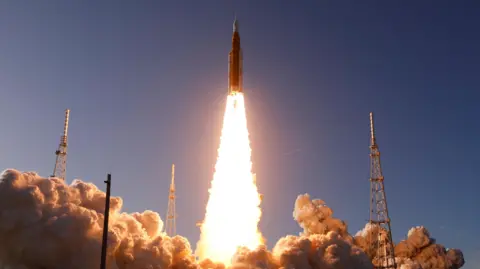
Goonhilly is helping to track the Orion spacecraft in the first crewed mission to the Moon in 50 years after it launched from the Kennedy Space Center in Florida at 23:35 BST on Wednesday.
Cosby said Goonhilly was undergoing a qualification test for Nasa to collect data and "hopefully we'll demonstrate that we are one of the best in the world".
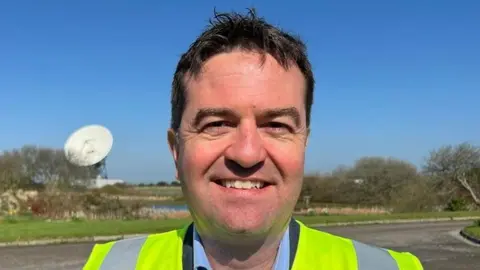
He said Goonhilly had supported about 20 lunar missions but this was the first time humans were on the spacecraft from which the team was collecting data.
He said Nasa would compare the data collected and processed by the Goonhilly team with that processed by its own stations.
Cosby said: "It's like going back to school, we're in an exam at the moment to show how capable the team is with all the procedures and how good the technology is that we've built in Cornwall."
If the Goonhilly scientists prove successful, Cosby said they would then be able to support future Artemis missions.
He said: "Future Artemis missions will see people return to the Moon and actually walk around the surface of the Moon, which will be a fantastic moment."
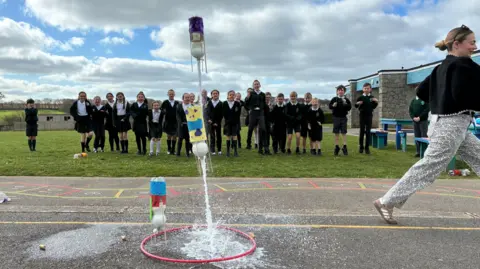
It was not just scientists who were excited about the Artemis II mission, pupils at Nansloe Academy in Helston were too.
The children have been learning about space and the Moon, as well as making their own rockets.
With many having missed the actual launch, they gathered in class on Thursday morning to watch the countdown and gave a huge cheer as they saw the spacecraft lift off.
Marla, 10, said: "I'm really excited to see what's on the far end of the Moon.
"I think there could be aliens. Maybe [we will learn] that we're not alone and there's other species out there other than humans."
Lily, 10, said: "The Moon is really interesting...and I'm just so interested that there's so many craters on there and it looks like a big piece of cheese, really."
Asked if she'd like to go to the Moon she said: "Yeah, probably, because it's not a lot of gravity that's on there, so I could probably fly."
Hattie, 6, added: "I hope there's other species out there that we can find and we can be, like, a part of the family with them."
Follow BBC Cornwall on X, Facebook and Instagram. Send your story ideas to spotlight@bbc.co.uk.