Backdrop of conspiracy theories to searches for Noah, inquest hears

 Pacemaker
A police witness at the Noah Donohoe inquest has described how searches for the missing boy were taking place against a background of conspiracy theories and antagonistic behaviour.
Former PSNI Insp Philip Menary, who was a member of the PSNI's Tactical Support Group, also said there was no evidence that Noah Donohoe was in an underground water tunnel when his team commenced searches around the tunnel.
Menary was part of a police hazardous environment team which began searching the tunnel three days after the 14-year-old's disappearance in June 2020.
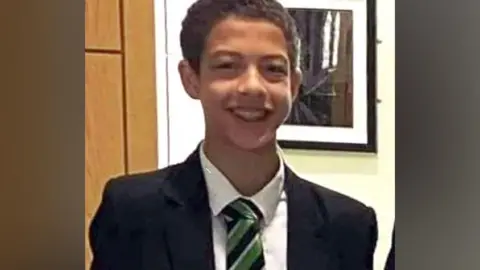
Noah's body was found in the tunnel six days after he went missing.
Menary explained to the inquest that his specialised unit was a search team as opposed to a rescue team.
Asked by a barrister for Fiona Donohoe, Noah's mother, if they considered "a possibility" that Noah could have been in the tunnel at the time of their initial search, he replied, "there was no evidence of that."
If there was any evidence that Noah was in the tunnel, he said, a rescue team such as the fire service would have been deployed to the scene.
He said his unit was deployed to "rule out any suggestion that Noah had actually gone into the tunnel".
The search around the tunnel was taking place while other searches were also continuing at nearby locations and around other areas of Belfast.
The witness was also questioned about delays around the sharing of information between police teams about tidal conditions in two thirds of the tunnel.
The family lawyer said this did not happen until five days after the boy went missing.
The witness once more repeated that there was no evidence that Noah was in the water tunnel at the time.
'Angry at anyone'
The Donohoe family barrister also suggested to the witness that the search of the tunnel "neither started not proceeded with any sense of urgency".
The witness replied: "We did what we could with what we had."
They also referred to issues linked to the searches including "conspiracy theories" among some members of the public about what may have happened to Noah.
He also said some people who arrived on the scene were angry at police and "angry at anyone".
He repeated previous evidence about hostile behaviour from some people who were among a large crowd who had come to the area to try to find Noah.
Menary said they were not in the majority but there were "quite a number of people who were antagonistic" towards the police.
He said there was "an element in the crowd that was very disruptive".
During his evidence, Menary repeatedly insisted that there was no evidence that Noah had gone into the tunnel when they began their searches.
If there was any suggestion that he had entered the culvert inlet, the witness said, there would have been a different search strategy.
The witness also told the Donohoe family barrister that the police requested a local neighbourhood police team to encourage members of the public to leave the area to allow expert search teams to conduct the operation.
Asked by the barrister why this had not been done sooner, he explained that it had to be managed carefully so that it did not became a public order issue.
Otherwise, he said, a number of public order units would have been needed to disperse the crowd of several hundred people.
Challenges for search team
The witness also accepted that specialised camera equipment used by his search team in the tunnel had a history of breaking down.
He said it was an expensive piece of equipment, but they often spent time fixing it, adding, "I'm not a great fan of it".
The witness was questioned at length about the time it took to conduct searches inside the tunnel, but he defended the timing of his team's operation, saying they had to contend with concerns around issues including health and safety and the potential for toxic gases being released when silt was disturbed.
The Donohoe family barrister challenged him repeatedly about his belief that there could have been a risk of gases in the tunnel, but he insisted that from his knowledge of working in similar environments he believed there were potential risks, and they had to be considered.
Noah's body was eventually recovered by divers, and the family barrister told Menary, "Your team failed to find Noah".
The witness replied, "In hindsight, all things are great".
The family barrister said Menary's team had been involved in the operation at the tunnel since the Tuesday after Noah went missing and his body was not found until the following Saturday.
The witness said that because the search for Noah went beyond the Friday, he considered it "a failure on our part".
Menary was the first member of the specialised police team to go into the tunnel during the search for Noah.
The tunnel runs from a culvert inlet close to where Noah went missing in north Belfast towards an outlet at Belfast Lough.
Noah's body was found more than 600 metres downstream from where he is believed to have entered the culvert beside Northwood Road where he was last seen naked and running behind houses.
Menary, who previously gave evidence to the inquest over a two-day period two months ago, returned to the hearing to continue his evidence on Thursday.
Earlier this week, a hydrology expert told the inquest that it is "very likely" Noah Donohoe drowned on the day he disappeared in the storm drain where his body was later discovered.