Amputee football team wants to offer coaching base

 Courtesy of Cambridge City FC
An amputee football team manager said he hoped to create a permanent base to promote the sport.
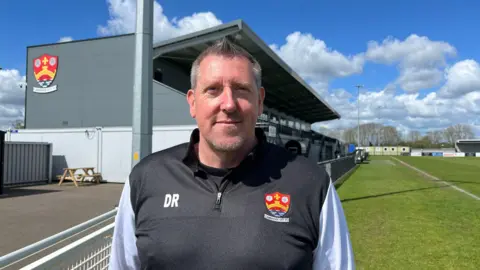
Duncan Rumbelow, who manages an amputee team adopted by Cambridge City FC, said he planned to offer taster sessions at the club's stadium in Sawston, but would like it to become a full-time base for amputees of all ages to benefit from professional training.
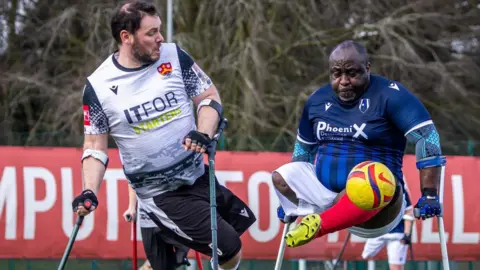
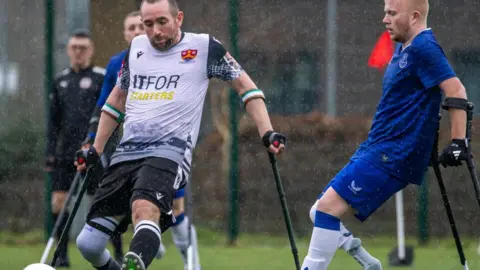
The seven-a-side sport is played on crutches and operates on a national model, with players across the country coming together for fixtures held in Cheshire.
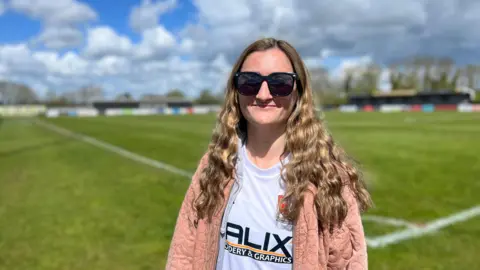
Izzy Papandronicou, a player in Rumbelow's mixed-gender team, said "travelling three to four hours" for football was "not ideal or great for growing the sport".
Rumbelow, whose father Richard played for Cambridge City in the 1950s and went on to play for Cambridge United, said the Cambridge City FC Amputee Team was only one of four in the UK currently playing in the England Amputee Football Association (EAFA) league.
The Cambridge team has members from as far away as Ireland, Newcastle and Portsmouth, as well as a few players closer to the city club.
And the other league clubs - Chelsea, Everton and Scottish team AFAS - also boast players from far and wide, forced to travel because there are so few opportunities to train with other amputees.
In international competitions, outfield players are single-leg amputees and play without prosthesis, while goalkeepers are typically single-arm amputees.
However, in domestic matches, players can play with or without prosthesis and arm amputees can play outfield. There is no offside rule and kick-ins replace throw-ins.
Papandronicou - an amputee Lioness - told BBC Radio Cambridgeshire: "The more bases we can get in different parts of the country, the bigger the sport will grow."
 Tom Jackson/BBC
Cambridge City adopted the amputee team in February, which has given it "club identity" ahead of the Amputee Cup Final in June at St George's Park in Staffordshire, part of the Disability FA Cup.
Papandronicou said Cambridge City had been "supportive" and that a "brilliant community" had grown around amputee football.
"I've always had a love for football, but once I lost my leg when I was 14 there weren't any opportunities to play," she said.
"I saw my friend playing football on crutches and wanted to be involved. I've not stopped playing since."
 Tom Jackson/BBC
Papandronicou said she had her leg amputated due to congenital pseudarthrosis of the tibia - a rare condition that caused repeated fractures.
After more than 20 surgeries, she chose to have part of her leg removed in favour of using a prosthetic.
She said she felt "too disabled to play normal football, but not disabled enough to play disabled football", and it was "really incredible" to be able to play again when she found amputee football.
 Courtesy of Cambridge City FC
Rumbelow said as the EAFA was based in Nantwich, Cheshire, it seemed likely games would have to be played there in the foreseeable future, but he hoped by offering "taster sessions" at the Cambridge ground more people would get involved in the sport.
One day, he would like to see the ground becoming a base for professional training for amputees of all ages and genders.
"Most players have to play and train with their local clubs but it's not the same as training with an amputee team, but if we can get this as a base, we can show we have the facilities and determination to make this happen," he said.
Do you have a story suggestion for Cambridgeshire? Contact us below.
Follow Cambridgeshire news on BBC Sounds, Facebook, Instagram and X.