'Mini Switzerland' rural transport plan approved

 Stagecoach
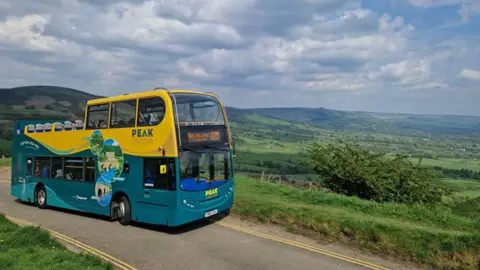
Plans for a new pilot project aiming to create a so-called "Mini Switzerland" transport network in the Peak District have been given the green light.
The project in the Hope Valley has received £6m to deliver a Swiss-style integrated public transport system, modelled on Switzerland's clock-face timetables and connections between buses and trains.
It aims to achieve better transportation connections, less waiting for travellers and a more reliable alternative to the car.
It is hoped the pilot will be fully functioning in time for the summer of 2027.
The proposed trial features tickets that work across different operators and the network is to be supported by "modest infrastructure upgrades".
Services will be timed to meet each other every hour, with simpler, joined-up ticketing and clearer information for passengers.
The focus will be on coordinating services that already exist, with improved links designed to grow passenger numbers and deliver better value for money.
The project is modelled on the hourly train service which runs to and from Sheffield and Manchester through the Peak District. A report last month stated the current bus services were "infrequent and unpredictable" and not timed to meet the trains.
This would be changed to better serve trains along the main bus corridor between Castleton, Hope, Bamford, Hathersage and Eyam, with services running every 20 minutes all day.
Campaigners have said it could become the "UK's first real‑world demonstrator" for a fully integrated rural transport system.
The project is the brainchild of volunteers at Hope Valley Climate Action.
The government granted the £6m to the East Midlands Combined County Authority (EMCCA), which recently became the official Regional Transport Authority for the Nottinghamshire, Derbyshire, Nottingham and Derby area.
Transport Secretary Heidi Alexander said the project would aim to "make getting to work or a day out in the Peak District by public transport as easy as jumping in the car".
Thomas Ableman, public transport expert and creator of the concept, said it was "fantastic" the project had received government backing and said he would be pushing for a longer-term funding settlement for it.
"One of the wonderful things about this is that it doesn't require large scale infrastructure investment [but] there is some investment because it needs to be good.
"You need good bus stops, better pedestrian access between stations and bus stops, new signalled crossings... plus much better, and more buses.
"There's absolutely no reason why this can't be done quickly and once it's proved in the Hope Valley, there's no reason why it can't be done in all rural areas," he said.
High Peak MP Jon Pearce said he was pleased to see the funding delivered after the area had been mired by issues with tourism.
"For too long, communities from Castleton to Hope and Bamford have put up with unreliable public transport, congestion and illegal parking," he said.
Alan Graves, leader of the Reform-UK run Derbyshire County Council said he was in favour of the scheme "on the face of it" provided the taxpayer gets value for money and private car use is not restricted as a result.
"There's a lot of people that actually like to use their own vehicles because it's more convenient, they can carry more things with them, take things with them on holiday wherever they're going," he added.
Listen to BBC Radio Derby on Sounds and follow BBC Derby on Facebook, on X, or on Instagram. Send your story ideas to eastmidsnews@bbc.co.uk or via WhatsApp on 0808 100 2210.