Soldiers take North Sea ferry to Nato exercise

 PA Media/Owen Humphreys
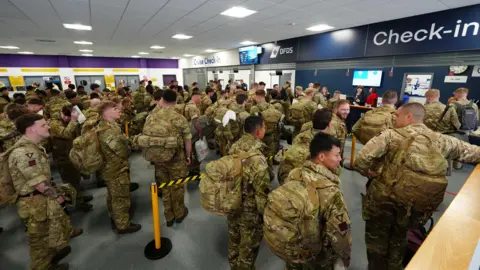
The Army has used a civilian ferry to deploy soldiers to mainland Europe en masse for the first time in more than 20 years.
About 1,400 troops boarded a DFDS vessel from North Shields, in North Tyneside, for a 16-hour North Sea crossing to the Netherlands.
From there, the soldiers from the 7th Light Mechanised Brigade, known as the Desert Rats, will take trains to central Germany for a Nato exercise.
The Ministry of Defence said using a civilian ferry - usually filled with lorry drivers and visitors to Amsterdam - was not due to a lack of military transport.
It was the first time since the Iraq War in 2003 that a ferry has been chartered for military use by the Army.
Nato's procurement agency arranged the contract with the intention for the organisation's members to test their ability to use civilian transport infrastructure.
Bingo and karaoke
Company Commander Charlie Gilmore of Right Flank, The Scots Guards, based in Catterick, North Yorkshire, described using a civilian ferry for a large-scale deployment as "unusual in recent times".
He said: "We used them a generation or two ago in the Falklands and a generation ago in the Gulf conflict.
"There's also a strong reason behind it. It shows a kind of flexibility."
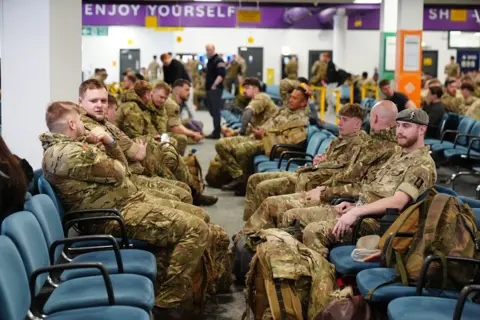
There was no alcohol or duty free shopping available for the trip, which was reserved for service personnel.
Entertainment on board included bingo, karaoke and music.
 PA Media/Owen Humphreys
Exercise Rhino Storm will involve live-firing exercises and brigade tactics over several weeks.
Gilmore added: "If we were to rely on the strategic airlift that's provided by the Royal Air Force, we would clog all of that up to move the circa 1,400 people that are going.
"It would take about seven flights to do that.
"So we can move by air, by sea, we can move by rail, and it allows us to force-project to the location we need to get to."