Bereaved families asked to help paramedic research

 North East Ambulance Service
A research paramedic wants to hear from people who have lost loved ones unexpectedly, to find out how ambulance crews can best support them.
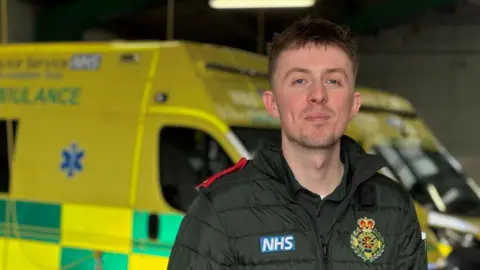
Owen Finney from the North East Ambulance Service (NEAS) is asking people in the north-east of England and Cumbria to take part in an anonymous interview about their experience.
The 28-year-old wants to know what they found helpful or what emergency responders could have done differently.
"There's not a lot of research on this topic and we really want to understand it more so we can improve the care - the emotional support - that we're providing to families," he said.
When someone dies unexpectedly, at home or in a public place, ambulance crews are often the first to deliver both emergency care and emotional support, NEAS said.
In the North East alone, they perform resuscitation on 10 to 20 patients a day, Finney said.
"Just in our small patch in the North East, we're dealing with this a lot," he said.
"[If a patient dies] our attention turns to: 'how do we then break bad news? How do we do that in a way that's empathetic, compassionate, respectful?'"
Online or in-person
He said it was important to make sure families understood when resuscitation attempts had failed and they were told "compassionately" and as early as possible.
Crews also give practical support at times of bereavement such as dealing with the police, undertakers, or supporting other family members who may arrive at the scene.
Finney said there was a lot of research about helping those whose loved ones died in hospitals, but not in community settings.
He hoped his work would pull together examples of best practice.
"We're quite optimistic and positive that this is really going to make a big impact," he said.
Research participants could be interviewed either online or in-person at a nearby ambulance service site.
Director of paramedicine at NEAS Andrew Hodge said: "The insights we gain will play a crucial role in shaping future training."
The research is being jointly funded by NEAS and the National Institute for Health and Care Research: Applied Research Collaboration North East and North Cumbria.