What to know about the SAVE America Act

 Anadolu via Getty Images
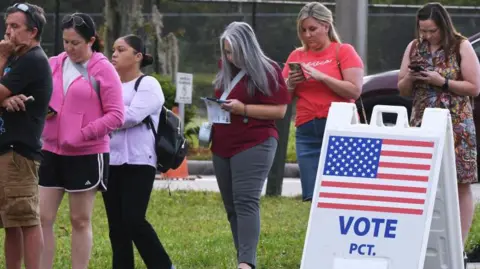
The US Senate is considering the SAVE America Act, which would require people to provide ID and proof of citizenship to vote.
President Donald Trump has pushed his fellow Republicans to do whatever it takes to pass the legislation, but it faces an uphill battle.
The House of Representatives has already passed the Safeguard American Voter Eligibility Act (SAVE).
A newer version of the bill, with amendments requested by Trump, now sits with the Senate, but it is not expected to pass the upper chamber of Congress.
Meanwhile, some US states with Republican-led legislatures have taken up the cause to introduce their own proof-of-citizenship bills.
Democrats say the legislation disenfranchises eligible voters, while Republicans say it is necessary to prevent voter fraud.
Here's what to know about this legislation.
What would the SAVE act do?
The SAVE act would require Americans to prove they are US citizens when they register to vote. It would also mandate showing a valid photo identification before they cast their ballots.
Some states already require voters to present valid photo identification at the polls. Federal law mandates that voters in national election be US citizens, but it does not require mandatory proof of citizenship, as the proposed legislation would.
Voter ID is a popular idea with US voters.
A Pew Research Center poll from last year found 83% of respondents favoured requiring all voters to show government-issued photo ID, including 71% of Democrat or Democratic-leaning voters and 95% of Republican or Republican-leaning voters.
Under the legislation, election officials who register a voter without obtaining the required proof of citizenship could face criminal penalties.
The SAVE act would also establish a process for people whose names have changed to submit additional documents to verify their identity.
This provision has drawn particular concern for individuals who changed their names after marriage.
An estimated 21 million Americans do not have documents proving their citizenship readily available, and 2.6 million lack any form of government-issued photo ID, according to the Brennan Center for Justice, a liberal-leaning think tank, and the University of Maryland's Center for Democracy and Civic Engagement.
What does Trump say?
President Trump has urged his Republican party to push the measure through both chambers of Congress so he can sign it into law.
He told House Republicans: "I'm not going to sign anything until this is approved."
"It'll guarantee the midterms," he said, referring to November's congressional elections. "If you don't get it, big trouble, my opinion."
Explaining his support for the bill, Trump has also repeated his claim that the 2020 election was stolen by massive voter fraud.
While cases of small-scale voter fraud do occasionally emerge in US elections, no proof has emerged of such corruption on a scale that would alter the result of a White House vote.
Members of the president's party, by and large, support the legislation in its original form.
Complicating the matter, Trump has attached additional provisions.
These include a proposed ban on postal ballots, with certain exceptions, such as for voters with disabilities or US military members.
But Republicans do not unanimously back a clampdown on mail-in balloting, which is popular in many US states.
Trump has also added other amendments unrelated to elections, in order to draw Republican support.
These include a ban on transgender surgery for children and on transgender athletes in women's sports.
Is the SAVE act likely to pass the Senate?
To become law, the new version of the bill would need to clear both the House and the Senate.
But it is unclear if and when the Senate will vote on the measure. Democrats have declared the bill "dead on arrival".
An older version of the legislation passed the House in February, mostly along party lines, in a 218-213 vote.
But with a 53-47 majority in the Senate, Thune does not have the 60 votes he would need to pass the bill.
Some have urged Thune to change the filibuster rules by lowering the threshold needed to pass such a bill to a simple majority of 51. But Thune has resisted pressure to eliminate the super-majority threshold.
Republicans have also encouraged Thune to use a "talking filibuster", which would require round-the-clock speeches on the chamber floor by Democratic senators as they seek to stall a final vote on the legislation.
"This particular approach in terms of the process is much more complicated and risky than people are assuming at the moment," Thune told reporters.
Republican Senator Lisa Murkowski of Alaska said she would not back the measure.
Previously, Democrats have also tried - unsuccessfully - to enact nationwide voting rules, as opposed to the current patchwork of state-by-state measures.
But the Freedom to Vote Act and the John Lewis Voting Rights Advancement Act did not make it through Congress under the Biden presidency.