Why isn't Martyn's Law in force a year after Royal Assent?

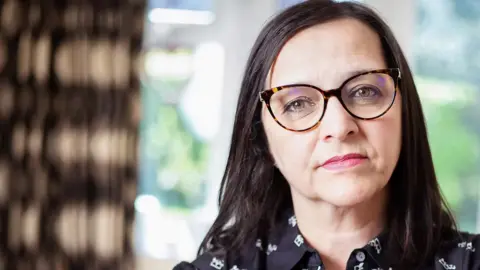 Senem Peace
The mother of a Manchester Arena attack victim who led the campaign for a new law to prevent terrorist attacks at public venues is still waiting for it to come into force despite being given Royal Assent a year ago.
Figen Murray, started the campaign in 2019 for The Terrorism (Protection of Premises) Bill, which is also known as Martyn's Law, after her son Martyn Hett who was one of 22 killed in the 2017 blast.
Although it got Royal Assent on 3 April last year, the government gave it an implementation period of at least two years before the Act becomes mandatory to allow those impacted "sufficient time to prepare for the requirements".
A year on, Murray said she promised to do something "outrageous" if there was the "slightest inkling" it would not be implemented by 22 May 2027 - the 10th anniversary of the Arena attack.
What is Martyn's Law?
Martyn's Law requires staff at all UK venues with a capacity of more than 200 to have a plan in place in case of a terrorist attack on their premises and sites with more than 800 people to implement extra measures such as CCTV, bag search policies and vehicle checks where appropriate.
How did the legislation come about?
 Family photograph
The campaign for the new law started in 2019 when Martyn Hett's mother launched an online petition to improve security measures to counter the threat of terrorist attacks and how venues respond to them.
Murray worked with a team of co-campaigners to get Martyn's Law fully implemented.
Why was it needed?
It is aimed at ensuring public places are better prepared for terrorist attacks and requires them to take practical actions to reduce the risk of physical harm and the impact of attacks.
It mandates who is responsible for considering the risk from terrorism and how they would respond to a terrorist attack at certain premises and events.
Clear and simple guidance will be given to duty holders, ensuring everyone involved knows what to do and how to do it.
Why isn't Martyn's Law mandatory now?
The government gave the legislation an implementation period of at least two years before the Act comes into force.
The Home Office said this would allow the Security Industry Authority, regulator of the UK's private security industry, to establish a new function to regulate the new law and give premises and event organisers sufficient time to understand and implement their new obligations.
Having spent "seven years of her life" campaigning for it, Murray said it was frustrating it was not mandatory yet.
Delays had included change of government and the Covid pandemic but she said she understood it needed "a lot of thought" especially as there was "no other legislation anywhere in the world like this" and it was "important to get it right in the first place".
However, she said she had set herself a personal deadline of "two years after the King [Charles] signed it - so 3 April 2027".
"If I get the slightest inkling this is going to be [delayed] beyond the 10th anniversary [of the Arena attack] I will do something crazy again... as a protest."
"I can't do another 16-day walk because having done it once but I will be doing something outrageous and silly if I feel they're going to drag their feet and delay it."
She added: "It is not OK for the legislation to be delayed any further because people need to be safe.
"We are in a global mess and there is danger out there and people are becoming more and more twitchy and could act out their frustrations on innocent people like Martyn and the 21 other people who got murdered."
What does the government say?
A Home Office spokesperson thanked Figen Murray "for her tireless work to make this law a reality".
They said: "The implementation period for Martyn's Law is still ongoing.
"We will publish guidance this spring, allowing those in scope sufficient time to prepare for the requirements under the Act coming into force."
Has anything changed one year on?
Murray said she had already seen material changes to security at venues and said she believed it was "beginning to be" much safer to go to public events.
"I am noticing it wherever I go," she said.
"I was in London a few months ago and I walked past Madame Tussauds and I smiled to myself because they were putting putting sort of security measures up whilst the queues were slowly forming."
"They are known in the industry as high footfall or mass screening technology that can actually screen people without them having to do bag searches.
"They just go through and they don't need to unpack anything or take their coats off so that will give venues the opportunity to screen people as quickly as they can and in greater quantities so queues outside will be kind of eliminated."
"On Saturday I was at Manchester Arena and they have the same high footfall technology there now, which is great to see."
She said: "I know people who go into that building during concerts or events have been screened and nobody can go in with anything... dodgy."
Murray said "more and more places" were experimenting with the technology and she was noticing more smaller venues were doing bag searches, which she believed was down to the legislation "because everybody knows it's coming".
She said she expected a "massive shift" in venues putting the new security measures needed in place when the government issues Section 27 guidance, which will include finer details of the law for venues.
What would Martyn's make of his legacy?
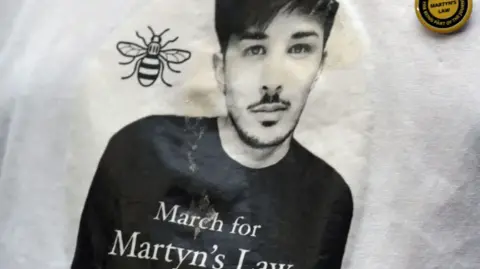 PA Media
She said her aim with the campaign was to make sure people were safe and not suffer the "same fate" as her family.
However, she said it was "quite a big deal" when she was told her son's name would be enshrined in British history.
When asked what she thought her son would think of his legacy, she said: "I hope he would be pleased that his name stands for something and that actually people are saved and everybody will remember what that was about and and who initiated it.
"It's obviously me who's done it, but it's in Martyn's name. He couldn't have done it himself; I'm his spokesperson. I'm his representative as his mum."
Listen to the best of BBC Radio Manchester on Sounds and follow BBC Manchester on Facebook, X, and Instagram. You can also send story ideas via Whatsapp to 0808 100 2230.