Will Destiny the humanoid robot take your job?
If you want to see how much Britain's industrial landscape is changing, pay a visit to Cotgrave in Nottinghamshire.
Futuristic human-like robots are being developed in a village where hundreds of men used to work as traditional coal miners.
The local colliery closed in the early 1990s, but now a small technology firm on the edge of that site is working on "humanoids" that look like sci-fi characters.
Welcome to the future.
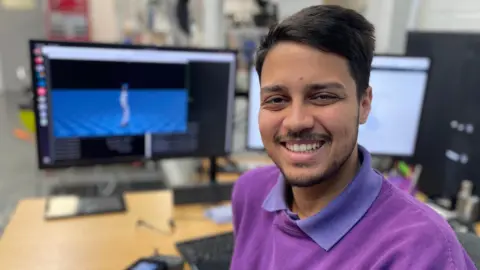
Robotics engineer Nathan Wallace has spent the past few months programming and training a robot he has named Destiny.
"We thought we needed some girl power, and Destiny just seemed perfect," the 23-year-old told the BBC.
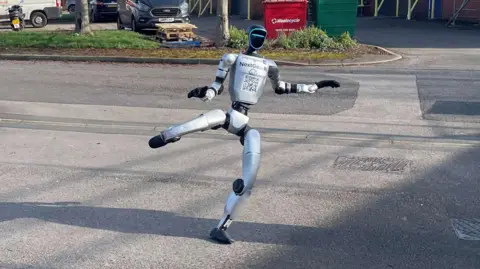
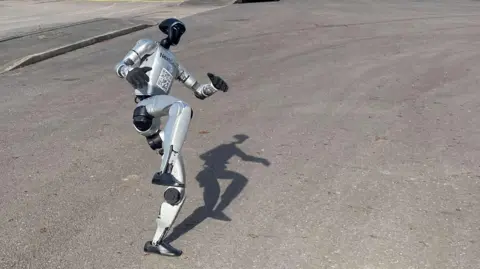
Destiny has articulated arms and legs that give it the flexibility to perform a wider range of tasks than traditional industrial robots.
"The difference between a humanoid robot and a specific robot like a robot vacuum is that they can be in any application where a human could be previously," Wallace said.

Destiny can run, dance and even perform Kung Fu moves, and Wallace, from Gedling in Nottinghamshire, expects to see humanoids programmed to do laundry or cooking and cleaning.
He describes the humanoid as an "embodied AI model with the ability to speak, react and manipulate the real world".
Like so much of our technology its basic hardware is built in China but NextGen Ri, where Wallace works as head of robotics, has a UK contract to build additional kit and customise those robots commercially.
Wallace designed a robotic dog for a national policing trial last summer, and now he is programming Destiny to perform tasks for businesses using instructions that train it like a pet.
"It might be a reward for staying stood up, but a punishment for falling over, and to get the higher reward it learns how to balance," he said.
Wallace says one woman asked whether she could use his humanoid to replace her Tai Chi instructor but was worried Destiny would "fight back".
He has also been approached by a firm that wants robots to operate a fully autonomous storage unit, from greeting customers to operating their lockers.
"It can be used in a vast array of situations but anything that's laborious or dangerous is what we're looking at first," he said. "Things like decommissioning nuclear reactors for example.
"We can do remote bomb disposal where someone would put on a VR headset and basically control the robot from across the world."

Humanoid research is the latest development in a robotics industry that is already using artificial intelligence to revolutionise factories and warehouses.
Wallace accepts that Destiny will replace traditional jobs but says the robots will create some new roles for people who build, fix and maintain them.
When I asked if Destiny will take my job, it began answering in Chinese - before a little help from Wallace gave me a response I could understand.
"I'm here to help you shine at work, not take your job," it said.
"If you ever need a robotic team-mate for boring tasks and fun company, just let me know. Would you like me to show off some of my moves?"
Those dance moves help to capture the public's imagination but the commercial value of humanoids is all about competitiveness and cutting costs.
The Trades Union Congress has warned that AI technology could repeat "the disaster of deindustrialisation" as shareholders get richer while jobs are "degraded or displaced".
But it adds that AI could have transformative potential if developed properly, and workers could benefit from its productivity gains.
Some politicians argue that automation could help the UK's aging population become less reliant on migrant workers.
How are humanoid robots being developed commercially?
In industry, humanoids have already been developed for repetitive and precision tasks in warehouses, distribution centres and some US and South Korean car factories.
The University of Nottingham is researching the use of healthcare robots to tackle a crisis in social care. Prof Praminda Caleb-Solly told the BBC it aims to find out what elderly people would want from those robots.
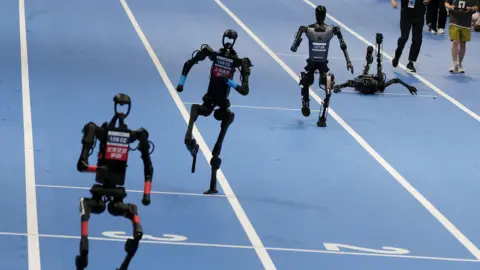
And in the world of sport and entertainment, humanoid robots are being developed for athletics and football and theme parks, and have appeared alongside humans in novelty dance routines in China.
 Reuters
A UK government briefing paper says "highly capable, mobile, dexterous and autonomous humanoid robots" will eventually have potential applications across society.
The paper says that could include education, healthcare, domestic support, construction and search and rescue.
It adds that challenges include safety, cost-effectiveness, privacy and inequality - and that public acceptance of the technology is "highly uncertain".
Those challenges were clear as Nathan demonstrated the humanoid's basic moves while people filmed on phones in the centre of Cotgrave.
One woman asked if it could do her housework and walk the dog, and a man who shook Destiny's hand described it as "impressive" and "amazing".
Other responses were less positive, with comments including "I don't trust it", "the freakiest thing I've ever seen" and "it's frightening me, is this the future?"
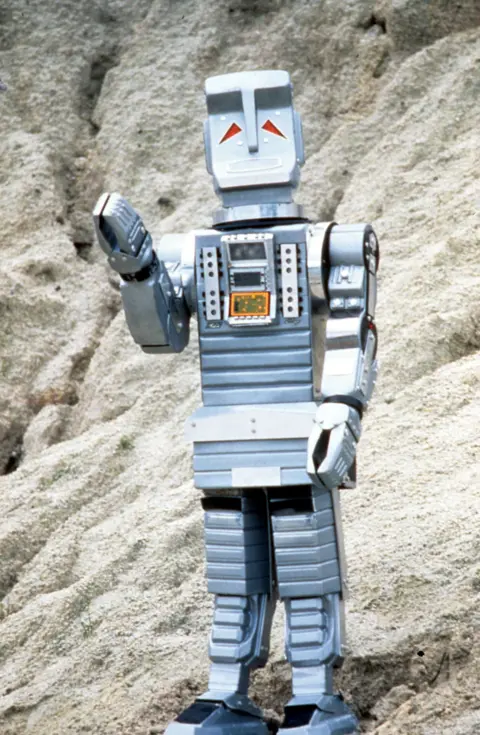
Nathan dismisses dystopian fears of rampaging autonomous robots as the stuff of science fiction movies.
"The software has come so far that if it gets hacked the robot is just able to cut all communication, so it turns itself off and it can't be controlled", Nathan adds.
"There won't be killer robots anytime soon, they do exactly as they're told".
Listen to BBC Radio Nottingham on Sounds and follow BBC Nottingham on Facebook, on X, or on Instagram. Send your story ideas to eastmidsnews@bbc.co.uk or via WhatsApp on 0808 100 2210.