New Beachy Head trawling ban gets go-ahead

 Paul Boniface/Sussex Underwater
A new law banning trawling and scalloping in an area off the Sussex coast has been approved by the government.
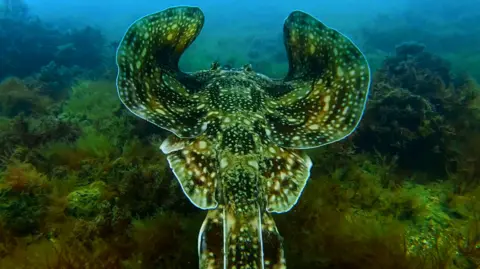
It means a zone of 101 sq miles (164 sq km) off Beachy Head which is home to short-snouted seahorses and reef building worms will be protected from fishing practices seen by many as destructive to marine habitats.
Five years ago fishing using bottom-towed gear was banned in an area stretching across nearly 117 sq mile (302 sq km) of Sussex waters.
The new law now sees almost 30% of the inshore waters in Sussex protected from trawling.
 Fiona Irving / BBC
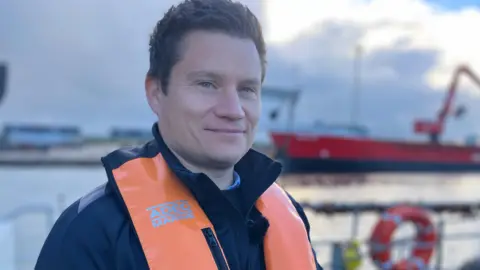
The Sussex Inshore Fisheries and Conservation Authority (IFCA) hopes the announcement of a ban in the Beachy Head East Marine Conservation Zone (MCZ) will help conserve some of the most important marine habitats within the Sussex district.
Robert Pearson, chief officer at Sussex IFCA, says the chalk reef that makes up the Beachy Head East MCZ not only provides "valuable habitat" for some important fish species but also valuable nursery areas and juvenile feeding grounds for those species.
Bottom trawling is viewed by many conservationists as damaging and indiscriminate.
The practice sees weighted nets dragged along the seabed to catch fish and can lead to the destruction of reefs and other marine habitats.
 Sussex IFCA
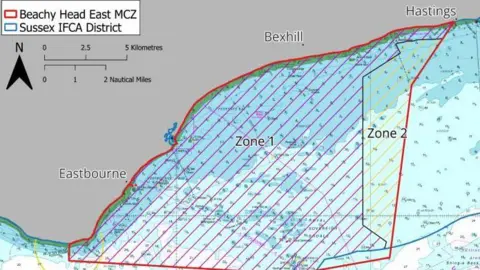
From today, trawls, seines, dredges, or similar types of fishing gear towed on or very close to the seabed are banned from being used in the 164 sq km zone 1 of the site.
Fishing vessels will still be able to trawl in a 28 sq km zone 2 area where sensitive habitats aren't present.
The use of "low impact" fishing techniques including nets, pots and rod and line fishing will continue on the site.
 Fiona Irving / BBC
It is Sussex IFCA's responsibility to monitor the trawling bans.
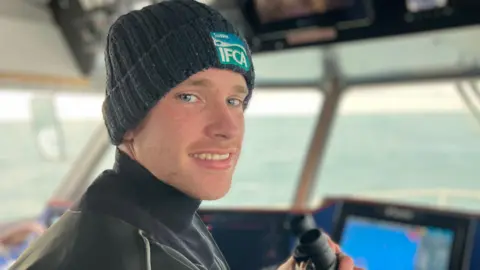
James Tapley a conservation officer from IFCA says when out on patrol he looks for fishing vessels in protected zone travelling at around "three to four knots".
"Imagine they're dragging a big heavy trawl behind them or heavy scallop dredges" he says, "they simply can't go any faster through the water."
Since the first no-trawl law came in Sussex IFCA have not had to issue any warnings or prosecutions to fishermen or women breaking the law.
 Fiona Irving / BBC
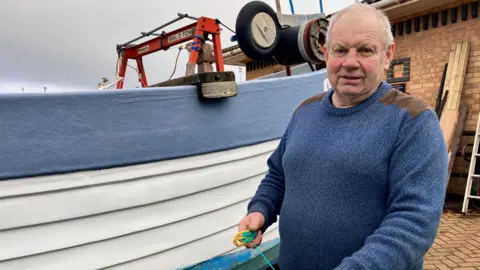
Trawlerman, Michael Scott, is not a fan of the new law.
He has fished out of Newhaven for more than half a century and believes the no-trawl bans have put pressure on his ability to make a living.
"Every closed area there is, income goes" he says .
He says the Beachy Head East Marine Conservation Zone is the "biggest area" that will be closed off to trawlers and he is sceptical whether they will see a benefit of increased stocks from the zone when the fish migrate in the winter.
Conservationists say The Sussex Nearshore Trawling Byelaw from 2021 has led to an "remarkable" recovery in marine life.
Sussex Kelp Recovery Project (SKRP) researchers have reported an increase in the populations of lobster, brown crab, angel shark and short-snouted seahorse in the controlled area.
It is hoped the new ban will also see positive results.
The government is currently considering implement further bottom trawling bans in Marine Protected Areas (MPAs) in the UK, including four in Sussex and Kent.
Follow BBC Sussex on Facebook, on X, and on Instagram. Send your story ideas to southeasttoday@bbc.co.uk or WhatsApp us on 08081 002250.