'Pioneering' message that changed the world

 BBC
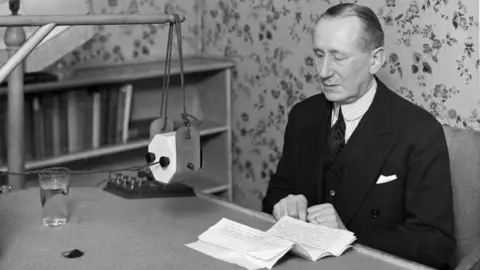
BBCA century ago this year, a message sent across the Atlantic to Somerset changed the way the world communicated.
The historic message was transmitted in 1926 using the world's first shortwave transatlantic telecommunication link between the UK and Canada, from Quebec to Bridgwater.
It was received at the former Marconi station at Huntworth, now an open field near the Bridgwater motorway service area, before being relayed to Cornwall.
Larry Bennett, a local author and former radio operator, said: "It was pioneering. It used this new thing called shortwave radio, which was a new fangled thing in those days - but it worked and Marconi liked Somerset. It was an ideal location."
The world's first radio message: "Can you hear me", was sent by Guglielmo Marconi across open water from Cardiff to Flat Holm, an island halfway across the Bristol Channel on 13 May, 1897.
Three years later, Marconi achieved the first transatlantic wireless signal from Poldhu to Newfoundland in Canada.
The first shortwave transatlantic transmission was no less important despite taking place more than 25 years later, according to Peter Garland, from the Drummondville Historical Society in Quebec in Canada.
"It had wider significance - because long wave transmission was good for telegraphy, good for across the Atlantic but the shortwave transmission eventually was able to carry voice," he said.
'Bit flakey'
Bennett, said the early pioneers "didn't quite understand" shortwave radio at first but through "research and experimentation it became a regular service".
"The Post Office was invested in the Imperial Wireless Network linking the UK with all the colonies around the World," he said.
"They employed Marconi to build a station at Bridgwater to link initially with Canada and South Africa.
"[And] Marconi liked Somerset. It was flat, on the West Coast for transatlantic communication, no industry, no electrical interferences - it was an ideal location."
He said the Marconi Beam Wireless Station was built between North Petherton and Bridgwater and boasted two ranks of masts around 287 feet (87m) high which "dominated the horizon".
"To get a call across to Canada was a complex procedure to set up - but it worked," he said.
"Some days it was good, some days it was a little bit flakey but as equipment got more sophisticated - it became much more efficient into the 1920s and the 1930s."
'Global first'
The experiment also laid the groundwork for modern communications technologies.
Bridgwater Town Council said it was a "communications breakthrough that changed the world".
"The first transmission was more than just a technical feat; it was the true tipping point towards the era of modern telecommunications," council leader Brian Smedley said.
"Without this breakthrough, mobile phones, satellite communications, 5G and even future 6G technologies would not exist in the way we know them today. It's another global first for Bridgwater."
To mark the centenary, a commemorative event is being held on 25 October.
Along with a re‑enactment of the original transmission, using artefacts and equipment from the 1920s, it will also feature radio amateurs from both sides of the Atlantic.
Follow BBC Somerset on Facebook and X. Send your story ideas to us on email or via WhatsApp on 0800 313 4630.