Mayor warns of London 'disinformation blizzard'

 Getty Images
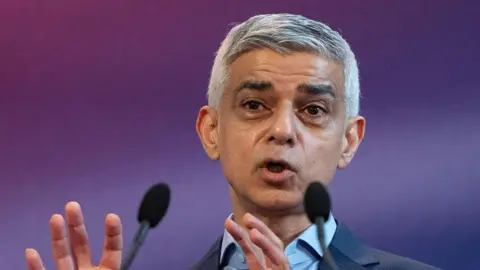
Sir Sadiq Khan has warned London is facing a "dark blizzard of disinformation" online, accusing social media companies of allowing organised networks to profit from a "division dividend".
Speaking on Thursday, the mayor cited new City Hall research suggesting hostile actors, including foreign states and far-right groups, are portraying the capital as a city in decline.
He said disinformation had become an industry, driven by an "outrage economy" that allows people to profit from division.
BBC News contacted major social media platforms for a response. TikTok and Meta said they remove coordinated inauthentic behaviour, while Telegram said it removes calls to violence when identified.
The analysis commissioned by the Greater London Authority (GLA) found there had been a sharp rise in narratives framing London as a "fallen city" where crime goes unpunished and "basic decency has all but disappeared".
Between March 2024 and March 2026, online activity describing the capital as a dangerous city in decline increased by between 150 and 200%, while migration-related narratives referencing London surged by more than 350%, the report said.
These trends emerged despite the mayor's assertion that London's per capita homicide rate has fallen to its lowest level on record.
The research identified coordinated efforts by UK-based extreme right-wing groups, alongside accounts aligned with Russian or Chinese state interests and US-related political movements, to amplify these claims.
One network identified in the study, based in Vietnam, used AI-generated imagery and the impersonation of local media outlets to spread emotive content to more than one million followers.

Encrypted messaging apps such as Telegram were also identified as key channels where disinformation can originate before spreading to mainstream platforms.
The report's author's noted the findings were indicative rather than comprehensive, citing limited access to platform data and reduced transparency around algorithms and moderation systems.
In February, BBC News reported on a wave of AI-generated videos falsely depicting a "taxpayer-funded water park" in Croydon, part of the wider trend portraying London as a city in decline.
The mayor highlighted the real-world dangers of these digital campaigns, pointing to the case of a retiree who blew up a Ulez camera with explosives after spending time in social media groups where conspiracy theories were being spread.
Speaking at the Cambridge Disinformation Summit, he warned "as extremists erode trust in our city and its institutions, it gets easier and easier for them to twist online anger into offline violence".
"In a few years' time, I think we'll look back on London as the canary in the coalmine. But I hope we'll also see it as the place where the fightback began," Sir Sadiq added.
He insisted he was not seeking to silence legitimate criticism, stating "I haven't come here today to ask anyone to take down content which criticises me", but argued that the "outrage economy is eating away at the basic bonds of trust that hold our societies together".
In a series of letters sent to the heads of major social media platforms, including TikTok, Meta, Google and X, the mayor called for greater transparency and an end to "opaque algorithms designed to maximise engagement at any cost".
He requested that tech companies provide "vetted independent researchers" with access to their data to allow for better monitoring of coordinated disinformation.
TikTok said it had a "longstanding and collaborative relationship" with City Hall, adding that the GLA's research did not include data from its platform.
The company said it had specialised teams to detect and remove coordinated inauthentic behaviour and supported independent research by giving UK-based academics access to public data, adding that content under "#LondonTok" offered a "joyful celebration" of the city's diversity.
Meta said it was "constantly working to disrupt" coordinated inauthentic behaviour, adding that it had removed more than 200 networks globally and does not allow fake accounts or the artificial boosting of content.
A spokesperson said the company was reviewing the research and was in contact with the mayor's office.
Telegram told the BBC it supports "peaceful free speech" and that calls to violence were "forbidden and are removed whenever discovered".
The mayor also urged the government to take a "much tougher approach" by creating a new central body to protect democracy and giving regulators like Ofcom the power to "hit companies where it hurts" if they fail to act.
A Department for Science, Innovation and Technology spokesperson said social media firms were required under the Online Safety Act to remove illegal misinformation and that Ofcom had strong powers to act if platforms fail to comply.
Listen to the best of BBC Radio London on Sounds and follow BBC London on Facebook, X and Instagram. Send your story ideas to hello.bbclondon@bbc.co.uk