Historic Vance-Ghalibaf talks must bridge deep distrust

 EPA
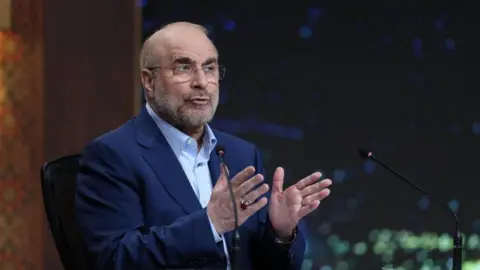
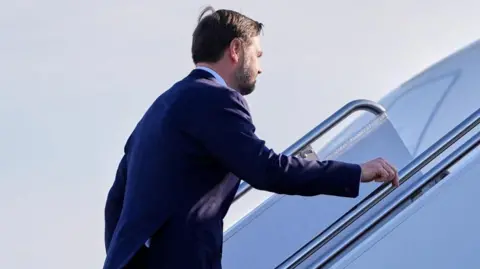
EPAIf and when a photograph is taken of US Vice President JD Vance standing next to Iran's Parliamentary Speaker Mohammad Bagher Ghalibaf in Islamabad this weekend, it will make history.
That moment would mark the highest-level face-to-face talks between the Islamic Republic of Iran and the United States of America since the 1979 Islamic Revolution shattered their strong strategic bond and cast a long shadow which still darkens relations to this day.
The two men may not smile. They may not even shake hands.
It would not make this troubled relationship any more easy, any less hostile.
But it would send a signal that both sides want to try to end a war sending shocks worldwide, avoid an even riskier escalation, and turn to diplomacy to do a deal.
There's zero chance though of President Trump's optimistic prediction of a "peace deal" within this shaky two-week ceasefire; its terms were contested and broken since the moment it was announced earlier this week.
Even until the eleventh hour, Iranians kept everyone guessing over whether they would still show up while Israel was insisting there would be no ceasefire in Lebanon.
But if serious and sustained talks make a start, it would also mark the most significant push since Trump pulled out of the previous landmark nuclear deal in 2018, during his first term. He dismissed what was widely seen as the foreign policy highlight of the Obama administration as the "worst deal in history".
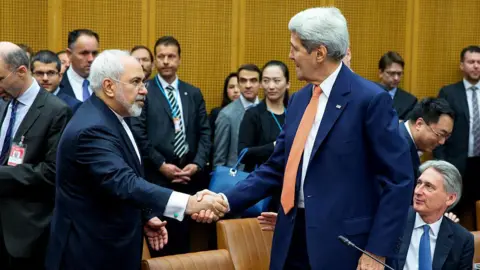
Those talks, in endless rounds stretching over nearly 18 months of breakthroughs and breakdowns, were the last high-level meetings between the US's then secretary of state John Kerry and Iran's then foreign minister Mohammad Javad Zarif.
 Thomas Imo/Photothek via Getty Images
Efforts since then, including during President Biden's term, made little headway.
"The dispatch of more senior officials and high stakes of failure for all sides could open possibilities that weren't there before," assesses Ali Vaez of the International Crisis Group, who has followed all the twists and turns over many years.
But, he cautions, this time is still "exponentially harder".
The gaps between the two sides remain very wide; the distrust runs very deep.
That well is especially vast for Tehran after their last two series of negotiations, in June 2025 and February this year, were suddenly whacked by the opening salvos of an Israeli-American war.
Contrasting styles
And, when they do talk, their negotiating styles are poles apart.
President Trump boasts he has the best dealmakers in his special envoy Steve Witkoff, a former property developer, and his son-in-law Jared Kushner, his go-to person during his first term, when the Abraham Accords normalised relations between Israel and a few Arab states while sidelining the Palestinians.
But Iran, which now views these envoys as too close to Israel, insisted on raising the level of engagement, specifically to the Vice President JD Vance. Not only does he hold a formal position within the US administration, rather than being a friend or family member, he is also seen as the strongest sceptic of this military campaign in Trump's team.
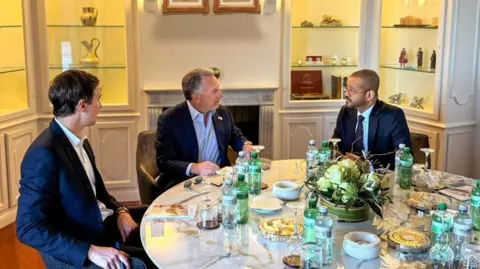
Iran's approach has also imposed limitations, especially in its insistence that the negotiations mainly be conducted indirectly, through Oman, their trusted mediator.
In Geneva in February, behind high walls and away from the world's cameras, some direct conversations did take place in the midst of the indirect exchanges. But Iranian hardliners, deeply distrustful of this track, were said to have tied the hands of negotiators who also wanted to avoid any risk of hostile or humiliating exchanges.
Witkoff's signature style had been to usually arrive on his own. Diplomatic sources involved in this process say he often didn't even take notes - which only heightened Iranian suspicion and meant the talks often went in circles. Then Kushner was added to his team.
 Oman Foreign Ministry
The contrast with the negotiations a decade ago couldn't be starker – the American and Iranian delegations included strong contingents of experienced diplomats and leading physicists. They were also bolstered by senior European diplomats as well as foreign ministers from the other four permanent members of the UN Security Council - the UK, France, China and Russia.
In the last rounds in February this year, progress is said to have been made when the two delegations were assisted by the technical expertise of the International Atomic Energy Agency (IAEA) head Rafael Grossi, and seasoned mediators from other countries. They were said to have narrowed some but not all of the gaps, at least on the nuclear file, where Iran offered new concessions including the dilution of its highly enriched uranium. Then war was unleashed again.
Now these hostilities have shifted the security calculus – for all sides. Even before this conflict, hardline voices within Iran's security establishment were arguing for the development of a nuclear bomb. Iran will now insist on keeping its arsenal of ballistic missiles for self-defence, and holding sway over the Strait of Hormuz. It gives Tehran major leverage and a desperately needed economic lifeline.
But most Gulf states, who had opposed the 2015 nuclear deal before later reaching a cautious rapprochement with their neighbour, are now demanding that the missiles which slammed into their countries need to be on the negotiating table.
Israel, and in particular Prime Minister Benjamin Netanyahu, is certain to be on the phone, or rushing to the White House, to ensure deep-seated worries about Iran's threats are addressed.
 Reuters
'Heroic flexibility'
There's an echo of another historic time.
Thirteen years ago, Iran's late Supreme Leader Ayatollah Ali Khamenei made a reluctant decision to allow his negotiators to intensify nuclear talks with America to try to reach a deal. It was called "heroic flexibility".
Tehran's top cleric didn't trust the country he scorned as "the Great Satan". But Iran's newly elected reformist president, Hassan Rouhani, convinced him that their dire economic straits gave them no other choice but to do everything they could to lift crippling international sanctions.
Now, his son Mojtaba Khamenei - who rose to power after his father's assassination in the early hours of this war - has given the go-ahead for his negotiators to meet American envoys in Islamabad.
But he was injured in that attack and the extent of his involvement, and authority, is far from clear. The hardliners, most of all the powerful Islamic Revolutionary Guards, are now calling the shots. Iran's economy is mired in a much deeper crisis. And it's facing more significant dissent at home after January's nation-wide protests were crushed with many thousands of casualties.
A nation shaken by this grievous war now struggles to hold onto hope for economic and social change, and for some, fundamental change.
Trump insists these six weeks of war achieved "regime change" and he describes Iran's new leaders as "less radical, much more reasonable".
The moment of truth could be approaching – for all sides. And there's another sobering thought.
Thirteen years ago, as talks got under way, their statements spoke of the two sides being "far apart".
Iran demanded that the US recognise its "right" to enrich uranium – which the US rejected, voicing its suspicion that the Islamic Republic was seeking a nuclear weapon.
For now, the US seems to be saying that right would be recognised - as long as there's no enrichment in Iran.
History may not repeat itself, but it does rhyme.